In the space of a single year, the tariff wall between India and the United States has been raised, torn down, rebuilt on a different foundation, and then topped with a fresh layer. That has left Indian exporters trying to plan around a number that keeps moving. For anyone struggling to follow the twists, here is the India-US tariff saga laid out as a timeline, with an explanation of what each turn actually means.
The short version: the headline reciprocal tariff on Indian goods swung from a punishing 50 percent down to 18 percent, was then legally upended, and has most recently been overlaid with a new 10 percent duty tied to forced-labour rules. Each move reshaped the competitive position of Indian textiles, gems, pharmaceuticals and engineering goods in America’s market, which remains the country’s single largest export destination.
February 2026: the deal that dropped tariffs to 18 percent
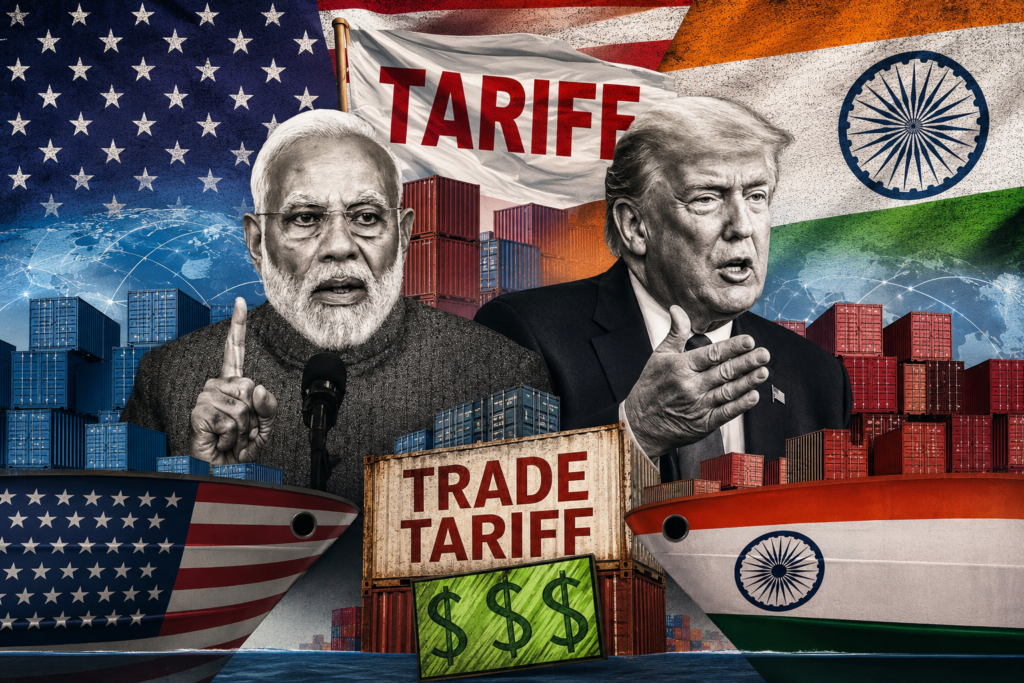
The turning point came on February 2, 2026, when President Donald Trump and Prime Minister Narendra Modi announced a framework interim trade agreement. Under it, Washington cut the reciprocal tariff on Indian imports to 18 percent, down from a peak that had reached around 50 percent once punitive duties were included. A US-India joint statement a few days later formalised the framework, and Commerce Minister Piyush Goyal told reporters that the deal left India with a lower tariff burden than competitors such as China, Vietnam and Bangladesh.
Part of that 50 percent had been a punitive 25 percent duty imposed in August 2025, penalising India for continuing to buy Russian crude oil during the Ukraine war. As part of the February understanding, India signalled a reduction in Russian oil purchases, which allowed that punitive slice to be lifted. The tariff maths, in other words, was as much about geopolitics as trade.
What India gave up, and what it protected
No trade deal is one-sided. In return for lower tariffs, India agreed to open up on a range of American industrial goods, with US officials talking about India moving toward zero tariffs on many industrial imports and committing to large purchases of American products and energy. Indian officials were more circumspect, publicly confirming the 18 percent rate while staying quieter on the more expansive American claims about market access.
The one line New Delhi held firmly was agriculture. The framework protected India’s farm and dairy sectors, which are politically untouchable given how many livelihoods depend on them, and it secured zero-duty access in the US for a list of Indian agricultural exports including spices, tea, coffee, cashews and several fruits. Textiles, gems and jewellery, pharmaceuticals and engineering goods, all of which run on thin margins, were the sectors expected to benefit most from the lower headline rate.
The Supreme Court twist
Then the story took a turn few had priced in. A US Supreme Court ruling invalidated the reciprocal tariffs that underpinned much of the structure, and by mid-March India’s commerce secretary was confirming that those reciprocal tariffs were no longer in force. In their place, the US government issued executive orders imposing a flat 10 percent tariff on certain products from all countries, a blunter instrument that swept India up alongside everyone else.
For exporters, the legal reprieve was double-edged. The steep reciprocal tariffs were gone, but the predictability the February deal had promised evaporated with them. Trade, briefly, was being run by court judgment and executive order rather than by a negotiated agreement, and that uncertainty rippled through shipping schedules and pricing decisions.
July 2026: a new 10 percent forced-labour duty
The most recent chapter came in late July 2026. The Trump administration unveiled fresh duties of between 10 and 12.5 percent on goods from around 60 trading partners, including India, on the grounds that those countries had failed to curb imports made with forced labour. The duty landed on India at 10 percent, lower than the 12.5 percent that had been floated in June, but a new cost nonetheless, applied on top of standard most-favoured-nation tariffs.
India’s response was measured. The commerce ministry said it would keep engaging with Washington to conclude a bilateral trade agreement and continue discussions on sector-specific issues such as textiles. Crucially, New Delhi noted that around 45 percent of its exports to the US would fall outside the new tariff because of product exemptions, while the remaining 55 percent would face the 10 percent duty.
Who gets hurt, and who is exempt
The exemptions shape who feels the pain. Generic pharmaceuticals, smartphones, steel, aluminium and auto parts were carved out of the new forced-labour duty, a meaningful shield given how large pharma and electronics loom in India’s export basket. The exposure falls hardest on labour-intensive sectors, and textiles and apparel are the obvious casualty. Reporting around the announcement flagged that Indian textile exporters risk being left at a disadvantage against several Asian rivals under the new regime, precisely the competitive edge the February deal had been meant to protect.
That is the recurring tension in this whole saga. Every time India secures relief on one front, a new mechanism appears on another, and the sectors with the thinnest margins, the ones employing the most workers, are the most sensitive to each swing.
What exporters have actually done
Faced with a moving target, Indian exporters did not wait for certainty. Through the turbulence, many adjusted shipment schedules, front-loaded orders when tariffs looked set to rise, and explored alternative routes as parallel disruptions in West Asia pushed up freight and insurance costs. Trade data through the period showed the merchandise deficit widening as gold and other imports climbed, a reminder that tariffs are only one variable among several buffeting the external account.
Industry bodies pressed the government for clarity above all else, arguing that a predictable 10 or 18 percent is far easier to price into a contract than a rate that changes with each court ruling or executive order. For sectors that plan production months ahead, volatility itself is a cost, separate from the level of any single tariff.
Why both sides keep coming back
For all the friction, neither capital wants the relationship to rupture, and that is the deeper reason the negotiations survive every shock. Washington sees India as an indispensable counterweight to China in the Indo-Pacific, and New Delhi sees access to the American market and technology as central to its growth ambitions. The tariff fights are real, but they play out inside a partnership both governments have decided is too important to abandon. That is how a punitive duty in one month can coexist with a framework deal in another, and why officials on both sides keep returning to the table even after the latest setback.
Where the talks go from here
Underneath the drama, both sides keep signalling they want a fuller bilateral trade agreement, of which February’s framework was only an interim step. Negotiating rounds have continued, and the ambition on the table is large. Indian officials have spoken of taking two-way trade to levels far above where it sits today. But the past year has been a lesson in how fragile these arrangements are when domestic politics, court rulings and geopolitics all intrude at once.
For Indian exporters, the practical takeaway is to plan for volatility rather than a fixed number. The relationship is deepening structurally, with the two governments increasingly describing each other as essential partners and counterweights to China, but the tariff line on any given shipment now depends on which chapter of the story you happen to be shipping in.