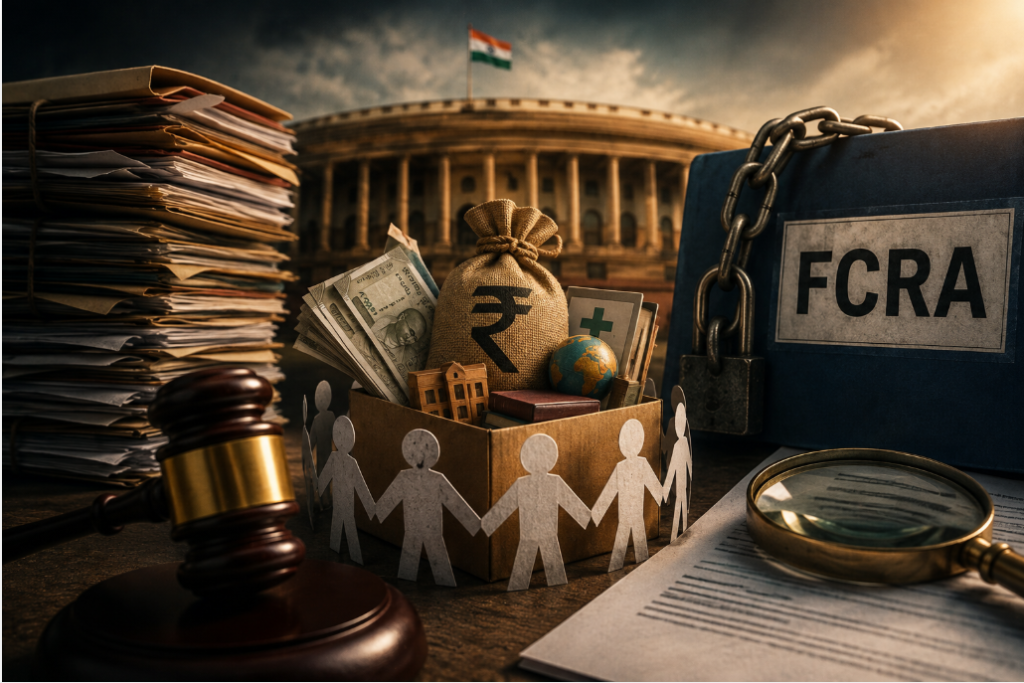
NEW DELHI — The FCRA Amendment Bill returns to Parliament this session carrying a provision that has drawn opposition from a Kerala Assembly resolution, three UN Special Rapporteurs and a US Congressman: a Designated Authority empowered to take over and dispose of the assets of any organisation whose foreign-funding registration lapses.
The Foreign Contribution (Regulation) Amendment Bill, 2026 was introduced in the Lok Sabha on March 25 and deferred after uproar. It is listed for consideration and passage in the Monsoon Session.
What the Bill actually does
The central change is the Designated Authority. It would have power to vest, supervise, manage and dispose of the foreign contributions and assets of an organisation that ceases to hold an FCRA certificate.
The definition of “ceases” is the part that matters. A certificate ends if the government cancels it, if the organisation surrenders it, or if the organisation simply fails to apply for renewal before its five-year validity expires. Administrative lapse and cancellation for cause are treated identically.
Where the assets include a place of worship, the Authority must maintain its religious character.
The Bill also reduces the maximum penalty for certain offences from five years to one. Separately, the FCRA Amendment Rules, 2026 have already been notified, requiring organisations to disclose intended uses of foreign contributions, project locations, activities, official websites and social media details.
The numbers behind it
Between 2019 and 2022, 13,520 organisations received ₹55,741 crore in foreign contributions, according to the Ministry of Home Affairs.
The current picture is more revealing. As of July 15, 2026, the FCRA portal showed 14,449 active certificates against 22,498 cancelled and 15,212 deemed expired. More registrations have lapsed or been revoked than remain live, and that was before a Designated Authority existed to take over what the expired ones own.
The government’s case
Minister of State for Home Affairs Nityanand Rai introduced the Bill in March, framing it around accountability rather than restriction.
He said the objective is to make the use of foreign contributions more transparent and accountable, and drew a line on intent. “If anyone attempts to act against the spirit of the Constitution, laws and the national interest, the government will not tolerate it and will take necessary action in accordance with the law,” he told the House.
He offered a reassurance in the same statement. “Any institution, be it an educational institution or an NGO that seeks to serve the nation, and whose objectives are in line with the sovereignty and integrity of India, will not be obstructed,” Rai said.
Home Minister Amit Shah launched an FCRA 2.0 portal alongside the electronic Overseas Citizen of India card in June, part of the same push. The government’s broader argument is that a country receiving thousands of crores annually in foreign contributions has both a right and a duty to know how the money is used.
Rai made a comparable defence during the 2020 FCRA overhaul, telling Parliament then that the amendments were not aimed at any NGO or religion but at maintaining transparency and curbing misuse. That overhaul barred transfer of foreign funds between NGOs, prohibited public servants from accepting foreign donations and made Aadhaar mandatory for office bearers.
Congress MP Anto Antony had argued during that debate that the provisions would be used “to suffocate NGOs” engaged in philanthropic work, a line the current opposition has essentially revived.
Parliamentary Affairs Minister Kiren Rijiju has taken the fight to the state where objection is loudest, alleging that Congress and the communist parties are spreading misinformation about the FCRA in Kerala.
Who is objecting, and on what grounds
The opposition is unusually broad, and the objections differ.
Trinamool Congress MP Derek O’Brien called the Bill “draconian,” arguing the amendments could produce excessive executive control over NGOs working in education, healthcare and welfare.
Congress general secretary K.C. Venugopal filed an adjournment motion notice over the Bill on the Monsoon Session’s opening day, placing it alongside the examination controversy as one of the two central legislative flashpoints. CPI(M) Rajya Sabha leader John Brittas and DMK leaders have also opposed it.
The geography of the objection is the notable part. The Kerala Assembly passed a resolution demanding withdrawal. Meghalaya Chief Minister Conrad Sangma, who leads an NDA-allied government, opposed it too, reflecting a predominantly Christian state whose social service infrastructure depends heavily on foreign-funded church and NGO networks. The Mizoram Pradesh Congress Committee protested in Aizawl on July 21.
Christian institutions have been the loudest civil society voice, for a specific reason: schools, hospitals and welfare bodies built over decades with overseas funding could pass to a government-appointed manager if a registration lapses.
The international dimension
Amnesty International and three UN Special Rapporteurs have raised concerns, and the Financial Action Task Force has issued warnings.
US Congressman Riley Moore went further. He said the amendments would permit the Indian government to take over churches and religious charities, amounting to “a clear attack against Christians.”
He grounded the objection in history. “Christians have been in India since St Thomas the Apostle travelled to the Malabar Coast just decades after the resurrection of our Lord Jesus Christ,” Moore said, before turning to the Bill’s provisions.
That intervention cuts both ways in Indian politics. It gives the opposition an external endorsement, and it gives the government a straightforward reply about foreign interference in domestic legislation, which is the Bill’s own subject.
What it means for India
Several international organisations already reduced their India programmes after the 2020 amendments, which barred transfer of foreign funds between NGOs and made Aadhaar mandatory for office bearers. The 2026 Bill goes further by attaching consequences to assets rather than only to permissions.
The practical question is what happens to a hospital or school when its registration expires through paperwork failure rather than wrongdoing. The Bill treats both the same, and the institutions most exposed are in states where the ruling party is weakest.
Whether it passes this session depends on whether the government wants the fight now. It has the numbers. It also has a Monsoon Session already paralysed over the examination protests, and a Bill that unites Kerala, Meghalaya, Mizoram and Washington in objection is a heavier lift than the MSME amendment it pushed through in 16 minutes.