MUMBAI — Maharashtra’s resident doctors called off an indefinite strike this week after the Bombay High Court ordered them back to work, but the dispute that triggered it remains unresolved: whether homoeopathy graduates who complete a one-year pharmacology course should be allowed to register with the state’s modern medicine council and prescribe allopathic drugs.
The state has paused fresh registrations while the legal position is clarified. The court case continues. A six-member committee is still writing the rules on what these practitioners will actually be permitted to do.
What the government did
On August 3 the Maharashtra government issued a Government Resolution covering the registration of Bachelor of Homoeopathic Medicine and Surgery graduates who have completed the Certificate Course in Modern Pharmacology, known as CCMP.
The design places eligible practitioners on a separate register kept by the Maharashtra Medical Council, or MMC, while they stay registered with the Maharashtra Council of Homoeopathy. Two registers, one practitioner. The MMC issued its first conditional registration under the framework the same day.
The CCMP itself is not new. Maharashtra University of Health Sciences introduced the one-year bridge course in 2016, after homoeopathic associations ran a long campaign for the legal right to prescribe essential modern medicines, including a 13-day hunger strike in Nagpur in 2013. The state’s stated reason then, and now, is healthcare delivery in areas short of doctors.
Why doctors walked out
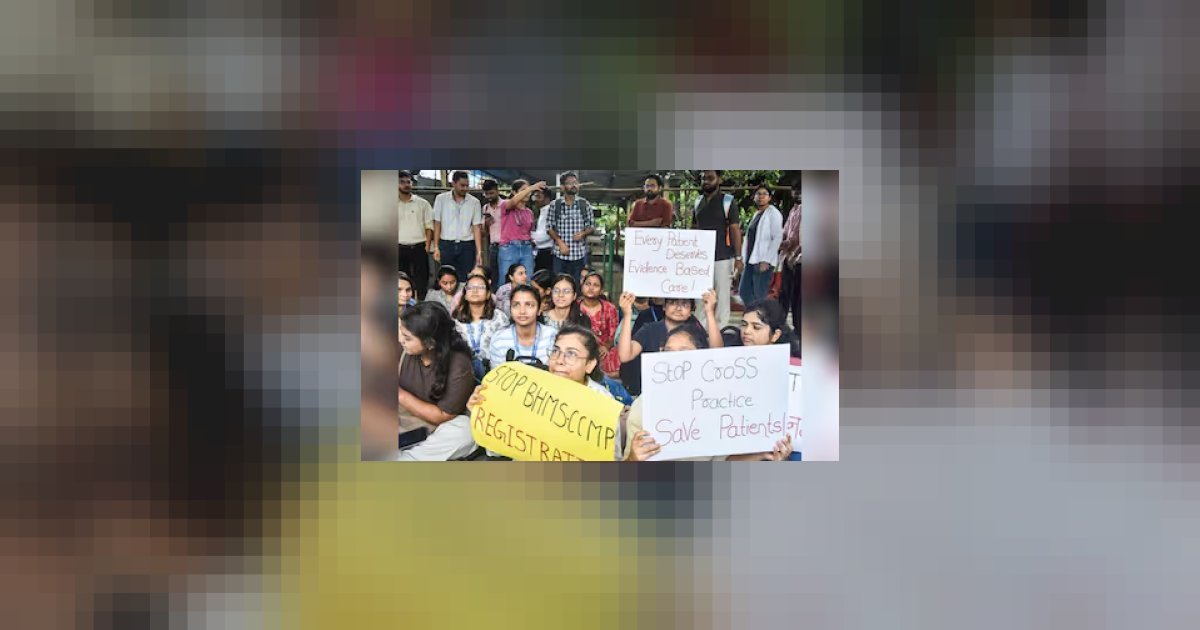
The Maharashtra Association of Resident Doctors, MARD, began an indefinite statewide strike on August 5. Routine outpatient services, routine inpatient services, elective surgeries and procedures, academic work, central laboratory services and fever OPDs were all suspended. Emergency and casualty care, trauma, ICUs, labour rooms, emergency surgeries and lifesaving procedures continued.
Central MARD president Atharva Shinde said the strike ran across 32 medical colleges plus hospitals run by the Brihanmumbai Municipal Corporation. He framed the objection as one of principle rather than turf.
“Our opposition is to the law. There should be no cross-pathy and mixopathy,” Shinde told PTI, adding that the state government should be prioritising services to patients.
He put the training gap in blunter terms. “It is akin to giving a person a firearm licence and allow him to use weapons indiscriminately,” he said of homoeopaths gaining an allopathy licence through a certificate course.
The clinical objection, stated plainly
The Indian Medical Association, MARD and other modern-medicine bodies group their concerns under the term mixopathy. Their arguments run along four lines: that a short pharmacology course cannot substitute for the clinical education and supervised training an MBBS requires; that patients may not understand what a practitioner is qualified to do; that the separation between recognised systems of medicine gets weaker; and that the government has not yet set clear enough rules on scope of practice, accountability and negligence complaints.
The IMA has separately challenged the concept of dual registration and argued that the CCMP framework lacks approval from the relevant national medical regulators.
The Federation of All India Medical Association, which backed the strike in a letter to Chief Minister Devendra Fadnavis, made the patient-safety case directly. “Mixopathy dilutes the rigour of modern evidence-based medicine and creates a dangerous precedent where practitioners are allowed to operate beyond their formally trained competencies,” the letter said.
FAIMA also drew a line under what the protest was not. “This movement is not against any system of medicine,” the letter said, describing the target as unsafe integration of systems rather than homoeopathy itself.
What the course actually covers
Much of the argument turns on what a CCMP graduate has been taught, and the two sides describe the same course very differently.
The programme trains registered homoeopathy practitioners in the use of a specified list of modern medicines. It is pharmacology-focused, meaning it covers what drugs do, how they are dosed and what their interactions and adverse effects look like. What it does not include is the several years of supervised clinical training an MBBS graduate completes, or the diagnostic grounding that sits behind a prescribing decision.
The government has never claimed the course equals an MBBS. Its position is that a defined, limited prescribing right, exercised within boundaries a committee is still drafting, is better than the alternative in places where no allopathic doctor is available at all.
The doctors’ bodies reject the framing. Their argument is that prescribing safely is not primarily a pharmacology problem but a diagnostic one, and that the harm in a wrong prescription usually starts before the drug is chosen. That is where the two positions genuinely fail to meet, and no committee report will reconcile them.
The court steps in
On Thursday the Bombay High Court ordered resident doctors to end the strike and return to work, pointing to the impact on patients. The doctors withdrew the agitation.
The order settled the strike without settling the substance. The legal challenge to the CCMP-registration framework remains live before the same court, and the IMA’s earlier challenge to the state’s 2016 amendments to the Maharashtra Homoeopathic Practitioners Act and the Maharashtra Medical Council Act is part of the same long-running litigation.
Fadnavis, for his part, said protests that interfere with patient treatment are inappropriate.
A fight that keeps returning
This is not the first round. The MMC issued a notification on June 30 permitting CCMP-qualified homoeopaths to prescribe modern medicines, which drew an immediate IMA response and the threat of a 24-hour withdrawal of services. In September last year the IMA’s Maharashtra chapter ran a statewide 24-hour strike over the same issue, with its president at the time putting the number of participating allopathic doctors at roughly 1.8 lakh.
Each round has followed the same shape: a government notification, a doctors’ agitation, a court intervention, and a pause. The underlying question has never been answered.
What it means for India
Maharashtra is not the only state weighing bridge courses as an answer to doctor shortages in rural and semi-urban areas, which makes the outcome here a template other states will read closely.
The trade-off is real and uncomfortable. Rural India is short of qualified prescribers, and homoeopathy graduates are already present in many of those places. Against that sits the argument that a one-year pharmacology certificate does not equip someone to judge when a drug is the wrong drug, and that patients bearing the risk usually cannot tell the difference in qualification from the signboard.
Two things will decide how this settles: what the Bombay High Court concludes on the framework’s legality, and what the six-member committee writes into the rules on scope of practice and accountability. Until both land, Maharashtra has a register with one name on it and a policy nobody has agreed to.
Patients, meanwhile, got their OPDs back this week. That is the part of the dispute that resolved.