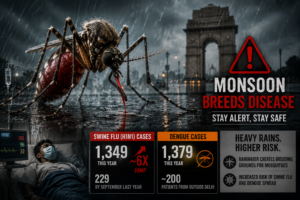
NEW DELHI — Delhi has recorded 1,349 swine flu cases this season, close to six times the 229 logged by September last year, with no deaths reported so far, the city’s health minister said this week.
Dengue stands at 1,379 cases, including roughly 200 patients from outside the capital. Both counts came as the city absorbed its heaviest August rain of the year, the conditions under which both diseases spread fastest.
The numbers, and what they compare against
The swine flu figure is the one that stands out. H1N1 cases running at 1,349 by early August against 229 by September last year is not a modest increase. It is a different order of outbreak, and it has arrived earlier in the calendar.
Health Minister Pankaj Kumar Singh attributed part of the count to testing volume. “Regular testing for H1N1 is being carried out, and around 1,349 people have tested positive so far this year, with the cases increasing this monsoon,” he said.
That caveat is worth taking seriously without accepting it entirely. More testing does find more cases. But a six-fold jump is larger than a testing expansion typically explains on its own, and Delhi’s clinicians reported an unusual swine flu wave as early as January this year.
The dengue trajectory is steeper than it looks in a single figure. The city had 347 dengue cases up to June 20, alongside 87 malaria and 19 chikungunya cases. Reaching 1,379 by early August means most of the season’s dengue arrived in roughly six weeks.
No deaths, and why that is the useful metric
Singh’s central claim is about outcomes rather than case counts. “I am happy to say that there has been no mishap due to either dengue or H1N1,” he said, adding that many patients have been treated and discharged, and that the Delhi government, the health department and city hospitals are fully prepared.
Zero deaths across 2,728 combined cases is a genuinely good result, and it is the number that matters more than incidence. Both diseases are usually survivable with timely care. Deaths cluster where diagnosis is late or ICU capacity runs out.
The qualifier is timing. Delhi’s dengue season historically peaks in September and October, not August. The case count and the strain on hospitals both have room to rise before this season is over.
What clinicians are seeing
Hospital numbers give a different texture to the official count. Doctors across Delhi-NCR report a distinct rise over the past several weeks, and they place the cause in the weather itself.
Dr Sanjeev Sinha, professor of medicine at AIIMS Delhi, attributed the influenza rise to the monsoon’s temperature drop. “During monsoon, there’s a decrease in temperature. So, because of the temperature change, the influenza virus is more common nowadays,” he said, describing patients presenting with sore throat, nasal discharge, dry cough and headache.
He was specific about what testing is turning up. “In our OPD, there is an increased number of patients who are suffering from upper respiratory tract infections, and we found that they are positive for influenza, especially H1N1 and influenza A,” Sinha said.
Dr Satish Koul, principal director and unit head of internal medicine at Fortis Memorial Research Institute in Gurugram, put a daily figure on it. “Over the past 3-4 weeks, hospitals have witnessed a rise in patients presenting with cough, cold and high fever. Testing has revealed a significant increase in H1N1 (swine flu) cases, with doctors reporting that they are seeing around 7-10 such patients daily in the OPD,” he said, noting a slight rise in Covid-19 cases alongside.
Most H1N1 infections stay mild, with fever subsiding in three to five days. The risk concentrates in the elderly, young children and people with diabetes, hypertension, heart disease or chronic kidney disease.
Sinha’s advice for anyone who tests positive is unglamorous and specific: “If you are diagnosed with it, then isolate yourself at home for two or three days, use a face mask,” he said.
What the city says it has in place
The government activated 35 sentinel surveillance hospitals ahead of the monsoon. Both government and private facilities are required to report vector-borne infections in real time through the Integrated Health Information Platform, with a centralised control room coordinating the response.
Singh said separate wards and dedicated rooms have been set aside for H1N1 and dengue patients in government hospitals, and that hospitals have been instructed to stay vigilant, monitor hotspot areas closely and treat patients promptly.
Singh described the planning cycle as starting well before cases appear. “The Delhi government begins implementing its action plan from May itself,” he said, adding that hospitals, doctors, medicines and resources are arranged from that point so patients arriving with symptoms find beds and ICU facilities available.
He reviewed roughly 18,000 beds across Delhi government hospitals last month, directing administrations to assess future requirements in maternity and emergency wards and submit proposals for additional capacity. Hospitals were told to procure medicines locally where necessary to avoid supply disruptions, and to keep stocks of consumables adequate for a rise in admissions.
The capacity question underneath
Delhi’s preparedness claims rest on hospital capacity that has been under scrutiny for other reasons. Of 36 Delhi government-run hospitals, only three currently offer in-house MRI services, a gap the government has acknowledged and is addressing through a public-private partnership tender covering 12 MRI machines, 30 CT scanners and 20 ultrasound units.
Diagnostic imaging is not what dengue or H1N1 management usually turns on. But the figure indicates where the system’s baseline sits, and outbreak response draws on the same staff, beds and laboratories as everything else.
On the testing side, the picture is better. The government has opened Ayushman Arogya Mandirs running more than 100 tests, and has floated a tender for nine diagnostic centres under the Integrated Public Health Laboratories scheme. For diseases where outcome depends on catching the case early, laboratory throughput matters more than imaging.
Two diseases, two different problems
Grouping swine flu and dengue together is convenient for a press briefing and misleading as public health.
H1N1 is respiratory and spreads person to person, through droplets in crowded indoor spaces. Rain drives it indirectly, by pushing people inside. Vaccination exists and is recommended for high-risk groups.
Dengue is mosquito-borne and depends entirely on standing water. Aedes aegypti breeds in clean water collected in containers, coolers, tyres, construction sites and blocked drains, which is precisely what a heavy rain event leaves behind across a city. There is no widely deployed vaccine in India, so control means killing larvae.
The interventions that work for one do almost nothing for the other. A city reporting both at once is running two separate campaigns.
The rain that just fell
Delhi recorded its heaviest August rain of the year on Friday, with Safdarjung logging 59.2 mm and parts of the National Capital Region taking far more. Waterlogging was reported across the city, with drains backing up on major roads.
The dengue consequence shows up on a delay. Aedes eggs laid in water pooled this week hatch into adults over roughly a week to ten days, and infections follow after that. The case count reflecting Friday’s rain will not appear until later in the month.
The city’s civic bodies logged waterlogging complaints across the South, Central, West and Civil Lines zones. Every one of those is a set of breeding sites that did not exist a week earlier.
What it means for India
Delhi’s H1N1 numbers are worth watching beyond the city, because a respiratory outbreak running six times ahead of last year in a densely connected capital rarely stays local. Neighbouring states have not reported comparable surges so far.
The practical advice from clinicians has not changed and is unglamorous. High-risk individuals with flu symptoms should get tested rather than wait it out. Households should empty standing water from coolers, plant trays and containers weekly, since the mosquito that carries dengue breeds in clean water rather than dirty.
The season has two months left to run.