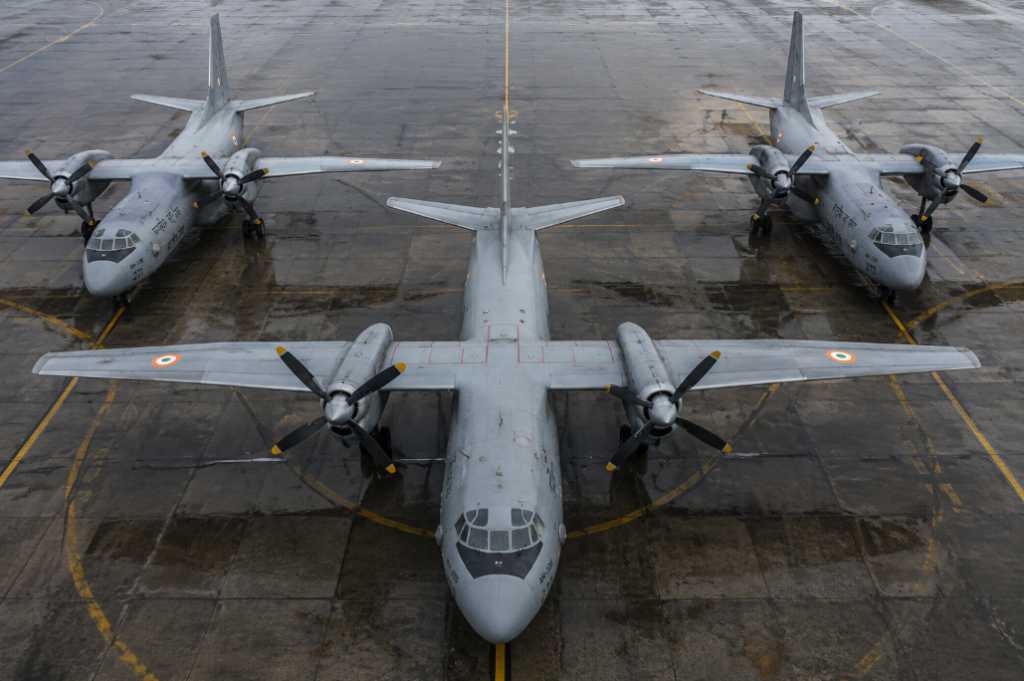
NEW DELHI — India has finally put money behind a gap it has lived with for two decades. The defence ministry has issued a tender worth about Rs 1 lakh crore for 60 new IAF transport aircraft to replace the ageing An-32, turning a roughly $10 billion purchase into a contest between two Indian-led teams and their foreign partners.
The request for proposal, floated on Wednesday, is one of the largest airlift orders India has attempted. It covers medium transport aircraft in the 18 to 30 tonne class, with an option clause for more. The IAF transport aircraft programme targets the workhorse tier of the fleet, the planes that move troops, guns and relief to places bigger jets cannot reach.
The gap the An-32 leaves
The An-32 has hauled cargo for the IAF since the 1980s. It is old, harder to sustain each year, and central to supplying forward posts in Ladakh and the Northeast. A crash in July 2026 that killed five personnel sharpened a long-standing worry about keeping the fleet flying. The new tender is meant to close that gap with a modern medium-lift platform that can operate at high altitude and land on the rough, short Advanced Landing Grounds that dot India’s mountain frontiers.
The medium tier is where the fleet is thinnest. The IAF flies heavy lifters in the C-17 Globemaster and the Il-76, and it has 12 C-130J Super Hercules for special operations, but the bulk of tactical cargo still rides on the An-32. A separate line of about 56 C-295 aircraft, built with Airbus and Tata, is replacing the even older Avro fleet at the light end. Between the C-130J and the Il-76 sits an unfilled middle that the new buy is designed to occupy.
A plan two decades in the making
This is a long-delayed idea. India and Russia agreed back in 2009 to jointly develop a Multirole Transport Aircraft, a project meant to yield some 200 planes. It stalled over cost and design, and India walked away by 2016, leaving the medium-lift gap open. The scramble to move troops and equipment into eastern Ladakh during the 2020 standoff with China exposed how much strain that gap put on the heavy fleet, and pushed strategic airlift up the priority list.
The Defence Acquisition Council cleared the 60-aircraft requirement in March 2026 as part of a package worth about Rs 2.38 lakh crore that also covered more S-400 systems and remotely piloted strike aircraft. Technical evaluations of the competing planes were reported complete by July, which is why the tender lands now.
Who is in the race
The RFP went to Indian firms: the Tata Group, Mahindra, Adani Defence and state-run Hindustan Aeronautics Limited. Officials framed the structure plainly. “In the programme, Indian companies would be in the lead role,” defence officials told ANI, with each Indian firm tying up with a foreign original equipment manufacturer to set up a final assembly line and maintenance base in the country.
Two pairings lead the field. Tata has partnered with Lockheed Martin to offer the C-130J, a type the IAF already flies, sitting at the lower end of the weight band at about 19 tonnes. Mahindra has teamed with Brazil’s Embraer to pitch the C-390 Millennium, a faster jet nearer the top of the requirement at about 26 tonnes and increasingly adopted by NATO air forces. HAL is in contention after reviving the shelved 2009 plan with Russia. Airbus, which had offered its larger A400M, is expected to sit the contest out because its 37-tonne payload overshoots what the IAF asked for.
The numbers behind the fleet explain the urgency. The IAF operates roughly 100 An-32s, most past their prime, against a small heavy-lift force of 11 C-17s and a handful of Il-76s. During the 2020 Ladakh build-up the force leaned hard on those heavy jets to rush armour, guns and men east, a strain that proved the medium tier was too thin to carry a two-front load.
The two front-runners offer different bets. The C-130J is proven in Indian service, shares spares and training with the existing special-operations fleet, and lands short and rough. The C-390 is newer, jet-powered and faster, carries more, and is winning orders across Europe as a modern replacement for exactly this class. One choice deepens what the IAF already flies; the other widens its options and its supplier base.
There is a strategic dimension to the pick as well. Buying American with the C-130J tightens an already close defence link with Washington. Choosing the Brazilian jet, or reviving the Russian option, spreads India’s dependencies, a hedge New Delhi has long valued as it tries to avoid leaning too far toward any single supplier.
Why the deal is about industry, not just aircraft
The tender is written to build capacity at home as much as to buy planes. Only the first lot, around 20% or a dozen aircraft, will arrive in fly-away condition. The rest will be built in India, starting at a minimum 40% indigenous content and rising to 60% in phases. That turns a procurement into an industrial contest, with the winning Indian partner anchoring an assembly line, a supplier base and a repair ecosystem for decades.
The push fits a wider pattern. Defence Minister Rajnath Singh, inducting the first of the smaller C-295 transports in 2023, called defence and aerospace “two important pillars for making India self-reliant.” The medium transport tender sits alongside a separate competition for 114 new fighters and plans for more than 100 trainer jets, a broad refresh of an air force stretched across two live frontiers and short of squadrons.
What happens next
With the RFP out, the shortlisted companies will submit bids. A technical evaluation follows, then flight trials, then a single winner. The choice will turn on payload, high-altitude performance and price, but also on which team can credibly build in India at the promised indigenous share. For the IAF, the prize is a medium airlift fleet it can rely on for the next 30 years. For Tata, Mahindra and HAL, it is a chance to move from assembling foreign designs to owning a large slice of the aircraft that carry India’s soldiers.