NEW DELHI — India can shoot down almost anything in its airspace. What a senior DRDO scientist told a defence seminar on Tuesday is that being able to shoot something down is no longer the same as being able to win, because the drone defence cost equation has turned against every country that owns expensive interceptors.
B.K. Das, Director General for Electronics and Communication Systems at the Defence Research and Development Organisation, was speaking at the opening of NETRA 2026, a two-day national seminar on electronic warfare, digital twins and mission-critical system design.
“Warfare has transformed to asymmetric warfare. It has transformed to saturation attack. It has transformed essentially to the warfare of economics,” Das said.
The arithmetic behind the argument
He then gave the example that makes the abstraction concrete.
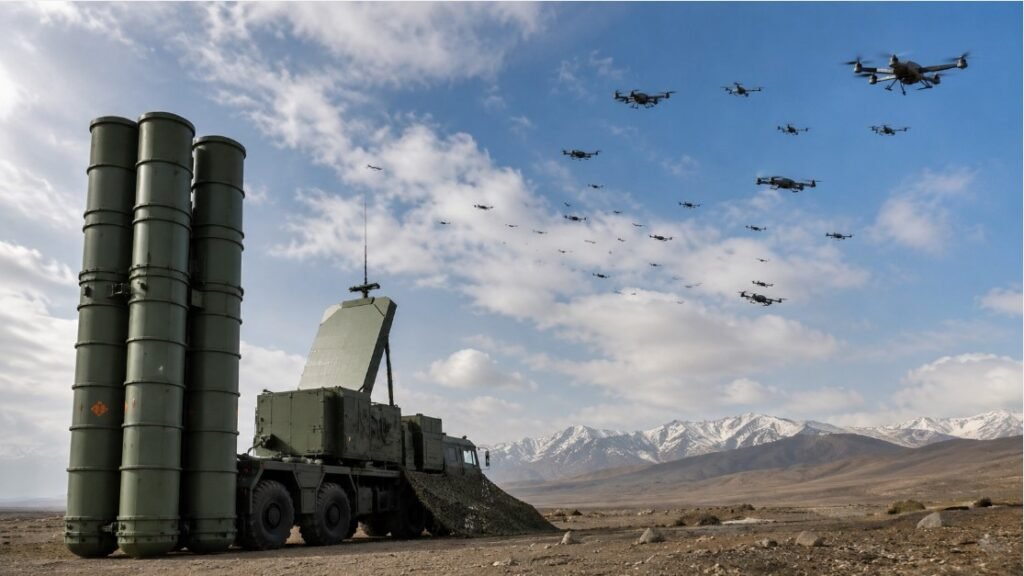
“Maybe your S-400 can always nullify your Shahed, but you have to compute the cost of a Shahed versus the cost of a 400,” he said, in remarks reported by PTI.
The two systems named are not comparable objects. The S-400 is a long-range Russian air defence system built to engage aircraft, cruise missiles and ballistic targets at ranges up to 400 kilometres. India operates it as the outer layer of its air defence. The Shahed family is Iranian-designed one-way attack drones, propeller-driven, slow, built largely from commercial components and produced in volume.
An S-400 interceptor missile is a precision object with a seeker, a guidance package and a limited production run. A Shahed is closer to a lawnmower engine with a warhead bolted to it. Using one to destroy the other works every time and loses money every time, and the losing side is the one with the better technology.
This is not a hypothetical. It is the central lesson of the past four years of drone warfare, from Ukraine to the Red Sea, where navies have fired multi-million-dollar surface-to-air missiles at drones costing a small fraction of that. Diurna examined the supply-side consequence of exactly this in our analysis of the Pentagon’s 21-day weapons production order, which found interceptor scarcity pushing export customers to the back of the queue.
The scarcity problem compounds the money problem. A missile you cannot replace inside a year is not really priced at its sticker value. It is priced at whatever the next crisis would have cost you if it were still in the magazine.
Sustaining a war, not winning a battle
Das’s point was about duration rather than a single engagement. A country that can intercept everything for a week but runs out of interceptors in a month has not built an air defence system. It has built a demonstration.
“More accuracy is definitely important, control algorithm is very important, but the most important is going to be the cheapest way to negotiate the target,” he said, framing it as the requirement for any country that wants to sustain a prolonged war.
The phrase to hold on to there is the cheapest way to negotiate the target. It reframes the design brief for an entire generation of Indian systems. The question stops being how precise a weapon can be made and becomes how little it can cost per kill while still working reliably.
That has direct consequences for what India should be building. Guns firing programmable air-burst ammunition, high-power microwave emitters, laser directed-energy weapons and electronic jamming all cost far less per engagement than a guided interceptor. A laser shot is measured in the price of diesel for the generator. None of them replaces the S-400. All of them relieve it of work it should never have been doing.
India already has pieces of this. DRDO has demonstrated a 30-kilowatt vehicle-mounted laser system capable of bringing down fixed-wing drones and swarms, and the services have inducted counter-drone systems combining detection radar, jamming and a hard-kill option. What does not yet exist is these things in the numbers a national shield would need.
Numbers, not showpieces
Das made a second argument that cuts against a habit in Indian defence communication, which is announcing a successful test as though it settled something.
“If I create one missile or one tank or one radar or one seeker, maybe that will be the global number one, but that is not going to sustain my country unless I have the numbers,” he said.
India’s record here is uneven. The country has repeatedly produced systems that performed well in trials and then reached the forces slowly, in quantities that limited how they could be used. The gap between a validated design and a mass-produced item, held at consistent quality across many production batches, is where Indian defence manufacturing has historically lost time.
The manufacturing base has changed. India’s defence exports reached a record 38,424 crore rupees in FY26, and as Diurna reported in our analysis of that figure, much of the growth came in sub-systems and components rather than complete platforms. That is precisely the industrial capability a cheap-interception strategy needs, because seekers, fuses, guidance sections and radio-frequency components are what go into large numbers of low-cost effectors.
Sudarshan Chakra and the layered problem
Das linked the argument to Prime Minister Narendra Modi’s Sudarshan Chakra concept, the national air and missile defence shield announced last year.
“It is going to be the plethora of technologies which needs to be stitched together to protect this nation,” he said, listing long-range missiles, radars, electronic warfare systems, directed-energy weapons and drones as the components.
Stitched together is the operative phrase, and it is the hardest part. A layered defence is not a list of systems. It is a decision architecture that assigns each incoming target to the cheapest effector capable of killing it, in seconds, without human deliberation. If a swarm of forty cheap drones and one cruise missile arrive together, the system has to tell the guns to take the drones and save the interceptors for the missile.
Getting that wrong in the first ninety seconds is how a saturation attack works. The drones are not primarily there to destroy anything. They are there to make the defender spend, to fill the radar picture with clutter, and to reveal which sites are firing.
India saw a version of this during the exchanges with Pakistan in May 2025, when large numbers of cheap loitering munitions and decoys were used against air defence sites across the western sector. The Indian systems worked. The question the seminar was really asking is what the same volume looks like sustained over weeks rather than days.
Digital twins and the development clock
The final theme was how India shortens the time between design and delivery. Das said greater use of digital modelling could reduce the need for physical testing.
“Very soon all our products are going to be digital twin, and all our model-based system engineering is going to define our future systems,” he said.
A digital twin is a simulation of a physical system detailed enough that changes can be tested against it before anything is built. For defence electronics this matters because range slots, target drones and instrumentation are scarce, and each physical trial consumes weeks of scheduling. Moving the early iterations into software is how development cycles compress from years to months.
There is a caveat Das did not raise and that anyone reading this should. A digital twin is only as good as the physics inside it, and simulation has a long history of producing systems that pass every model and fail in dust, heat and jamming. The Indian operating environment supplies plenty of all three, from Thar desert summers to Siachen winters.
What it means for India
The practical test of this thinking is not a laboratory. It is the western border, where drone incursions carrying weapons and narcotics have been a routine problem in Punjab and Jammu for several years, and where the Border Security Force has been running jammers, spoofing kits and net-capture systems precisely because a missile makes no sense against a quadcopter carrying two kilograms of heroin.
Scaling that up to a national shield means procurement rules that reward cost per engagement rather than headline capability, and an acquisition process that can buy thousands of cheap effectors as readily as it buys a handful of expensive ones. Defence procurement in India is still built around large capital acquisitions with long trial cycles, which is the opposite of what buying disposable counter-drone rounds in bulk requires.
That is a bureaucratic problem more than a scientific one, and it is the one Das was really describing.