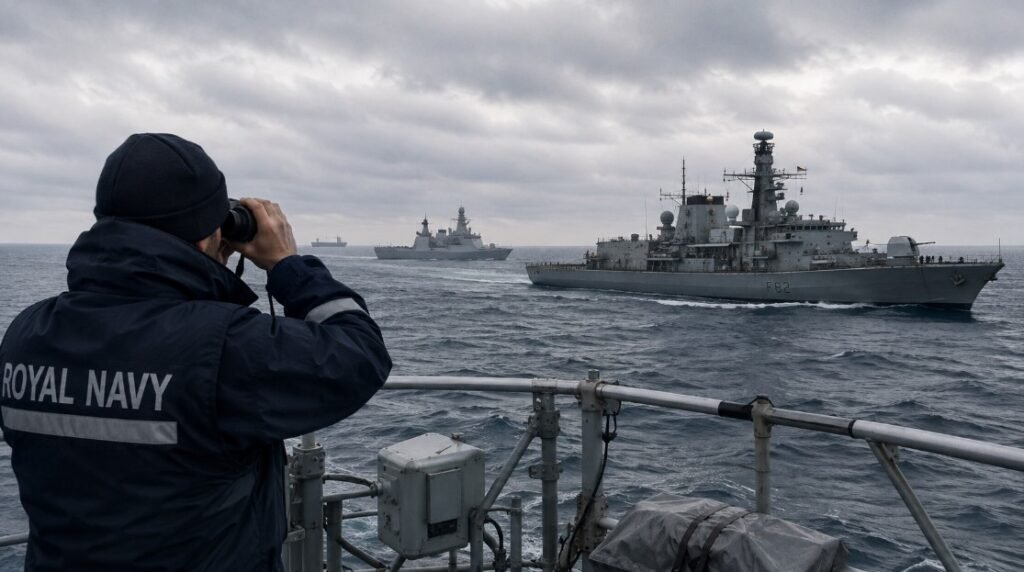
LONDON — Russian ships in UK waters kept the Royal Navy at sea for 21 days in July alone, and activations to track them are running 25 per cent above last year, according to figures the Ministry of Defence released on August 8.
The number sounds like a story about Russia. Read alongside the state of the British escort fleet, it is mostly a story about Britain.
What the July figures actually say
Four warships were involved: the Type 23 frigate HMS Somerset and the River Batch 1 offshore patrol vessels HMS Tyne, HMS Severn and HMS Mersey. They were supported by Wildcat helicopters from 815 Naval Air Squadron and Merlin anti-submarine aircraft from 814.
The comparison window is January 1 to July 31, set against the same period in 2025. The MoD’s annual report gave the longer view: Royal Navy vessels were activated 116 times in the year to March 2026, shadowing 61 Russian warships and 28 merchant vessels around British waters.
Most of July’s work came down to one ship. The frigate RFN Neustrashimy transited the UK’s area of responsibility repeatedly, escorting sanctioned tankers through recognised traffic lanes. The Admiral Grigorovich did the same, with HMS Severn activated twice to shadow it.
Why Moscow is spending frigates on tankers
This is new behaviour, and it follows directly from enforcement.
Britain has sanctioned more than 500 vessels linked to Russia’s shadow fleet, the ageing and often poorly maintained tankers Moscow uses to move crude outside the sanctions regime. In June the UK interdicted one of them, the Smyrtos, in the English Channel. In March, British military and law enforcement agencies were formally authorised to interdict sanctioned vessels.
Once cargo can be stopped, cargo needs guarding. That is why a Baltic Fleet frigate is now doing convoy escort in the Channel rather than anything a navy would prefer to do with it.
The MoD reads this as a cost imposed on Russia, saying Moscow is “using up valuable operational capacity to constantly guard cargo.” The claim has some force. Russian oil and gas revenues fell 24 per cent year-on-year in 2025.
The July 20 incident
On July 20 the Neustrashimy conducted gunnery firings outside British and French territorial waters. HMS Tyne closed to within five nautical miles and observed the fall of shot, counting roughly 20 rounds from the frigate’s 100mm main armament and further fire from its 30mm battery.
Lieutenant Commander Sam Fields, HMS Tyne’s commanding officer, described the task in terms of presence rather than confrontation, saying the ship was “providing reassurance and monitoring while enabling other Fleet units to continue” their commitments.
General Richard Dannatt, head of the British Army from 2006 to 2009, was less inclined to treat the timing as coincidence. He told The Times the decision to fire that day was “not entirely by happenstance.” The exercise came days after Andy Burnham took office as prime minister.
The mismatch nobody in Whitehall disputes
Here is the part that turns a monitoring statistic into a capability question.
The River Batch 1 vessels doing much of this work are patrol ships. HMS Tyne, Severn and Mersey carry light guns and nothing else, and the class is due to retire in 2028. They are excellent at watching. In a fight with a Russian frigate they would be spectators.
The Neustrashimy is a Project 11540 hull built at the Yantar shipyard in Kaliningrad, and it is an outlier in one important way: it has no launch tubes for the Kalibr land-attack cruise missile. Most modern Russian frigates do. When the Neustrashimy is eventually replaced on this run by a Grigorovich, Gepard or Gorshkov-class ship, the escort passing through the Channel will be carrying a weapon that can reach any point in Britain.
That is not a hypothetical range claim. Written evidence submitted to a House of Commons committee assessed that Russia’s ability to threaten Britain with conventional strikes rests on the ship and submarine-launched Kalibr along with air-launched cruise missiles, and that defence would depend on destroying launch platforms or intercepting missiles in flight. Britain’s ground-based air defence over its own cities is close to nonexistent.
The cables underneath
Surface escorts are only the visible half. British security officials have been more worried about what happens on the seabed, where power interconnectors, gas pipelines and the fibre carrying most of the country’s data all sit unguarded.
That concern has a name attached to it. The Yantar, a Russian vessel widely assessed to be used for intelligence gathering rather than research, was detected near undersea cables off Scotland in November 2025 and was shadowed by HMS Somerset and HMS Tyne in an earlier encounter. Deterring it became one of the operations folded into the 116 activations recorded to March 2026.
Protecting undersea infrastructure has since been written into the centre of Britain’s national security planning. The difficulty is that a cable cut in deep water is almost impossible to attribute quickly, which makes deterrence a matter of being visibly present rather than of responding after the fact. Presence is exactly what a shrinking fleet cannot guarantee.
Frigates, money and a new prime minister
The escort shortage is structural. The Royal Navy is running a shrunken frigate and destroyer force through a period of rising tasking, which is why shadowing duties fall to patrol boats, minehunters and Royal Fleet Auxiliaries. Only a handful of British warships currently carry anti-ship missiles at all.
Money is the reason the fleet has not grown, and it is now openly political. Disagreement over the Defence Investment Plan, with Downing Street offering the Ministry of Defence 13 billion pounds against the 18 billion the department said it needed, led to defence secretary John Healey’s resignation in June and contributed to Keir Starmer’s fall.
Burnham has pledged to “honour commitments,” promising half a million defence and aerospace jobs by 2030 and confirming an 8.4 billion pound tranche for the four Dreadnought-class ballistic missile submarines at Barrow-in-Furness on July 30. The UK remains committed to 3.5 per cent of GDP on defence by 2035 under its NATO obligation.
None of that adds an escort this decade. Paul Mason, a Labour defence commentator, argued the arithmetic will force a choice: “Current defence plans are not doable on the money,” he said, adding that plans would have to be rewritten if the figure stayed at 13 billion.
HMS Somerset, meanwhile, returned to Plymouth on August 7 after four months in the North Atlantic and more than 24,000 nautical miles, much of it protecting the approaches used by Britain’s nuclear deterrent. Commander Matt Millyard, her commanding officer, said he was “immensely proud of every single member of the ship’s company” after a deployment held at high readiness throughout.
She is one of a diminishing number of hulls that can do that job at all.
What it means for India
The shadow fleet is not a European problem with a European solution. The same tanker network that Russian frigates are now escorting past Dover is the network that carries discounted crude to Indian refiners, and the enforcement pressure being applied in the Channel is the leading edge of a wider effort to make that trade expensive.
Washington’s own sanctions bill, which Diurna reported this month, authorises tariffs on buyers of Russian oil. Britain is demonstrating the physical version of the same policy. For Indian buyers, the risk is shifting from paperwork to interdiction, and insurers price that long before governments announce it.