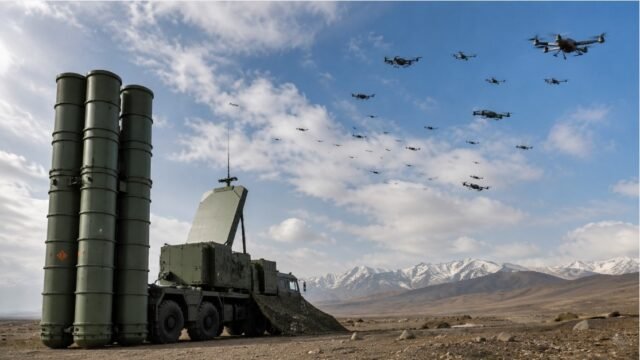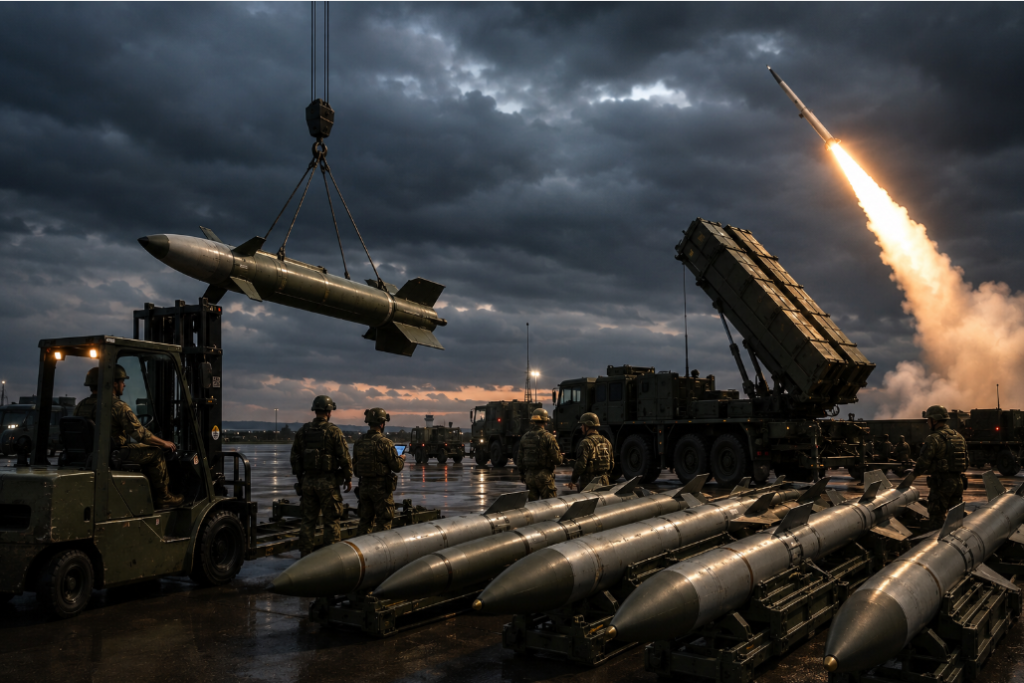
WASHINGTON — The Pentagon has given American arms manufacturers three weeks to say how they will build missiles faster, after the war with Iran cut deep into stocks of the interceptors that protect US troops and allied cities.
The Pentagon weapons production directive went to industry chiefs on Wednesday from Deputy Defense Secretary Steve Feinberg. Companies have no more than 21 days to submit plans that “drive significantly faster, more aggressive delivery schedules and/or increased production for critical capabilities,” according to the memo, which was obtained by The Washington Post and reported by the Associated Press.
Feinberg’s language is unusually blunt for a procurement document. “Years-long development cycles are not acceptable,” he wrote, adding: “We must dramatically accelerate our program schedules and expand our production capacity now.”
The memo also asks contractors to propose capital investment and factory expansion of their own, rather than waiting for the government to fund every line. Feinberg told them to “demonstrate your willingness to put skin in the game.”
The interceptor arithmetic
The numbers explain the urgency better than the memo does. The Center for Strategic and International Studies, a Washington think tank, estimated that the global count of Patriot interceptors fell from about 2,330 before the war to roughly 1,030 by the time the April ceasefire took hold. Fighting since then has pushed the figure below 830.
THAAD, the higher-altitude system, has been drawn down harder. CSIS put the stock at 452 before the war and under 278 now. CNN reported last week that close to 80 per cent of American THAAD interceptors and about half the Patriot inventory have been expended.
CSIS warned that shrunken inventories will force the United States and its West Asian partners to take more risk with what they have left, holding fire against smaller threats to keep rounds in reserve for larger ones. That is a doctrinal change made by accident, driven by supply rather than by choice.
Money that has not been voted
The awkwardness is that the Pentagon is asking industry to spend before Congress has agreed to pay. A defence spending bill is stalled on Capitol Hill. The White House has asked for about $1.5 trillion, up from roughly $900 billion last year, and lawmakers angry about the military action against Iran have declined to move it.
Pentagon spokesman Sean Parnell confirmed on Saturday that the memo is “real,” and said it “will inform the fiscal year 2028 budget submitted to Congress for funding.” He described it as “entirely consistent with our ongoing push to rebuild the defense industrial base.”
Fiscal 2028 begins in October 2027. A manufacturer reading that sentence is being told to expand capacity now against money that may arrive in fourteen months, if the appropriation passes. The framework agreements the Pentagon has signed with major contractors in recent months carry the same weakness: they are nonbinding and depend on funding that does not yet exist.
Why interceptors are the hard part
Air-defence rounds are the slowest thing in the munitions catalogue to make. A Patriot PAC-3 interceptor takes roughly two years from order to delivery, and the bottleneck is not final assembly but the seekers, solid rocket motors and specialised energetics that feed it. Adding a shift at the plant does not fix a rocket motor shortage.
That is why the memo reads as it does. Feinberg is not asking for a bigger order book. He is asking firms to restructure schedules and pour capital into sub-tier suppliers, which is exactly the layer that decades of consolidation thinned out.
What was actually fired
Interceptors are consumed at a rate their makers never planned for. A single incoming ballistic missile is typically engaged with two interceptors, sometimes more, because a miss is unacceptable and the defender does not get a second attempt. A ten-missile salvo can therefore cost twenty-five rounds to stop.
Iran fired in salvos. That arithmetic, repeated over weeks, is how a stockpile assembled over two decades was halved. It is also why replenishment cannot be solved by buying differently; the shortfall is measured in thousands of rounds, and the plants that build them run at a few hundred a year.
Allies are watching the same numbers
The shortage is not only an American problem. Patriot batteries operated by Gulf states, Japan, South Korea, Germany, Poland and Ukraine all draw from the same production lines, and Washington controls the allocation. Ukraine has spent two years learning what it means to be third in that queue.
When the Pentagon replenishes first, every export customer’s delivery schedule moves right. Governments that built their air defence plans around a US supply chain are now discovering that the plan had a single point of failure written into it, and that the failure is not technical but industrial.
What it means for India
India is not in the queue for Patriot or THAAD, and that is now an advantage rather than a gap. But three effects reach New Delhi anyway.
The first is the order book. When American stocks run low, US requirements are filled first and export customers wait. Countries that had planned to buy Western air defence in the next two years will find delivery dates slipping. Gulf states that India competes with for the same industrial attention are already in that position.
The second is the case for building at home. Operation Sindoor put India’s layered air defence under real load, and the systems that carried it were largely indigenous or Russian. The Akash and QRSAM programmes exist precisely to avoid depending on a foreign production line whose priorities are set in another capital. The Pentagon’s memo is the clearest argument yet for that choice.
The third is the export opening. Indian defence exports hit a record Rs 38,424 crore in FY26, and the growth has been strongest in fuses, propellants and sub-systems rather than complete platforms. That is the same tier the Pentagon has just told its primes to invest in. Indian suppliers with US certifications may find buyers who were not returning their calls a year ago.
There is a cautionary reading too. Conflict-driven demand is the least reliable kind. Stockpiles get rebuilt once and then the orders stop, which is precisely what happened to the artillery ammunition boom after 2023. Suppliers who add capacity for a two-year surge can be left carrying idle plant in year three.
None of that is automatic. Qualification into an American supply chain takes years and survives only if the demand lasts. If Congress funds the surge, the window stays open. If it does not, the memo becomes another document about intentions, and the interceptor count stays where it is.