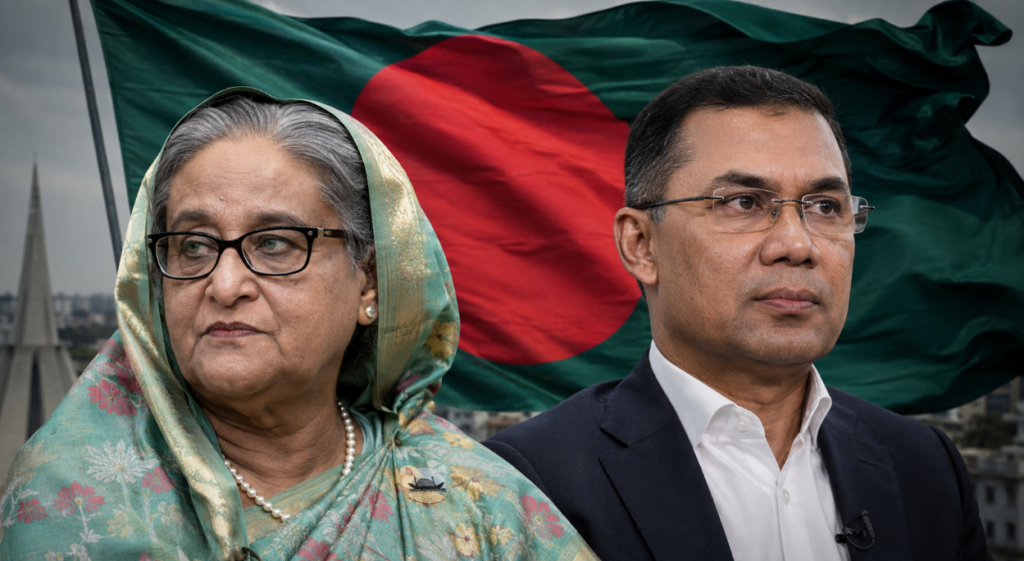
DHAKA — Bangladesh’s foreign ministry said Sunday that a “propitious environment” must be created before Prime Minister Tarique Rahman travels to India, tying his first bilateral visit since taking office in February to New Delhi’s response on extraditing former prime minister Sheikh Hasina.
The statement, issued as speculation mounted over a possible visit in the third week of August, played down reports that dates had been finalised. “We are of the view that a propitious environment needs to be created for the visit,” foreign ministry spokesperson A.K.M. Shahidul Karim told reporters, according to the South China Morning Post. Officials in Dhaka added that the two governments have been “in touch with each other for several weeks” on the possibility of the trip, even as the extradition question keeps the schedule open.
A New Government, A First Test
Rahman took office in February after Bangladesh’s first general election since Hasina’s Awami League government fell, a vote the BNP won after 15 years out of power. India recognised the result and moved to rebuild its diplomatic presence in Dhaka, appointing Trivedi, a former Union railway and health minister from West Bengal, as its 16th High Commissioner in April. He arrived in Dhaka on June 12, more than six weeks before his first direct meeting with Rahman, a gap Bangladeshi commentators read as New Delhi taking its time to size up a government it had not dealt with before.
That caution cuts both ways. Rahman’s BNP spent years positioning itself as the party India was wary of, given its historical ties to Islamist-leaning coalition partners and its rivalry with the Awami League India had backed for over a decade. Since taking office, Rahman’s government has tried to project the opposite: a working relationship with New Delhi that does not require reviving the closeness of the Hasina years, and does not require apologising for ending it either.
A Visit Still Without Dates
Indian and Bangladeshi officials have spent the past two weeks laying the groundwork for what would be Rahman’s first trip to India since the Bangladesh Nationalist Party leader took office after February’s election. Indian High Commissioner Dinesh Trivedi called on Rahman at the Prime Minister’s Office in Dhaka on August 10, a day after meeting Foreign Minister Khalilur Rahman. Parag Jain, chief of India’s Research and Analysis Wing, led a separate team to Dhaka for talks with Bangladeshi security officials around the same time, according to regional reporting.
A window of August 20-25 has circulated in both capitals, with Indian sources telling Bangladeshi media that a two-day visit in the third week of the month was under discussion. Dhaka has been more guarded. State minister for foreign affairs Shama Obaid Islam said only that the government was “positive about visits to all countries” but that scheduling depended on Rahman’s own calendar. The visit is also being read against Bangladesh’s decision on whether to attend the BRICS summit in India next month, where Rahman would otherwise appear in his capacity as current BIMSTEC chair.
The Extradition File Goes Back Two Years
Hasina fled to India in August 2024 after a student-led uprising ended her 15-year rule, and she has lived there since. Dhaka’s interim government sent its first extradition request that December; India’s foreign ministry said at the time it had “no comment.” The file gained urgency in November 2025, when Bangladesh’s International Crimes Tribunal convicted Hasina of crimes against humanity over the deadly crackdown on the uprising and sentenced her, in absentia, to death. Then-foreign affairs adviser Touhid Hossain said Dhaka had sent a fresh note, telling reporters “we sent a letter seeking the extradition of Sheikh Hasina.” India has not acted on any of the requests.
Sunday’s statement folds in a second, less publicised demand: the handover of those accused of killing Shaheed Sharif Osman Hadi, a case Dhaka says is covered by the countries’ existing bilateral extradition treaty. Bangladesh has not detailed the killing publicly in this statement, but its inclusion signals that the government is widening its extradition ask beyond Hasina alone as it sets conditions for the visit.
What Went Wrong on August 5
Officials in Dhaka say the diplomatic track was on firmer footing until Hasina gave a press interaction from New Delhi on August 5, the second anniversary of her ouster, in which she said she had watched Bangladesh suffer since her departure. Dhaka lodged a formal protest. India distanced itself from the event, describing it as the work of a “private media entity” rather than anything it had organised or endorsed. Sunday’s statement referred to the episode obliquely, saying the visit process “was vitiated” by the New Delhi appearance and that Dhaka has “made our position clear on this matter.”
Trivedi has tried to keep the temperature down since. At a press interaction after his meeting with Foreign Minister Khalilur Rahman, he called Prime Minister Rahman a “people’s person” and said, “When the two leaders meet, many problems are resolved.” The Bangladesh Prime Minister’s Office, for its part, said the August 10 meeting with Trivedi had stressed the “creation of a suitable environment” for deepening ties, language that closely tracks Sunday’s statement.
Bangladesh First
Sunday’s statement closed by restating what Rahman’s government calls its “Bangladesh First” policy: friendly relations with all countries, including neighbours, built on “sovereign equality, national dignity, non-interference in each other’s internal affairs and mutual benefit.” Dhaka has used similar language since the BNP took office, positioning itself as neither anti-India nor beholden to New Delhi, a contrast officials draw deliberately with Hasina’s 15 years of close alignment with India, which she led largely as Awami League chief before her ouster.
The practical effect for now is a visit in limbo. Both governments have an interest in banking a first Rahman-Modi meeting before BRICS, and neither wants to be seen scuttling it. But Dhaka has made clear the extradition file is the visible test of whether New Delhi is prepared to treat the current government, rather than the exiled former one, as its actual partner in Bangladesh.
More Than One File on the Table
The extradition dispute is the visible obstacle, but it is not the only business waiting for a Rahman-Modi meeting. Bilateral trade has slowed since 2024, when border tensions and a temporary suspension of Bangladeshi transhipment through Indian territory disrupted garment exports worth billions of dollars a year. Talks on Teesta water-sharing, stalled for over a decade, remain unresolved, as do questions over India’s rail and port connectivity projects through Bangladesh, several of which slowed after the change of government in Dhaka. Officials on both sides say a functioning summit-level relationship is needed to unblock these, regardless of how the Hasina question is settled.
There is also the matter of who else is courting Dhaka while the file sits open. Rahman’s government has kept up outreach to Beijing and Islamabad even as it talks to New Delhi, part of the balancing act Dhaka has signalled with its Bangladesh First framing. India’s own strategic planners view a prolonged freeze with Dhaka as ceding ground in a neighbourhood where China has expanded its footprint through the port at Chattogram and infrastructure financing elsewhere in the region.
What It Means for India
India has extended Hasina refuge without formally rejecting Dhaka’s extradition requests, a position it has sustained for nearly two years without forcing a resolution. That ambiguity is now colliding with India’s own diplomatic calendar: a Rahman visit ahead of BRICS would signal that ties with Dhaka’s elected government are back on track, while a delay or cancellation would be read across the region as New Delhi choosing continuity with Hasina over reset with Dhaka. Neither outcome is free. Extraditing Hasina would end a relationship India built over a decade and a half; continuing to shelter her keeps a visible irritant in a relationship India needs functioning, from transit and connectivity projects to managing China’s growing footprint in Dhaka.