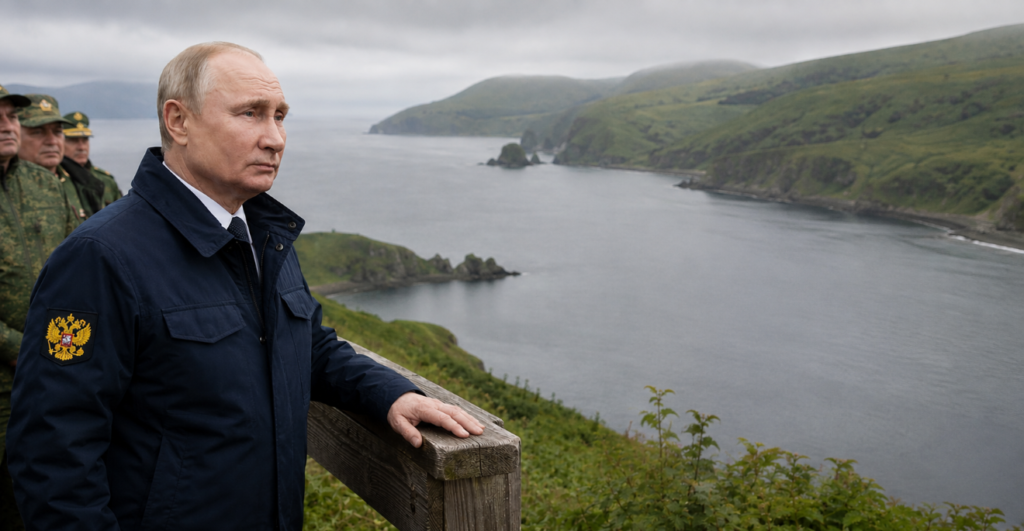
MOSCOW — Vladimir Putin toured a fish plant, a hospital and a school on the island of Iturup on Thursday, an ordinary itinerary made pointed by the place. It was the Russian president’s first visit in 26 years in power to the Kuril Islands, the Pacific chain that Japan still claims and calls its Northern Territories, and Tokyo answered within hours.
Japan summoned the Russian ambassador, lodged a formal protest and warned that the trip had set relations back for years. The Putin Kuril Islands visit was brief and choreographed, but it landed as a deliberate message to a new and more hawkish government in Tokyo.
A dispute frozen since 1945
The four southernmost islands of the Kuril chain sit between Japan’s Hokkaido and Russia’s Kamchatka Peninsula. Their ownership has moved with the wars. An 1855 treaty recognised them as Japanese, and a later exchange in 1875 handed Tokyo the whole chain. That order ended in the last days of the Second World War, when Soviet forces seized the islands after Japan’s surrender and expelled the Japanese residents.
Tokyo has never accepted the loss, and the dispute is the reason the two countries have never signed a formal peace treaty ending their wartime hostilities. A 1956 declaration came closest to a deal. Moscow offered to hand back the two smaller islands, Shikotan and the Habomai group, once a peace treaty was signed. The treaty never came, and the offer lapsed into a standing grievance.
The Abe opening that closed
The last serious attempt to break the deadlock ran through Shinzo Abe. As prime minister he met Putin around 27 times, pushed joint economic projects on the islands, and in 2018 agreed to base fresh talks on the 1956 declaration. The effort collapsed within two years, foundering on the question of sovereignty and on Russia’s refusal to hand back territory it had fortified.
Japan calls the islands its inherent territory. Foreign Minister Toshimitsu Motegi said Tokyo “strongly protests” the visit and summoned Ambassador Nikolay Nozdrev to receive the complaint in person. The Russian embassy in Tokyo called the protest unfounded, saying the southern Kurils became part of Russia after the war on legitimate grounds, and that the president’s domestic travels were not open to discussion with foreign states.
Why now
Timing is the whole story. Putin reached Iturup at the end of a swing through Siberia and the Far East, having first stopped on Sakhalin to watch the closing stage of Pacific Fleet exercises. Visiting the disputed chain straight after a naval drill fuses the diplomatic claim to a show of military reach. The Kurils are strategic ground. They screen the Sea of Okhotsk, which Russia treats as a protected bastion for its nuclear-armed submarines, and Moscow has spent years reinforcing the islands with coastal missile systems and an upgraded airfield.
The visit also lands on a specific audience. Prime Minister Sanae Takaichi, who took office promising a firmer line abroad, called it “absolutely unacceptable.” She said it had hardened Japanese opinion and made any repair of ties harder for years to come. Speaking aboard a warship the day before, Putin framed the status of the islands as fixed by the outcome of the war, while adding that Russia had once been “prepared to seek a solution with the goal of concluding a peace treaty with Japan.” He named the late Abe as the leader who had tried hardest to bring the two capitals closer.
Washington watched the trip warily. Japan anchors the US alliance network in the Pacific, and a Russian president planting himself on contested ground close to Hokkaido reads as a test of that system. For Moscow, isolated in the West, the Far East is where it can still project confidence at little cost, and the Kurils are the cheapest way to do it.
The islands carry hard military value. They guard the approaches to the Sea of Okhotsk, which Russia treats as a protected haven for the nuclear-armed submarines at the core of its deterrent. Over the past decade Moscow has deployed coastal missile batteries, air defences and additional troops across the chain. Handing any of it back would mean surrendering a piece of that shield. The visit also fits Russia’s wider tilt toward Asia, where deepening ties with China and North Korea have given Putin room to press claims he once softened for the sake of talks with Tokyo.
Takaichi has her own reasons to answer sharply. She rose promising a tougher defence posture and closer alignment with Washington, and a public slight over the Northern Territories is exactly the kind of moment that hardens a new leader’s line. Her warning that ties would be harder to restore for years was aimed as much at her own public as at Moscow.
Japan’s shrinking leverage
That opening is now mostly closed. Japan imposed sanctions on Russia after the 2022 invasion of Ukraine and listed Moscow among its primary security threats, which ended the warmer patch Abe had built. Russia, in turn, has little reason to compromise while its economy leans east and its relations with the West stay frozen.
Tokyo keeps a channel open partly for humanitarian reasons, to let former Japanese residents and their families visit ancestral graves on the islands. Beyond that, its bargaining chips are thin. Dmitry Medvedev, the former president who first visited the Kurils as Russian leader in 2010, dismissed Takaichi’s protest on social media. “This chatter won’t change a thing,” he wrote, adding that the islands “were, are, and will remain Russian land.”
What it means for India
The freeze between Moscow and Tokyo touches New Delhi in a quieter way. India is deepening its own engagement with the Russian Far East, including interest in the Northern Sea Route and a proposed Chennai to Vladivostok shipping corridor, at the same time as it builds Quad ties with Japan. A Russia that is digging in against a US-aligned Tokyo complicates that balancing act. India gains commercially from Russian isolation in the Pacific, yet it also watches a partner harden its posture against a friend, with no easy way to sit on both sides for long.
For Japan, the immediate result is a colder relationship and a peace treaty pushed further out of reach. For Russia, the visit cost little and signalled much. The Kurils remain what they have been since 1945: held by Moscow, claimed by Tokyo, and now a stage on which Putin chose to stand.