NEW DELHI — For the second time in a week, India has told China that the state of their disputed frontier will decide the state of everything else between them, even as its own defence establishment waved away reports of a fresh face-off in Arunachal Pradesh. The message on the India China border is deliberate, and the timing is no accident.
Foreign ministry spokesperson Randhir Jaiswal said New Delhi treats border matters as “most serious,” and repeated the formula India has used for three years: that border affairs “will reflect on the state of our larger bilateral ties.” He said it in response to a question about renewed tensions, without confirming any specific incident. The careful wording is the point.
What is said to have happened at Taksing
The trigger was a report, published by ThePrint after the ministry briefing, that Indian and Chinese patrols came face to face in late July near Taksing, a remote village in Arunachal’s Upper Subansiri district on the Tibet frontier. The encounter reportedly took place about 2.5 km inside territory India controls. The Chinese side withdrew, the report said, then returned in early August and pitched a couple of tents.
A residents’ welfare body in the area had already written to local authorities on 26 July, in a letter seen by Reuters, complaining that Chinese personnel were “occupying new and important places of our land situated at border area.” Social media has since filled with unverified clips claiming heightened Chinese activity, none of them independently confirmed. That gap between viral video and verified fact is now part of the problem New Delhi has to manage.
New Delhi denies, and warns, at the same time
India’s response was two-track. A defence spokesperson for Arunachal Pradesh dismissed the incident reports outright, calling them “unsubstantiated and uncorroborated.” Yet the foreign ministry chose the same week to restate its toughest line on the border. Denying a specific clash while reaffirming the doctrine that the frontier governs the relationship is not a contradiction. It is perception management. New Delhi is signalling firmness to a domestic audience without letting an unconfirmed tent at Taksing set the diplomatic agenda.
Beijing played it down from its side. Foreign ministry spokesperson Guo Jiakun said the situation was “generally stable at the moment,” declining to engage with the specifics. China claims Arunachal Pradesh, which it calls Zangnan, as part of southern Tibet; India calls the state an integral and inalienable part of its territory. Both sides said their joint border affairs consultation panel, which met in New Delhi last week, had agreed to keep talking through diplomatic and military channels.
A thaw that took four years to build
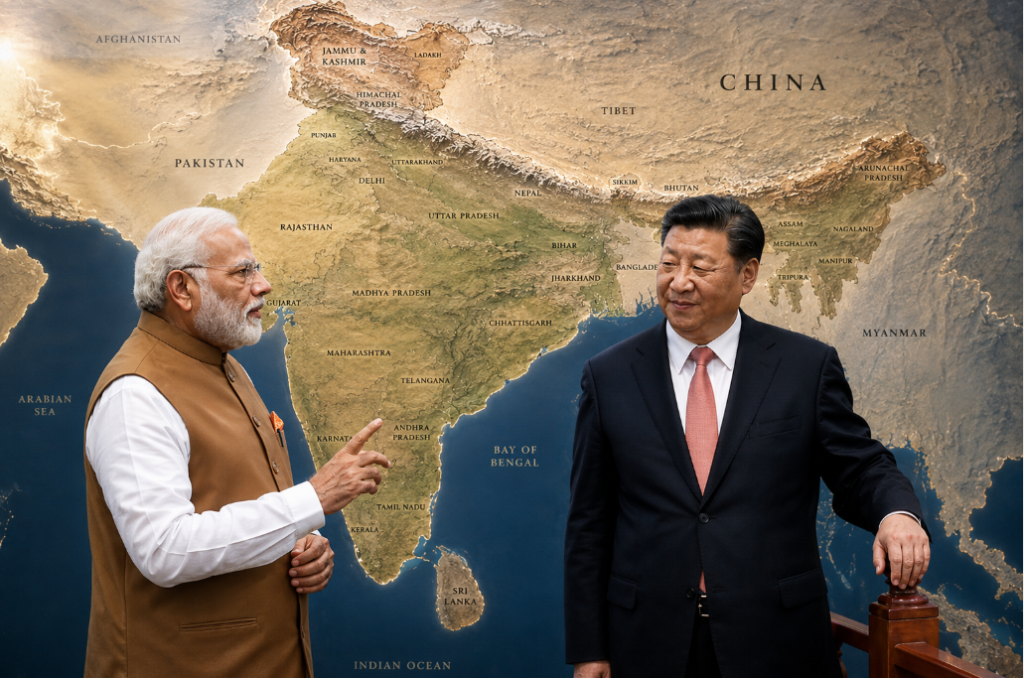
The reason for the caution is how fragile the calm is. The 2020 clash in the Galwan valley, in the western Himalayas, killed 20 Indian soldiers and at least four Chinese troops, and froze the relationship for four years along the 3,488 km frontier. It took a patrolling agreement in October 2024, and a meeting between Narendra Modi and Xi Jinping at the BRICS summit in Kazan that month, to begin the thaw. Since then the two sides have resumed direct flights, restarted the Kailash Mansarovar pilgrimage and eased some visa rules, small steps that a border flare-up could stall.
The dispute also has a paper front. As Diurna reported earlier, China has issued repeated batches of “standardised” Chinese names for Arunachal places since 2017, and India has answered with its own list and a flat rejection of Beijing’s claim. The Taksing episode is the same argument in a harder form.
Managing the information war has become its own task. The special representatives, India’s Ajit Doval and China’s Wang Yi, have met repeatedly since 2024 to rebuild trust and run the mechanisms meant to handle exactly these flashpoints. But a single unverified clip now travels faster than any diplomatic channel, and New Delhi knows that letting rumour define the frontier would cede the story to whoever posts first.
On the ground, the two armies have pulled back from the friction points of the 2020 standoff and resumed coordinated patrolling in the Depsang plains and Demchok. Buffer zones remain, and neither side has returned to its pre-2020 positions everywhere. The arrangement is a managed calm rather than a settlement, which is why each new report from a place like Taksing carries more weight than its scale suggests.
For India, the border is also a domestic political line. Any government seen to be soft on Chinese incursions pays a price at home, and the opposition is quick to ask what the ruling party is conceding for the sake of trade and summits. That pressure pushes New Delhi to talk tough even when it wants the diplomacy to work, and it explains the careful two-track message this week. Beijing has an interest in calm before the summit too, since a border crisis would overshadow the agenda Xi wants to shape in New Delhi.
Why the calendar matters
The immediate pressure sits five weeks out. India hosts a BRICS summit in New Delhi on 12 and 13 September, and Xi is expected to attend. That makes this the worst possible moment for a border row to harden into a crisis. India wants the diplomatic track to hold through the summit, but it will not let Beijing separate the optics of a leaders’ meeting from the state of the ground in the mountains.
The economic backdrop makes the calm valuable to both sides. Since the 2024 thaw, India and China have restored direct passenger flights, reopened the Kailash Mansarovar pilgrimage route through Chinese territory, and begun easing the visa and investment curbs New Delhi imposed after Galwan. Trade between the two runs well over 100 billion dollars a year, most of it Chinese exports into India, and neither capital wants a border incident to unravel ties it has spent two years rebuilding. Officials on both sides call the relationship stable but not normalised, a phrase that captures how much remains unresolved.
The balancing act is delicate. Play down every report and India looks passive on its own soil. Amplify every clip and it risks torpedoing a summit it is about to host. The government has chosen a third path: deny the unverified, restate the principle, and keep the channels open. Whether that holds depends on what actually happens at places like Taksing, and on whether Beijing reads India’s restraint as confidence or as room to push.