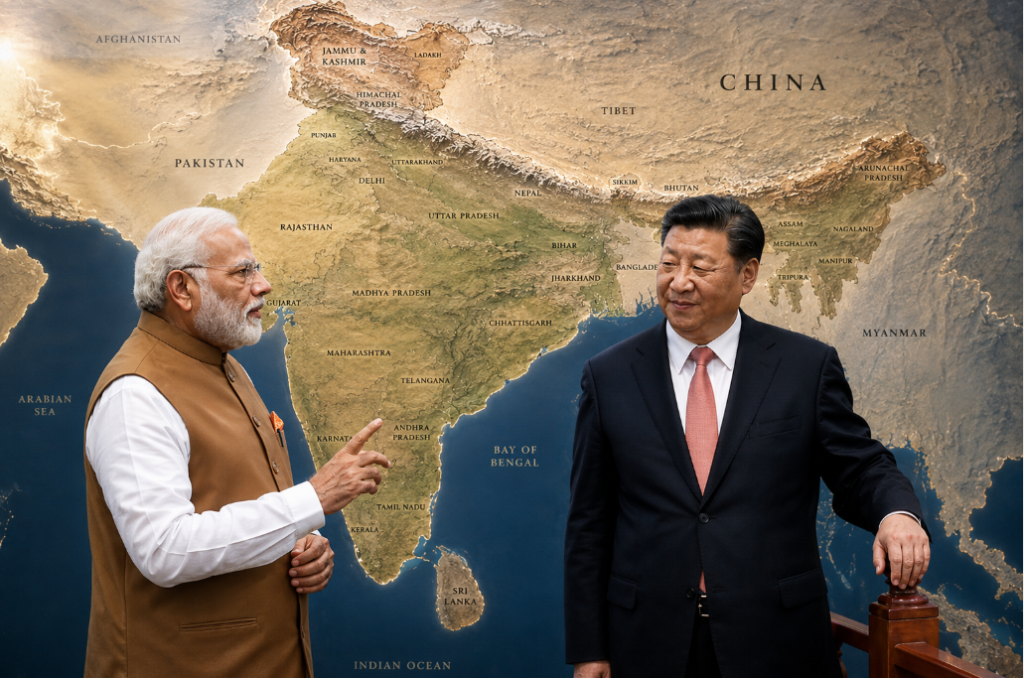
NEW DELHI — India has stopped only rejecting Chinese maps of Arunachal Pradesh and started drawing its own, and the Ministry of External Affairs used its briefing on Tuesday to attach a warning to the change.
Randhir Jaiswal, the ministry’s spokesperson, described the border question with China as the most serious issue between the two countries and said the situation along the Line of Actual Control would determine where the whole relationship goes. He was speaking amid unconfirmed reports of aggressive posturing by Chinese troops in Arunachal Pradesh’s Upper Subansiri district.
“We consider these issues as most serious and the maintenance of peace and tranquillity in these areas is of the utmost importance,” Jaiswal said of discussions with the Chinese side on the border areas.
He added the line that gives the day its weight. “We have also stated that the state of the border affairs will reflect on the state of our larger bilateral ties.”
The map exercise, and why it is new
On Friday the Ministry of Home Affairs announced that 27 places and geographical features in Arunachal Pradesh had been formally identified by their standard names on Survey of India maps, following an exercise carried out with the state government. The stated purpose was accurate recognition and better public awareness, and the statement did not mention China at all.
The list is 21 land areas, four mountain passes, one lake and one monument. It includes Long Ju on the Line of Actual Control, where Chinese forces crossed in 1959 in one of the earliest flashpoints between the two armies, and Maja village nearby in Upper Subansiri. It includes Thag La, the pass where one of the opening battles of the 1962 war was fought. It includes the passes Dzo La, Riza La and Pukur La, the logistics hub of Jairampur in Changlang district, Jaswant Garh on the Tawang road, Sambho Sarovar and the Sher-e-Thapa Memorial.
Read together, that is not a random cartographic tidy-up. Long Ju, Thag La and Jaswant Garh are the coordinates of India’s worst military memories on that frontier. Jaswant Garh carries the name of Rifleman Jaswant Singh Rawat, who fought at Nuranang in 1962 and whose memorial is still maintained by the army on the road to Tawang. Standardising these places on the official map fixes them in the administrative record as Indian sites with Indian names, at locations where the argument has historically been about who was where in 1959 and 1962.
Nine years of one-way naming
Until now the pattern ran only in one direction. China’s Ministry of Civil Affairs has issued batches of Chinese and Tibetan names for places in what it calls Zangnan since 2017: six names that year, fifteen in 2021, eleven in 2023, thirty in 2024 and a further list in April. India rejected each batch in similar language, calling the attempts vain and preposterous, and the exchange became a routine.
External Affairs Minister S Jaishankar gave the standard Indian answer in 2024, when he asked what would happen if he changed the name of somebody else’s house, and answered that it would not become his. It was a good line. It was also purely defensive.
The Survey of India exercise is the first time New Delhi has responded with an act of its own rather than a rebuttal. Beijing noticed.
Beijing’s reply
Chinese Foreign Ministry spokesperson Guo Jiakun rejected the Indian move on Monday. “China does not recognise the so-called Arunachal Pradesh illegally set up by India,” he said at a press briefing, describing the replacement of names long used by China with Indian standard names as illegal, null and void.
Jaiswal answered the following day. “Arunachal is inalienable and integral part of India and this is a fact which is self-evident,” he said, underlining that nothing can change what he called an indisputable reality.
India blocked the accounts of Xinhua and several other Chinese state-linked outlets on social media platforms in the country last year, after New Delhi said they had circulated false claims during the four-day military exchange with Pakistan. The information side of this dispute has been running as long as the cartographic one.
Beijing claims roughly 90,000 square kilometres of Arunachal Pradesh. The naming campaigns have never been about persuading anyone. They are about generating a documentary record that can be cited later, in the same way that fishing logs and lighthouse maintenance records get cited in maritime disputes. India has now started generating its own.
Upper Subansiri, and what the army has not said
The troop reports are the unresolved part of Tuesday’s briefing. Jaiswal was asked directly about the military situation in Arunachal Pradesh and whether it had been raised with Beijing. He answered about diplomacy and did not confirm the reports. The Indian Army has not commented on them at all.
Diurna is treating them as unconfirmed. What is confirmed is that the 36th meeting of the Working Mechanism for Consultation and Coordination on India-China Border Affairs was held on 6 August, five days before the briefing, and that both sides reviewed the situation along the Line of Actual Control in what Jaiswal called frank discussions.
“The Indian side again underlined that maintaining peace and tranquillity in the border areas is essential for the overall development of bilateral relations,” he said. The two governments agreed to keep using existing diplomatic and military channels, including the working mechanism and local commander-level meetings, to prevent misunderstanding and miscalculation.
The phrase to notice is miscalculation. That is the vocabulary of two militaries in close contact with poor visibility of each other’s intent, not of a settled frontier. Upper Subansiri is also the sector where the last publicly confirmed face-off in the eastern theatre occurred, at Yangtse in Tawang district in December 2022, when troops from both sides were injured in a clash with clubs and improvised weapons.
The thaw and its limit
India and China have spent the past year rebuilding a relationship that broke in the Galwan Valley in June 2020, when twenty Indian soldiers and an undisclosed number of Chinese troops were killed, and which stayed broken through more than four years of forward deployment along the Line of Actual Control.
Direct flights, visa issuance, the Kailash Mansarovar pilgrimage route and border trade have all been part of the repair since the patrolling understanding reached in October 2024. Business delegations have resumed. Chinese technicians have started returning to Indian factories that had been waiting on visas for years.
Infrastructure has moved faster than diplomacy on the Indian side of that frontier. The Sela tunnel on the road to Tawang, opened in 2024, gives the army all-weather access to a sector that used to close in winter, and the Arunachal Frontier Highway is being built to run close to the Line of Actual Control for more than 1,700 kilometres. The Vibrant Villages Programme is funding roads, power and connectivity in border settlements that had been emptying for a generation.
Naming places is the administrative counterpart of building roads to them. Both are assertions of ordinary state presence rather than military moves, and both are hard for Beijing to answer without escalating.
Tuesday’s briefing marks out the limit of it. New Delhi is not saying the thaw is over. It is saying the thaw is conditional, that the border is the variable everything else depends on, and that a normalisation which leaves the Line of Actual Control unresolved is not normalisation.
The naming exercise fits that framing precisely. It commits nothing militarily, costs nothing diplomatically and cannot be walked back, because a name on a Survey of India map is an administrative fact rather than a negotiating position. It is the cheapest possible way of signalling that the eastern sector is not going to be quietly conceded while the two capitals talk about flights and visas.
Whether Chinese troops are in fact moving in Upper Subansiri will determine how the next few weeks read. The naming of Long Ju and Thag La will read the same way for years.