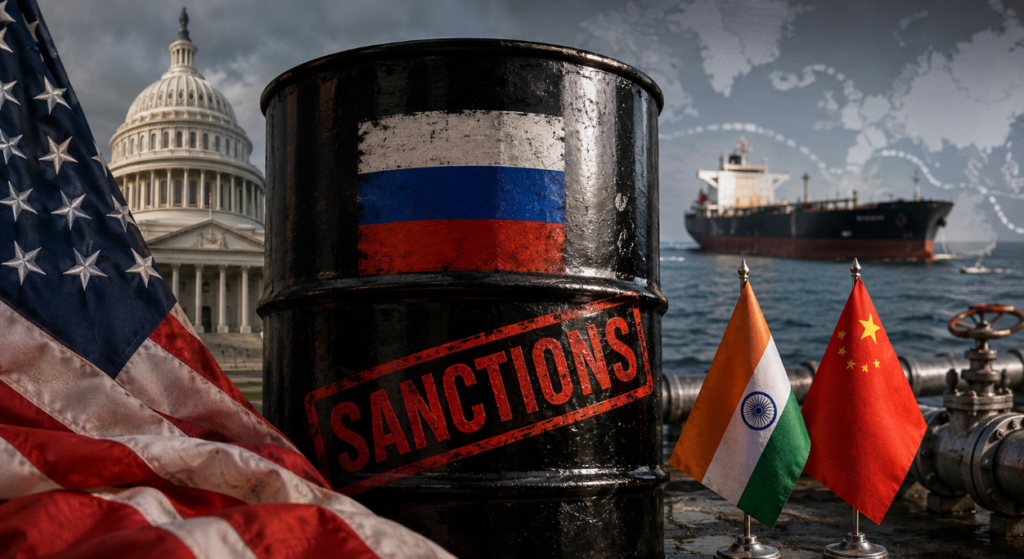
WASHINGTON — The US Senate passed a Russia sanctions bill on Friday that authorises tariffs of up to 100 percent on the largest buyers of Russian oil and gas, a list on which India sits alongside China.
The vote was 86 to 11. The legislation now goes to the House of Representatives, where it will not be taken up until at least early September because of the congressional summer recess.
What the bill does
The measure is titled the Lindsey O. Graham Sanctioning Russia and Iran Act of 2026. It has three main components.
The first is direct sanctions on Russian officials. The second is the tariff authority: up to 100 percent duties on the top five countries purchasing Russian crude oil and natural gas, with US Trade Representative Jamieson Greer setting the final level. The third targets the clandestine maritime networks used to move Russian oil around Western embargoes, and covers the top five countries assisting that evasion.
There is an exemption. Countries importing less than 15 percent of Russia’s total natural gas exports, and working to significantly reduce their use of Russian gas, can be carved out.
The bill also extends Iran sanctions, including a provision preventing a lapse in authority restricting funding for Iranian energy and weapons. That was sought by President Donald Trump.
Why India is named
India’s exposure here is not incidental. It is the design.
Graham, when introducing an earlier version of the bill, was explicit about the target. He described the real focus as hitting Putin’s customers, noting that China and India together buy roughly 70 percent of Russian oil, gas and other petroleum products.
The mechanism reaches India because Indian refiners became the largest buyers of discounted Russian crude after 2022, and stayed there. The Hormuz closure since February deepened that dependence rather than reducing it, since Russian barrels arrive by routes the Gulf crisis does not touch.
The natural gas exemption offers India a possible route out that the oil provisions do not. India imports very little Russian natural gas. It imports a great deal of Russian crude. The 15 percent threshold is written against gas, and the tariff authority applies to buyers of oil and gas alike.
A bill named for a dead senator
Lindsey Graham, the South Carolina Republican who spent over a year negotiating the package, died last month shortly after returning from a visit to Ukraine. The day before he died, standing in front of tanks in Kyiv, he announced that the administration and the bill’s key Senate backers had finally reached a deal.
His colleagues moved the legislation in the days after his death, casting passage as a fitting legacy. The renaming was part of that.
Senator Jim Risch, ranking member of the Senate Foreign Relations Committee, made the case on the floor before the vote. “This could finally bring Russia to the negotiating table and end this conflict between Russia and Ukraine,” he said, arguing the measure would go beyond what could be achieved militarily.
He was direct about the mechanism. “It will cut off the flow of cash that powers Putin’s war machine,” Risch said.
A year and a half in the making
The bill that passed on Friday is substantially softer than the one Graham introduced. The Sanctioning Russia Act of 2025, brought with Democratic Senator Richard Blumenthal of Connecticut, proposed a 500 percent tariff on imported goods from any country purchasing sanctioned Russian products.
Five hundred percent is not a tariff in any ordinary sense. It is a trade embargo written as a number, and it was never going to survive contact with an administration that had to apply it to China and India simultaneously. The final text caps the rate at 100 percent, limits it to the five largest buyers of Russian crude or gas plus the five largest facilitators of sanctions evasion, and hands the level-setting to the Trade Representative.
Senate Majority Leader John Thune had said in mid-2025 that he hoped to move the bill before that year’s August recess. It took a further twelve months, a change in the war’s trajectory, and Graham’s death to get it to a vote.
Senate Majority Leader Thune framed the stakes in scale terms in a recent floor speech, describing Ukraine as the largest conflict in Europe since the Second World War and arguing that Putin can continue the war for as long as he has oil and gas revenue.
The eleven who voted no
The opposition was not about Ukraine. It was about tariffs.
Republican Senator Rand Paul of Kentucky and Democratic Senator Ron Wyden of Oregon jointly sought to strip out the provisions allowing 100 percent duties on countries buying Russian energy. Their amendment failed.
Paul’s argument was that sympathy for one cause should not obscure the cost of the instrument. “Do not let sympathy for Ukraine blind you to the reality of tariffs,” he said.
Wyden warned the provisions could carry broad economic consequences for Americans, calling the tariffs an economic wrecking ball.
The disagreement is really about presidential power. Traditional sanctions are administered by Treasury under statutory criteria. Tariff authority handed to the executive is discretionary, and once granted for Russian energy it becomes a precedent for other purposes. Several House members are wary for the same reason, which is why Senate passage does not guarantee the bill becomes law.
What India has actually said
Section 113 of the Act names the five largest importers of Russian energy as the potential targets: India, China, Slovakia, Hungary and Azerbaijan.
The Ministry of External Affairs has been careful in response, and its careful wording is the substance. Spokesman Randhir Jaiswal confirmed at the weekly briefing that New Delhi is tracking the legislation.
“We are closely monitoring the developments,” Jaiswal said.
On the underlying question of why India buys the oil at all, he restated a position India has not moved from. “On energy security, our position has been clarified and very well articulated on several occasions. It is something which is predicated on our national priorities and on securing the energy needs of our 1.4 billion people through diversified sources, which includes the US,” he said.
That last clause is doing work. By naming the United States among India’s diversified sources, the MEA is pointing out that Washington is itself a beneficiary of the sourcing strategy the bill would penalise.
Jaiswal also indicated where the argument will now be made. “We remain engaged with relevant stakeholders in the US at various levels on this particular matter,” he said, describing continuing dialogue through official channels.
India has not threatened retaliation, characterised the bill as hostile, or committed to reducing Russian purchases. It has said it is watching and talking.
What happens next
The House does not return until September. A 435-seat chamber where some members are uneasy about expanding Trump’s tariff powers is a harder vote than an 86-11 Senate.
Even if it passes, the tariffs are authorised rather than mandated. Greer determines the level, and the President decides whether to use the authority at all. A bill that permits 100 percent duties on India is not the same as a bill that imposes them.
That distinction is the space in which Indian diplomacy will operate over the next several weeks.
What it means for India
The immediate risk is not the tariff. It is the uncertainty. Indian exporters cannot price contracts against a duty that may or may not arrive, at a level nobody has set, following a House vote that has not happened.
The strategic problem is sharper. India’s crude import bill already rose more than 60 percent year-on-year in the April-June quarter, as refiners rerouted roughly 70 percent of purchases away from the closed Strait of Hormuz and leaned harder on Russia, the United States and West Africa. Washington is now proposing to penalise the Russian portion of exactly the workaround that the Hormuz closure forced.
The two pressures point in opposite directions. Reducing Russian crude means buying more from a market where the Gulf route is shut and prices are elevated. Keeping Russian crude means carrying tariff risk on goods exported to the United States, India’s largest single export destination.
New Delhi has until early September before the House takes it up. The gas exemption suggests the drafters were willing to write in off-ramps for countries that move. Whether one can be constructed for an oil buyer is the question Indian negotiators will now be asking in Washington.