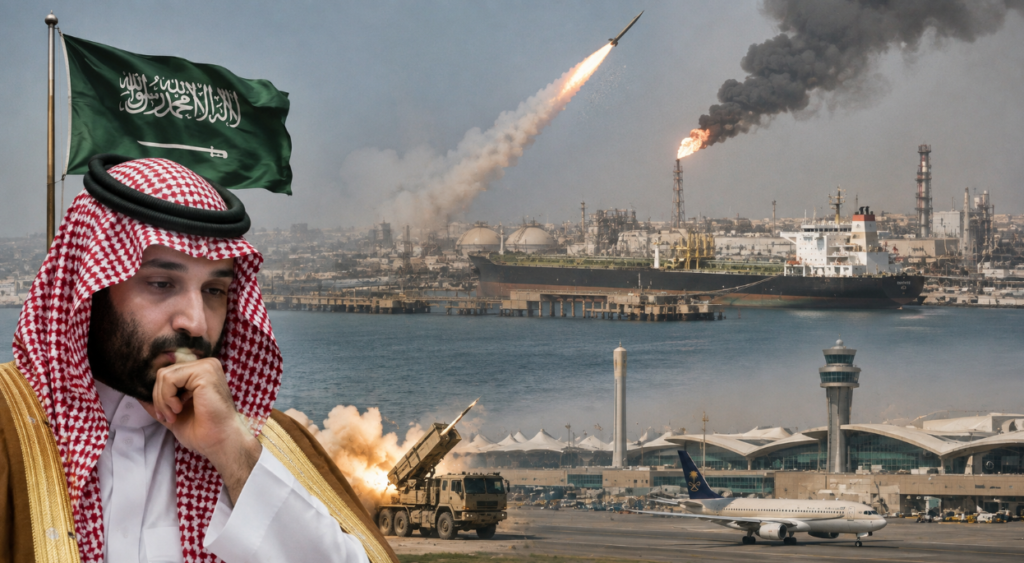
RIYADH — Saudi Arabia is bracing for coordinated attacks by Yemen’s Houthis and Iran-backed Iraqi militias, a senior Saudi official said, after a Houthi strike in the kingdom’s south wounded 11 civilians including a four-year-old child.
The warning is unusual in its specificity. Riyadh says intelligence from Saudi, American and other regional services points at civilian and economic targets: energy infrastructure, ports and airports.
What Riyadh says it is seeing
The official, speaking anonymously, said Saudi Arabia had detected meetings involving Iraqis, Houthis and members of Iran’s Islamic Revolutionary Guard Corps, along with movements of drones and missiles suggesting operations planned from two directions at once.
That geography is the point. The Houthis strike from the south, across the Yemen border. Iraqi militias strike from the north. A kingdom defending against both simultaneously has to split air defences that were built primarily to face one.
The official’s framing of the timing was pointed. He said the threats were alarming precisely because Riyadh has been pursuing de-escalation, with contacts including Iran and mediation efforts appearing to move in the right direction.
“Saudi Arabia will take all necessary measures to deal with any aggression,” the official said, while declining to detail what a response would involve.
He offered two readings of why attacks would come now. One is that they are meant to derail the negotiations. The other, more consequential, is that they signal a power struggle inside Iran itself, with factions acting against a settlement their own government is pursuing.
The attack that has already happened
The strike on Thursday hit Najran province, near the Yemen border. Eleven civilians were injured. Seven were Saudi nationals, including a woman and a four-year-old child who suffered second-degree burns. A Yemeni national, two Egyptians and a Pakistani were among the wounded.
Saudi military spokesman Major General Turki Al Maliki condemned the method as much as the act. “The terrorist Houthi militia carried out these terrorist attacks using indiscriminate shelling against civilian objects,” he said in the coalition statement.
The Houthis also killed dozens of Yemeni government troops in simultaneous attacks on Marib and Hadhramaut provinces, and struck displacement camps in Marib, killing two people and injuring 14.
How this started
The current escalation dates to July 20, when the Houthis declared a maritime blockade of Saudi Arabia. They describe it as a siege for a siege, arguing that Riyadh restricts maritime and air traffic into Yemen, including Sanaa International Airport, at the request of Yemen’s internationally recognised government.
Since then the group has claimed attacks on eight Saudi-linked vessels in the Red Sea. On July 25 it claimed strikes on energy facilities at Yanbu and at Jazan, an oil refinery on the Red Sea coast processing 400,000 barrels a day. Saudi Aramco suspended operations at Jazan afterwards. On July 27, eastern energy facilities were targeted.
On August 5, Houthi military spokesman Brigadier General Yahya Saree claimed a ballistic missile attack on the Wafa, a Saudi oil tanker near Yanbu. The Houthis claimed a further attack on a Saudi tanker in the Gulf of Aden the following day.
This follows years of relative quiet. A Saudi-Houthi agreement in 2022 sharply reduced hostilities, and held until this summer.
Why the Houthis are moving now
Analysts point to motives that are partly regional and partly internal.
Maysaa Shuja Al Deen, a senior researcher at the Sanaa Centre for Strategic Studies, has argued that resources are a large part of it. The provinces the Houthis are attacking are oil-rich, and territorial gains there would give the group revenue it badly needs. She has said the group faces internal pressure from a population suffering under a poor economy and poor governance, pushing it to seek income and popularity.
The regional motive is leverage. Pressure on Saudi Arabia raises the cost of the current standoff for a country Washington listens to, which could push the United States towards a deal with Iran that ends attacks across the region.
There is a countervailing signal. After a meeting between Saudi and Iraqi officials, Iraqi militia leaders reportedly told fighters to postpone retaliation against Saudi Arabia, a sign that Baghdad is under real pressure to restrain groups operating from its territory.
The shipping arithmetic
Bab al-Mandeb is the reason this fight matters beyond the Arabian Peninsula. The strait between Djibouti and Yemen is the southern gate to the Red Sea and the Suez Canal, and it is roughly 29 kilometres wide at its narrowest, limiting traffic to two channels.
The volumes moving through it have changed beyond recognition this year. Saudi seaborne crude exports via Bab al-Mandeb surged eightfold between March and mid-July 2026 compared with the same period in 2025, according to maritime tracker Kpler. That is not growth. That is displacement: with Iran’s closure of Hormuz, Yanbu became the kingdom’s main exit point for oil rather than its alternative one.
Which is precisely what the Houthis appear to have understood. Saree said the blockade had pushed Saudi Arabia to divert “its oil tankers toward the northern Red Sea,” and that the group would therefore “escalate in targeting Saudi oil tankers in the northern Red Sea to close all access points and prevent their passage.”
A campaign that began at the southern chokepoint has followed the traffic north. The Wafa strike off Yanbu was the eighth Saudi tanker targeted since the blockade began.
What the Houthis say they are doing
The group frames all of this as reciprocal. It accuses Riyadh of imposing an unjust siege for nearly 12 years, plundering Yemeni resources and blockading its ports and airports by land, sea and air.
Saree has tied specific strikes to specific Saudi actions. Of an attack on Najran Airport on August 4, he said: “This targeting comes in response to the Saudi enemy’s violation of the airspace in the provinces of Saada and Hodeidah with its drones.”
Earlier, after Saudi strikes on Hodeidah, he said the attacks demonstrated Riyadh’s determination to continue its siege and violate Yemeni sovereignty, and vowed the group would answer escalation with escalation.
Whether the reciprocity framing holds is a separate question from whether the targeting is effective. On the evidence of the past three weeks, it has been.
What Riyadh is building
Saudi Arabia announced a maritime coalition on July 30 to protect the Red Sea and the Bab al-Mandeb strait, with 13 other countries. Major General Abdullah Al Shehri was named its commander on Thursday.
The coalition’s composition is notable for who is missing. Neither the United States nor the European Union joined, though both were invited.
Riyadh is also evaluating military options including a ground operation that Yemeni government forces would lead. Separately, Turkey, Saudi Arabia and Pakistan were due to sign a defence agreement in the kingdom on Friday, according to regional sources cited by Reuters. Saudi Arabia already has a defence cooperation arrangement with Pakistan.
What it means for India
India’s exposure here is direct and expensive. Roughly nine million Indians work in the Gulf, with around 2.6 million in Saudi Arabia alone, and attacks on ports and airports would affect them before they affect anyone in Delhi.
The energy consequence compounds a problem India is already managing. With the Strait of Hormuz still shut and Indian refiners having rerouted about 70 percent of crude purchases away from it, the Red Sea has become more important, not less. Threats to Yanbu, Jazan and Bab al-Mandeb narrow the alternatives further. India’s crude import bill rose more than 60 percent year-on-year in the April-June quarter, and a Red Sea escalation would push it higher.
A Turkey-Saudi-Pakistan defence agreement, if signed, is the development New Delhi will read most carefully. India has spent years building its own security relationship with Riyadh, and a formal arrangement placing Pakistan alongside Turkey inside Saudi defence planning cuts against that.