NEW DELHI — Saudi Arabia, Turkey and Pakistan signed a mutual defence pact in Mecca on Friday committing each to treat an armed attack on one as an attack on all three, and India said it was watching closely.
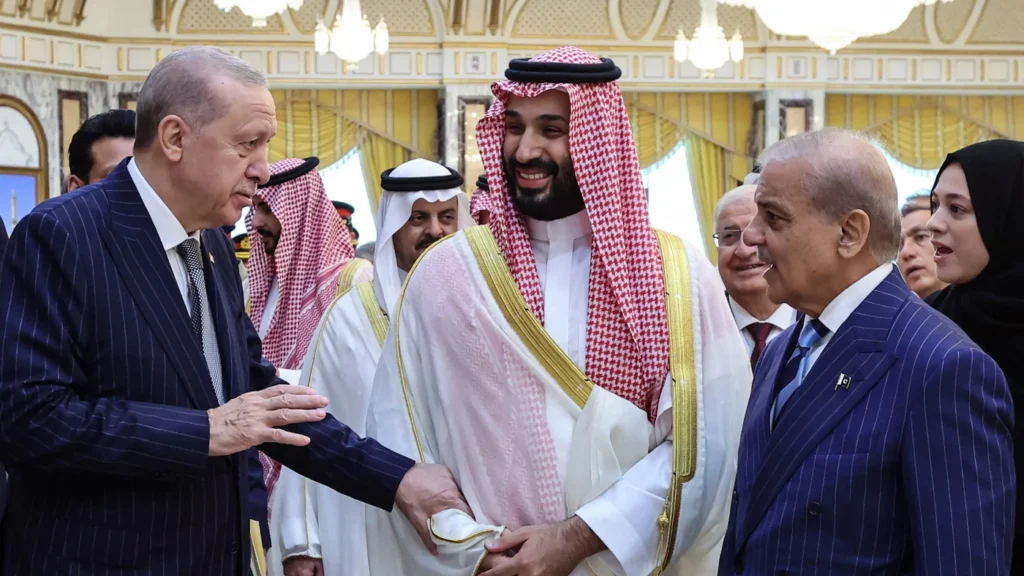
The Mecca Joint Defence Agreement was announced after a meeting between Saudi Crown Prince Mohammed bin Salman, Turkish President Recep Tayyip Erdogan and Pakistani Prime Minister Shehbaz Sharif. It is the first formal trilateral defence arrangement between the three.
What the agreement says
The joint statement sets out the core commitment in NATO-style language. The pact aims “to strengthen collective deterrence against any act of aggression, and stipulates that any armed attack against any one of the three States shall be regarded as an attack against them all,” it reads, adding that it provides for enhanced defence cooperation across all aspects.
What it does not do is specify obligations. There is no detail on what each party is required to contribute, under what circumstances, or on what timeline. A Turkish official told Reuters the pact was “purely defensive in nature.”
The arrangement builds on an existing base. Saudi Arabia and Pakistan signed a Strategic Mutual Defence Agreement in Riyadh in September 2025, committing to treat an attack on either as an attack on both. Saudi Crown Prince and Defence Minister Khalid bin Salman marked that signing with a line that has aged into the current pact: “KSA and Pakistan…One front against any aggressor…Always and forever.”
Why now
The timing is not incidental. Since the US-Israeli campaign against Iran began on February 28, Tehran and its allies have struck targets in Saudi Arabia and other Gulf states, disrupted traffic through the Strait of Hormuz, and blockaded the Red Sea.
Saudi Arabia has absorbed repeated attacks on its energy infrastructure. The Houthis have claimed strikes on Yanbu and on the Jazan refinery, which processes 400,000 barrels a day, and Saudi Aramco suspended operations at Jazan afterwards. Eastern facilities including Abqaiq, the world’s largest crude stabilisation plant, were hit by drones in late July.
Riyadh has responded by widening its security relationships rather than narrowing them. It announced a 13-nation maritime coalition on July 30 to protect the Red Sea, which the United States and European Union declined to join despite being invited. The Mecca pact follows the same logic.
Turkey brings a different set of concerns, including escalating tension with Israel over Gaza and the wider regional conflicts in Iran and Lebanon.
The ‘Islamic NATO’ framing, and its limits
The agreement formalises what strategic circles have speculated about for months, sometimes under the label of an Islamic NATO. That framing overstates what has been signed.
NATO’s Article 5 works because it sits on decades of integrated command structures, joint planning, standing forces and interoperable equipment. The Mecca agreement has a declaration and no published machinery. Three militaries that have never operated together under a common command have committed to defending each other without saying how.
Masoud Alfak, a Riyadh-based analyst, described it as a major development in the region’s security architecture, arguing the three countries believe they face common threats and that the primary objective is regional stability rather than confrontation or joining wars.
Tehran’s response was dismissive. Ebrahim Rezaei, a member of Iran’s National Security commission, wrote that “the Saudis should know that a paper agreement with Turkey and Pakistan does not bring them security, just as years of unilateral milking of the Americans did not bring them security.”
What each side wants from it
The three signatories are not seeking the same thing, and that is both the pact’s strength and its weakness.
Saudi Arabia wants deterrence it can point to. Its security architecture rested for decades on an American guarantee, and the war with Iran has demonstrated the limits of that arrangement in a way Riyadh cannot ignore. When the United States declined to join the Red Sea maritime coalition it had been invited to lead, the message registered.
Pakistan wants money and standing. Its economy has needed Gulf support repeatedly, and a formal defence relationship with the region’s wealthiest state converts an informal dependency into a structured one. It also gains an argument for relevance at a moment when its strategic value to Washington has diminished.
Turkey wants reach. Erdogan has spent a decade positioning Turkey as a leading voice in the Muslim world, and its defence industry, particularly drones, has become its most successful export of influence. A trilateral pact with Riyadh and Islamabad places Turkish equipment and Turkish doctrine inside Gulf planning.
What none of them has committed to is fighting the other’s war. The absence of specified obligations is not an oversight; it is what made signature possible.
India’s response
The Ministry of External Affairs was brief. Spokesman Randhir Jaiswal said at the weekly briefing that New Delhi was tracking the pact.
“This is also a development that we are closely following, and we shall keep you updated,” he said.
Asked separately about reports of Somalia entering a security arrangement with Pakistan, Jaiswal offered the same formula, saying India continues to follow developments between the two.
The 2025 Saudi-Pakistan pact drew a slightly firmer line. India then said it was aware of the agreement, would study its implications for national security and regional stability, and remained committed to comprehensive national security in all domains.
What it means for India
The uncomfortable fact for New Delhi is that India has invested heavily in the Saudi relationship. The Modi-Mohammed bin Salman rapport has been a centrepiece of India’s West Asia policy, built on energy, investment and roughly 2.6 million Indian workers in the kingdom.
Riyadh has now twice entered mutual defence commitments with Pakistan regardless. That does not make Saudi Arabia hostile to India; it reflects a kingdom under direct attack widening its options wherever it can find them. But it does establish a limit on what the bilateral warmth buys.
Turkey’s inclusion sharpens the discomfort. Ankara has been openly aligned with Pakistan on Kashmir and supplied it with drones and naval technology. A structure that places Turkish and Pakistani defence planning inside a Saudi framework gives Islamabad a route into a relationship India has spent a decade cultivating.
The practical military consequence is limited for now, because a declaration without command structures changes very little on a border. The diplomatic consequence is immediate: India’s assumption that Gulf partnerships would stay separate from the Pakistan question no longer holds.