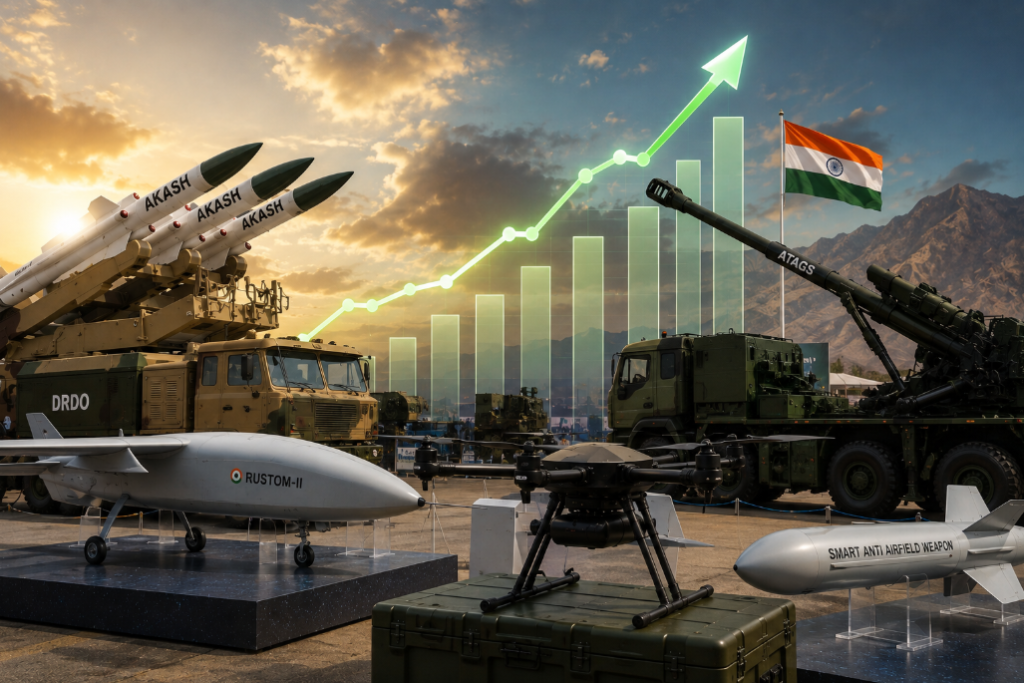
NEW DELHI — India’s defence exports hit a record ₹38,424 crore in FY26, and the composition of that number matters more than the total. The growth came from state-owned firms whose sales jumped 151 percent, and increasingly from drones, munitions and guidance electronics rather than the marquee missile that made India’s export reputation.
BrahMos remains the headline. It is not where the next phase of growth is expected to come from.
The number, and who earned it
Exports rose 62.66 percent over the previous year, an increase of ₹14,802 crore on FY25’s ₹23,622 crore. Defence Minister Rajnath Singh announced the figure on social media. “India defence exports have touched a new all-time high with a record Rs. 38,424 crore in FY 2025-26,” he said, calling it robust growth over the previous fiscal and evidence of rising global confidence in Indian manufacturing.
The split between public and private was close to even: Defence Public Sector Undertakings accounted for 54.84 percent and private industry 45.16 percent. That is a reversal from the previous year, when the private sector had the larger share.
DPSU exports surged 151 percent to ₹21,071 crore from ₹8,389 crore. Public sector shipments run heavily to munitions, fuses and lightweight torpedoes, categories that scale in a way single high-value platforms do not.
Set against the longer run, the trajectory is steep. Exports stood at ₹8,434 crore in 2020-21 and ₹686 crore in 2013-14. India now ships defence equipment to more than 80 countries by the ministry’s count, with the United States emerging as the single largest destination, largely buying sub-systems including aircraft fuselages.
Where the next growth is expected
The shape of global demand has changed. Wars over the past few years have pushed buyers away from big platforms like fighter jets and main battle tanks and towards drones, electronic warfare, precision-guided systems and air defence.
India’s export list already reflects that shift in places. The Philippines has bought BrahMos. Armenia has purchased Pinaka rocket systems and artillery. Other buyers are taking Dornier aircraft, helicopters, fast interceptor boats, torpedoes and aerospace components.
The less visible layer is electronics. Fuses, guidance systems, sensors and precision modules determine how a munition actually performs, and Indian firms have been building capability there. DRDO, working with IIT Madras and Munitions India, has been converting conventional artillery shells into precision-guided munitions, a retrofit market that is large because the shells already exist in inventories worldwide.
The BrahMos pipeline
The missile itself is not standing still. BrahMos-NG, the next-generation lighter variant, is tracking towards first flight trials in late 2026, with DRDO confirming that ground-level engine testing and design validation were completed last year. Mass manufacturing is projected for 2027 to 2028, with Indian Air Force induction expected around 2029.
Serial production is anchored at the BrahMos facility in the Uttar Pradesh Defence Industrial Corridor at Lucknow, designed to build up to 100 missiles a year at full capacity. A torpedo-tube-launched variant for submarines is on the roadmap, intended for the Project-75I boats.
Rajnath Singh flagged off the first batch of Lucknow-built missiles last October. “BrahMos is not just a missile but it is a symbol of country’s growing indigenous capabilities,” he said at the event, noting that the BrahMos team had recently signed contracts with two countries worth ₹4,000 crore.
The indigenisation arithmetic
Cost is the constraint on export volume, and cost tracks indigenous content. BrahMos currently runs at roughly 83 percent Indian content, with a near-term target of 85 percent. DRDO has been in discussions with Russian partner NPO Mashinostroyenia about pushing that to 90 to 95 percent, specifically to bring the unit price down.
That matters because the missile export market has got more competitive. A supersonic cruise missile that costs less to build is a missile that can be priced against rivals without eroding margin.
Domestically, the Indian Army is moving to procure 150 extended-range BrahMos missiles in a deal worth around ₹10,000 crore. Bharat Electronics Limited and Bharat Dynamics Limited together account for close to 70 percent of the manufacturing share in the programme.
The intelligence inside the weapon
The argument industry executives make is that India’s export potential is misread when it is measured only in finished platforms. What decides whether a munition works is the electronics: the fuse that detonates at the right moment, the guidance package that steers it, the sensors that tell it where it is.
Priyanka Singhal, chief executive of Ammunic Systems, which has worked with the Indian armed forces and DRDO on advanced munitions and electronic fuses, has argued that this component layer is where India’s competitive position is strongest and least visible. A country that supplies fuses and guidance modules to many buyers is embedded in more supply chains than one that sells a complete missile to two.
That also explains why the United States has become the largest single destination. American firms are not buying Indian missiles. They are buying sub-systems, including aircraft fuselages, at volumes that add up.
The private sector shift
Rajnath Singh has been explicit that the composition change is deliberate policy. Speaking after opening an ammunition manufacturing unit at Shirdi, he described the sector as undergoing a historic transition in which private firms build complete weapons systems rather than supplying components.
He put the ambition in unusually blunt terms. “No power can now stop it from being the biggest exporter in 25-30 years,” he said, arguing that a nation which makes its own weapons controls its own future.
Private participation currently sits at 25 to 30 percent of defence manufacturing. The government wants it at 50 percent. To get there it has opened DRDO laboratories and testing facilities to industry on a paid basis, allocated 25 percent of the defence research budget to private firms, academia and start-ups, and transferred more than 2,200 DRDO technologies to industry.
Singh has also credited recent operational experience with improving the sales pitch. “The effective use of Made-in-India equipment by the Armed Forces during Operation Sindoor bolstered India’s reputation both regionally and internationally,” he said at the Society of Indian Defence Manufacturers annual meeting.
That claim is commercially significant rather than merely rhetorical. Combat use is the reference buyers ask about, and until Sindoor most Indian systems had no operational record to point at.
The target, and the gap
The government is aiming for ₹50,000 crore in defence exports by 2029-30. From ₹38,424 crore, that requires roughly 30 percent growth over four years, a far gentler rate than the 62.66 percent just recorded.
On the face of it the target looks conservative. The caution is that FY26’s jump was partly demand-driven, helped by the Russia-Ukraine war, tensions between Armenia and Azerbaijan, and a broad rush among mid-sized militaries to restock and modernise. Demand pulled by conflict does not necessarily persist.
Indigenous defence production reached ₹1,27,434 crore in FY24, up 174 percent from ₹46,429 crore in FY15. Defence spending has risen from ₹2.53 lakh crore in FY14 to ₹6.81 lakh crore in FY26.
What it means for India
The export number is genuinely a milestone, and it is worth being precise about what it does and does not show. India is now a significant supplier of components, munitions and mid-tier systems. It is not yet a major supplier of complete high-end platforms, and SIPRI’s global arms transfer rankings continue to reflect that.
The strategic value of the shift is less about revenue than about the industrial base. A supply chain that can produce fuses, guidance electronics and precision munitions at export volumes is a supply chain that can sustain the Indian armed forces through a long engagement without foreign resupply. That is the argument the Atmanirbharta push has always rested on, and the FY26 numbers are the strongest evidence for it so far.
Whether it holds depends on what happens when the current wave of global restocking ends.