A little over a decade ago, India was a net importer of missiles, dependent on Russia, France and Israel for the sharp end of its arsenal. Today it is exporting one of the fastest cruise missiles in the world, and in doing so it is quietly redrawing the security map of the Indo-Pacific. The vehicle for that shift is BrahMos, and its export success has now crossed a symbolic threshold. Sales to just three Southeast Asian buyers already exceed 1.7 billion dollars.
The story matters because it is not really about one weapon. It is about how India is turning a Cold War-era joint venture with Russia into a tool of statecraft, arming China’s maritime neighbours with a missile that changes the arithmetic of any confrontation in the South China Sea. Here is how the BrahMos arc came together, and where it goes next.
The three deals that built the arc
The Philippines was first. In 2022, Manila signed a deal worth roughly 375 million dollars for the shore-based anti-ship variant, with deliveries beginning in 2024 and batteries positioned near strategic chokepoints on Luzon and the Luzon Strait, precisely the corridors used to monitor Chinese naval movements.
Vietnam followed in May 2026 with a much larger package worth close to 700 million dollars, slotting BrahMos into a coastal-defence network that already includes Russian Bastion-P systems, Kilo-class submarines and Su-30 fighters. Then, in July 2026, Indonesia became the third operator, signing a defence package exceeding 600 million dollars that bundled BrahMos with India’s indigenous Astra air-to-air missile and joint development of Sabang port, which overlooks the Strait of Malacca. The timing was pointed. The agreement was firmed up around Modi’s visit to Jakarta and his talks with President Prabowo Subianto.
Line those three up on a map and a pattern appears. The Philippines, Vietnam and Indonesia form a rough triangle across the southern and eastern edges of the South China Sea, a distributed network of anti-ship missiles that any hostile fleet would have to account for. Analysts have started calling it a missile arc.
Why Southeast Asia wants a supersonic cruise missile
The demand is driven by a single strategic problem. How does a smaller navy deter a much larger one? For countries with limited fleets but disputed maritime claims, the answer increasingly is sea denial, making the waters near your coast dangerous enough that a superior force thinks twice before entering them. A supersonic cruise missile that can sink a warship does exactly that, and it does so far more cheaply than building a blue-water navy.
BrahMos fits the brief almost perfectly. It travels at nearly three times the speed of sound, flies a sea-skimming profile that compresses an enemy’s reaction time to seconds, and carries a warhead designed to punch through the toughest ship hulls. For a coastal state watching Chinese vessels operate in contested waters, that is a great deal of deterrence per dollar.
What BrahMos actually is
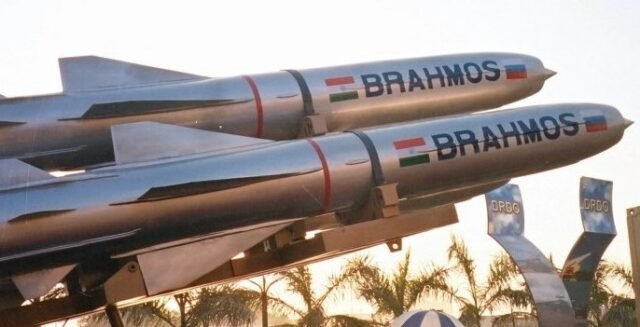
BrahMos is a joint venture between India’s Defence Research and Development Organisation and Russia’s NPO Mashinostroyenia. The name fuses the Brahmaputra and Moskva rivers. The current missile is a roughly three-tonne supersonic cruise weapon with a range that has been progressively extended and a speed in the region of Mach 2.8. It can be launched from land, ships, submarines and aircraft, which is a large part of its appeal, because a single weapon family covers multiple domains.
Crucially for India’s export pitch, the missile is now combat-validated. Its use during Operation Sindoor demonstrated the system in a real operational setting, and that battlefield reference is worth more to a prospective buyer than any brochure. Combat proof is the single most persuasive line in an arms salesman’s script, and India now has it.
The Russia factor and the export unlock
The joint-venture structure is both BrahMos’s origin and, for years, its constraint. Because the missile is co-developed with Russia, exporting it meant navigating shared ownership and international rules on missile technology. The decisive shift came in 2016, when India joined the Missile Technology Control Regime, the club that governs the spread of such systems. Membership cleared the way to extend the missile’s range beyond its earlier cap and, crucially, to sell it abroad. Without that step, the Philippines, Vietnam and Indonesia deals would not have been possible.
That history also explains a subtle tension in the arc. Every BrahMos sale deepens India’s defence ties with Southeast Asia while relying on a platform born of cooperation with Moscow, even as New Delhi works to indigenise the missile and diversify its wider arms suppliers. India is, in effect, using an Indian-Russian product to build its own independent export brand. The faster the indigenisation runs, the freer its hand becomes to sell where it chooses.
The BrahMos-NG delay, and the production problem
The next-generation variant, BrahMos-NG, is where the ambition is heading, and where the friction is showing. The NG is designed to be smaller and lighter, roughly 1.2 to 1.3 tonnes against the current three, which would let it deploy from a wider range of platforms including the Tejas Mk-1A and MiG-29 fighters. It is meant to be stealthier, longer-legged and harder to shoot down, with future ranges potentially stretching well beyond the current missile.
Flight trials had been expected to begin in 2026, but they have slipped. The reason cited is not a technical failure but the Indian customer tightening its operational requirements, forcing further refinement before testing. Less comfortably, there have also been reports of production disruptions at BrahMos Aerospace, with staff transfers destabilising manufacturing lines and cutting output. That is a worrying signal, because BrahMos underpins the Indian Navy’s sea-denial doctrine at home even as the export order book grows. For now, ambition and domestic supply are pulling in slightly different directions.
Indigenisation is the counter-story. Components once imported from Russia, including boosters, are increasingly made in India. A domestic supplier has delivered its hundredth indigenous booster and lifted production capacity several-fold. That matters both for cost and for the freedom to export without external sign-off, since a missile built largely from Indian parts is far easier to sell abroad.
Who is next on the order book
The pipeline is busy. A string of countries have been reported as evaluating or negotiating BrahMos, and there has been persistent interest from the Middle East, Africa and Latin America. India has shown willingness to extend lines of credit to help buyers, the same financing playbook it has used to move other indigenous hardware to African and South American customers. Not every reported deal will close, and the more speculative figures deserve caution until they are confirmed, but the direction of travel is clear. BrahMos has become India’s flagship defence export and the proof of concept for its wider ambition to reach tens of billions of dollars in annual arms sales.
The bigger strategic picture
Step back, and the arc is really about leverage. For years, China has empowered Pakistan on India’s western flank. With BrahMos, India has begun mirroring that logic on China’s maritime periphery, arming Beijing’s neighbours with a weapon that raises the cost of coercion in the South China Sea. The consequences arguably run wider, because these sea lanes link the Western Pacific to the Indian Ocean and carry a vast share of global trade.
For New Delhi, the missile does triple duty. It advances the Aatmanirbhar Bharat push for defence self-reliance, it earns hard currency and industrial depth, and it buys strategic goodwill across Southeast Asia. The BrahMos arc is a rare case where commercial success, industrial policy and grand strategy point in the same direction, which is exactly why India intends to keep building it out, delay in the next-generation variant notwithstanding.