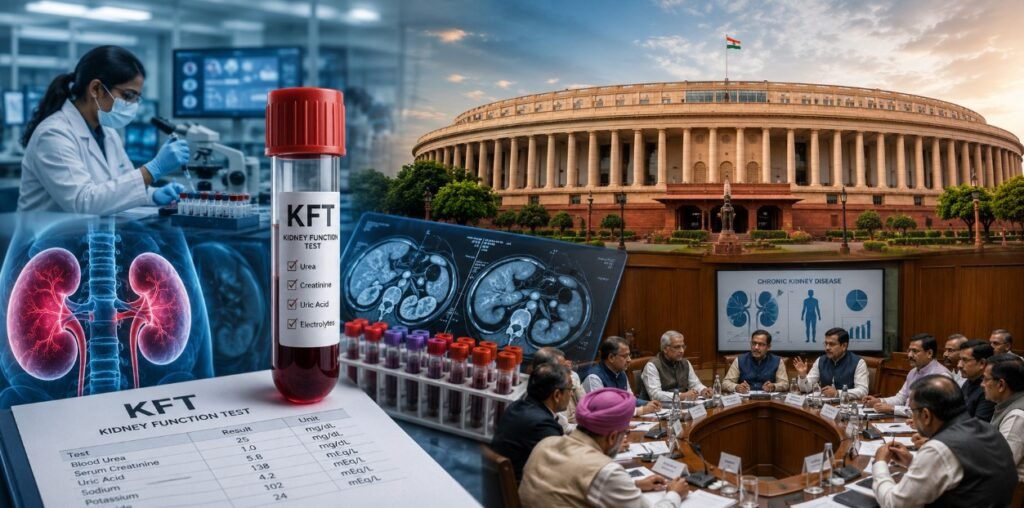
NEW DELHI — A parliamentary committee has recommended that every Indian aged twenty and above undergo a mandatory kidney function test twice a year, a proposal that would convert kidney screening from something people seek out into something the health system delivers on a schedule.
The recommendation sits in the 177th report of the Department-related Parliamentary Standing Committee on Health and Family Welfare, headed by Prof. Ram Gopal Yadav, presented to the Rajya Sabha and laid before the Lok Sabha on 7 August. It runs to 66 recommendations on the prevalence, prevention, diagnosis, treatment and management of chronic kidney disease.
The scale of what is being proposed is unusual for Indian public health, which has historically screened for disease in defined risk groups rather than across an entire adult population.
What the committee actually recommended
The core text is specific about who pays and under which programme.
“The committee recommends that the ministry institutionalise regular annual CKD screening of all high-risk individuals and mandatory biannual kidney function test of all persons aged 20 years and above,” the report said, specifying that it should be free for people below the poverty line and at nominal cost for others under the NP-NCD, to enable early diagnosis and delay progression.
NP-NCD is the National Programme for Prevention and Control of Non-Communicable Diseases, the existing framework through which India screens for hypertension, diabetes and common cancers at Ayushman Arogya Mandirs.
The screening itself would assess kidney function using estimated glomerular filtration rate, or eGFR, together with urine albumin or protein testing, plus referral and follow-up. Those are two cheap, widely available tests. Neither requires a specialist to order.

The single most consequential line in the report
Buried among the 66 recommendations is one that would change Indian diagnostics almost immediately if adopted, and it costs the system nothing.
The committee recommended that every serum creatinine test performed in public and private laboratories should automatically report an eGFR value, preferably calculated using the CKD-EPI equation, without a separate request from the doctor and without additional charge to the patient.
Serum creatinine is already one of the most commonly ordered blood tests in India, bundled into routine health packages sold by every diagnostic chain. On its own the number is hard to interpret, because what counts as normal varies with age, sex and body size. A reading that looks unremarkable in a large young man can indicate significant impairment in a small older woman.
eGFR converts that raw figure into a percentage of expected kidney function, which is the number that actually tells a clinician whether something is wrong. The calculation is arithmetic performed on data the laboratory already holds. Making it automatic would surface a large volume of undiagnosed impairment from tests being run today, at effectively zero marginal cost.
Almost every other recommendation in the report requires new infrastructure. This one requires a software update to laboratory information systems.
Why a disease with no symptoms needs a schedule
The committee describes CKD as a silent disease throughout, and the description is medically accurate. Kidneys continue working after losing a large share of their capacity, so damage accumulates without producing symptoms until function has fallen a long way. Many patients present for the first time at a stage where dialysis or transplantation is the only option.
The report is blunt about why the current approach fails. It calls the existing system an occasional approach intervention and says it “does not ensure periodic screening of all high-risk individuals,” because it depends almost entirely on people walking into a health centre on their own initiative.
For a condition with no early symptoms, waiting for people to present is the same as waiting for the disease to advance.
Who the committee counts as high risk
The panel identified diabetes and hypertension as the principal drivers, together accounting for the majority of CKD cases in India. Both are conditions India already screens for under NP-NCD, which means part of the referral pathway exists.
The wider priority list covers adults over sixty, people with a family history of kidney disease, obesity or tobacco use, and those with a history of acute kidney injury, recurrent urinary tract infections, recurrent kidney stones, or prolonged exposure to nephrotoxic medicines including non-steroidal anti-inflammatory drugs.
That last category deserves attention. NSAIDs are sold across India with minimal restriction and taken routinely for pain, fever and inflammation, often for long periods without medical supervision. The committee also flagged unsupervised use of herbal remedies, uncontrolled hypertension and alcohol consumption as factors amplifying the burden.
Heat, fields and a disease with no known cause
The report devotes serious attention to chronic kidney disease of unknown etiology, or CKDu, which it says accounts for roughly sixteen per cent of patients and predominantly affects younger, low-income agricultural workers. It also notes a high incidence of CKDu and chronic interstitial nephritis in rural communities.
The finding that connects it to India’s climate trajectory is stark. The report states that “chronic heat stress and recurrent dehydration among outdoor labourers have been identified as key drivers of CKD,” citing studies that associate every one degree Celsius rise in temperature in endemic regions with roughly an eight per cent increase in CKD risk.
Researchers are also examining exposure to organophosphate pesticides and contaminated surface water. If the heat association holds, CKDu becomes a climate adaptation problem as much as a medical one, and one that falls on farm labourers and construction workers who have no practical way to avoid the exposure. India already loses working hours to heat stress at a scale few countries match, and this is what that looks like inside a body.
The numbers driving the urgency
India adds roughly 2.2 lakh new patients with end-stage kidney disease every year, generating demand for about 3.4 crore additional dialysis sessions annually. Annual haemodialysis sessions under the Pradhan Mantri National Dialysis Programme have risen from about 25 lakh to 70 lakh over five years.
That is a near-tripling of a programme that treats people whose kidneys have already failed. The committee’s argument is that India cannot keep expanding replacement therapy fast enough to meet demand generated upstream, and that screening is the cheaper intervention.
The report puts it directly: “Screening, therefore, represents one of the most cost-effective public health interventions for reducing the overall burden of CKD.”
What would have to exist for this to work
The committee also recommended a dedicated National CKD Programme modelled on India’s HIV/AIDS programme, a National CKD Registry for surveillance, expansion of home-based peritoneal dialysis for rural and remote patients, an integrated digital CKD framework under the Ayushman Bharat Digital Mission with electronic referral and longitudinal records, stronger nephrology services at district hospitals, mandatory insurance coverage for CKD patients, and a separate national programme for paediatric kidney care.
Screening an adult population twice a year is only useful if the system can absorb what it finds. India has a limited number of nephrologists, heavily concentrated in large cities, and district hospitals frequently have none. A screening programme that identifies impaired kidney function and then has nowhere to refer people produces anxiety rather than treatment, and it produces it at population scale.
Peritoneal dialysis is the committee’s answer to part of that. It can be done at home, does not require a dialysis chair or a technician, and suits patients hundreds of kilometres from the nearest centre. India has been slow to adopt it compared with haemodialysis, largely because the supply chain for the fluid bags is thinner and the training burden falls on families.
These are recommendations, not policy. The health ministry is not bound to accept them, and the committee has proposed a screening frequency more aggressive than most national guidelines anywhere in the world. The automatic eGFR reporting is the piece that could be implemented within months, and it is the piece to watch.