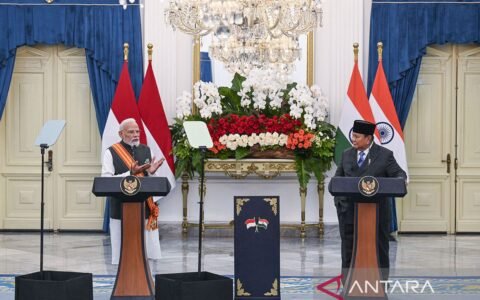
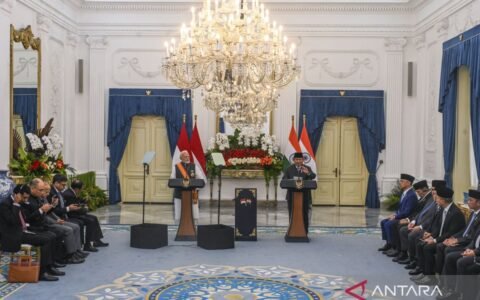
Among the twenty outcomes of Prime Minister Narendra Modi’s July visit to Indonesia, one stood out for being entirely unprecedented: the Indian Institute of Management Bangalore will establish its first overseas campus in Indonesia, at the Singhasari Special Economic Zone in the Malang region of East Java.
The proposal enjoyed visible political backing from the top of the Indonesian government. President Prabowo Subianto openly supported the IIM plan and welcomed a parallel proposal for the Indian Institutes of Technology to set up a branch in the country, ANTARA reported, while also expressing hope that more Indonesian students would study at Indian universities. Prabowo cast the broader relationship in expansive terms, describing his talks with Modi as “a forward-looking, intensive, and prolific meeting covering several strategic issues of mutual concern,” and committing to deepen cooperation “in capacity building in the field of new technology,” as reported by ANTARA — the kind of human-capital language into which an education partnership fits naturally.
A First for India’s Elite Institutes
It marks the first time one of India’s flagship management institutes has committed to a full overseas campus — a step that follows the National Education Policy’s push to internationalise Indian higher education, which has already seen IIT Madras open in Zanzibar and IIT Delhi in Abu Dhabi. Exporting the IIM brand to Southeast Asia’s largest economy is a different order of ambition: a bid to shape the region’s management talent through Indian institutions rather than the Australian, American or Chinese universities that have long dominated the market.
Rooted in a Civilisational Frame
Modi placed the education push inside a much older story. Addressing the Indonesian Parliament, he recalled that for over two millennia the Indian Ocean has connected the two nations through the exchange of ideas, commerce, culture and faith, describing India and Indonesia as “natural and trusted partners,” as reported by Asia News Network. The two governments named 2026-27 the Tagore-Dewantara Year, honouring the Indian poet Rabindranath Tagore and Indonesia’s education pioneer Ki Hajar Dewantara — a framing that binds the campus to a century of intellectual exchange.
The education agreement did not travel alone. Modi and Prabowo also inaugurated a joint restoration project at the Prambanan temple complex near Yogyakarta, one of Indonesia’s most important Hindu heritage sites, and agreed to integrate India’s UPI payments system with Indonesia’s networks — a cluster of people-to-people outcomes that officials were keen to present alongside the missile deals.
The campus also slots into a specific plank of Modi’s proposed Ganga-Mahakam Vision: the idea that the two countries should learn directly from each other’s growth stories. Addressing Parliament, Modi called for the two nations to “share their development pathways with each other” and to jointly strengthen the voice of the Global South, the MEA said, tying the synergy between his Viksit Bharat 2047 goal and Indonesia’s Golden Indonesia 2045 vision to concrete cooperation in education, skills and emerging technologies. An IIM campus in East Java is that abstraction made physical — a place where the “development pathway” is literally taught.
What Happens Next
Timelines, programme offerings and fee structures are yet to be announced, and campus projects of this kind typically take several years from agreement to first intake. Indonesian officials have also cautioned, as they did across the visit, that signed documents do not by themselves guarantee delivery — implementation is the harder half.
But the signal is unambiguous. India’s engagement with Southeast Asia is no longer only about ships, missiles and minerals. It is about lecture halls too — and about who gets to educate the managers and engineers who will run the region’s economies a generation from now. For decades, ambitious Indonesian students looking abroad for a business or engineering education have turned to Australia, the United States, Singapore or, increasingly, China. An IIM campus on Indonesian soil offers a different option, and plants Indian academic soft power in the heart of ASEAN’s largest economy — a form of influence that compounds quietly over decades and long outlasts any single defence contract.