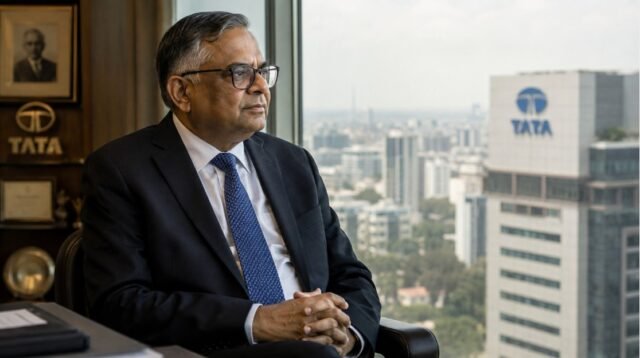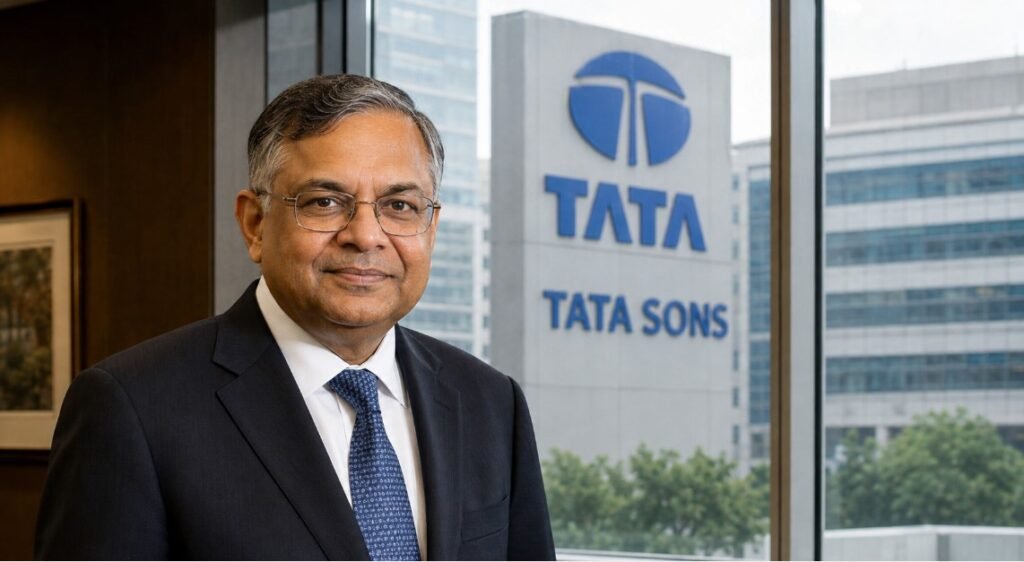
MUMBAI — Who is N Chandrasekaran, the man who announced on August 12 that he will leave the chairmanship of Tata Sons in February? The short answer is the most unlikely person ever to hold the job, and the one who held it longest since Ratan Tata.
He was born on June 2, 1963, in Mohanur, a small town in the Namakkal district of Tamil Nadu, into a farming family. He has two elder brothers and three elder sisters. His early schooling was at a Tamil-medium government school in the town. Every degree he holds was earned in India.
The farm he was expected to run
The expectation was that he would take over the family land, where his father grew rice, sugarcane and bananas. After finishing a bachelor’s degree in applied sciences at the Coimbatore Institute of Technology, he went home and tried it.
It did not take. His father, who had abandoned a legal career to run the farm after his own father died, told him to follow the computers instead. In 1986 he completed a master’s in computer applications at the Regional Engineering College in Tiruchirappalli, now NIT Trichy.
At 24 he joined Tata Consultancy Services as an intern. Two months in, TCS offered him a permanent job as an engineer. He formally joined in 1987 and never worked for another company.
Thirty years at one address
Between 1987 and 2002 he did roughly everything TCS did, including ten years posted at client sites in the United States, the United Kingdom and Sweden. He became chief operating officer and executive director in 2007.
The succession to the top job at TCS was decided long before it was announced. S Ramadorai, the outgoing chief executive and the man Chandrasekaran still calls his mentor, had identified him more than a decade earlier. Inside the company the joke was that TCS stood for Take Chandra Seriously.
He became chief executive and managing director in 2009. TCS consolidated its position as India’s most valuable company and its largest private sector employer under him, with consolidated revenue growing close to fivefold from Rs 27,812 crore in 2009 to fiscal 2016.
The job nobody wanted in 2017
Tata Sons removed Cyrus Mistry as chairman on October 24, 2016. Ratan Tata returned as interim chairman, litigation followed in every direction, and roughly $9 billion came off the combined market value of the group’s main companies.
Chandrasekaran joined the Tata Sons board that same month. On January 12, 2017, a five-member selection committee that included Ratan Tata unanimously recommended him from a field of more than a dozen names. The board said he had shown “exemplary leadership” at TCS.
Vijay Singh, the former bureaucrat and non-executive director who sat on the board that ratified the choice, gave the plainest explanation of why. “He stood out both within the group and outside,” he said.
He took charge on February 21, 2017. He was the first non-Parsi to hold the post and the first chairman with no blood or marital connection to the Tata family in the group’s 150-year history.
His own assessment on appointment was characteristically flat. “We are at an inflection point,” he said, and set about ending the court cases.
What he built
The strategy had a name, One Tata, and three words attached: simplification, scale, synergy. In practice it meant fewer companies doing bigger things together.
The signature deal was Air India in 2022, bought back from the government seven decades after JRD Tata founded it and lost it to nationalisation. It was the most symbolic acquisition in modern Indian business and the most operationally punishing, and it is still losing money.
He took the group into semiconductors, backed electric vehicle batteries, restructured Tata Steel’s European exposure through the ThyssenKrupp talks, exited the telecom business, listed Tata Technologies and prepared Tata Capital for market. He chaired Tata Steel, Tata Motors, Tata Power, Indian Hotels, Tata Consumer Products, Jaguar Land Rover and Air India along the way, and served as president of the Indian Institute of Science and chairman of IIM Lucknow.
Between 2017 and 2026 group revenue nearly doubled and profit tripled. Tata Sons now promotes more than 100 operating companies with aggregate annual revenues above $150 billion.
He was awarded the Padma Bhushan in 2022 and an honorary knighthood, KBE, in 2026.
The roles accumulated outside the group too. He served on the board of the Reserve Bank of India, chaired the industry body NASSCOM, co-chaired the US India CEO Forum and holds honorary doctorates from Aligarh Muslim University, NIT Tiruchirappalli and Nyenrode Business Universiteit in the Netherlands.
The running
The detail colleagues reach for first is the marathons. He runs long distances regularly, has completed several international races, and often starts the day with a run before anything else.
He has been direct about why it matters to the job. “Running has made me more observant, calmer, and taught me to persevere,” he told the Financial Times.
Those who work with him describe someone who reads, travels and spends time with his family rather than courting attention. He lives in Mumbai with his wife Lalitha. They have one son, Pranav.
The crisis that defined the second half
On June 12, 2025, an Air India Dreamliner bound for London Gatwick crashed moments after taking off from Ahmedabad, killing 260 people on board and on the ground. Chandrasekaran heard about it in his Mumbai office.
He told the Tata Sons board a dedicated trust would be created with Tata Trusts to provide long-term support to the families, and interim compensation reached nearly two-thirds of them within weeks. It was the hardest thing the group faced in his decade and it involved the airline he had personally fought to buy.
What he is leaving behind
He goes because one director would not vote for him and six months of silence followed, a standoff Diurna has reported in detail. He stays until February 20, 2027.
“Leading Tata Sons over the past decade has been a great honour,” he wrote to the board, describing 40 years at the group as an immensely satisfying opportunity.
The unusual thing about the career is not the ascent. Indian business has produced other men who started with nothing. It is that he did all of it inside one institution, was chosen by that institution’s patriarch to succeed a member of the founding family’s orbit, and is now leaving because the same institution’s owners could not agree on him. The farm boy from Mohanur ran the Tata group for a decade. The Tatas will now decide whether they want another one.