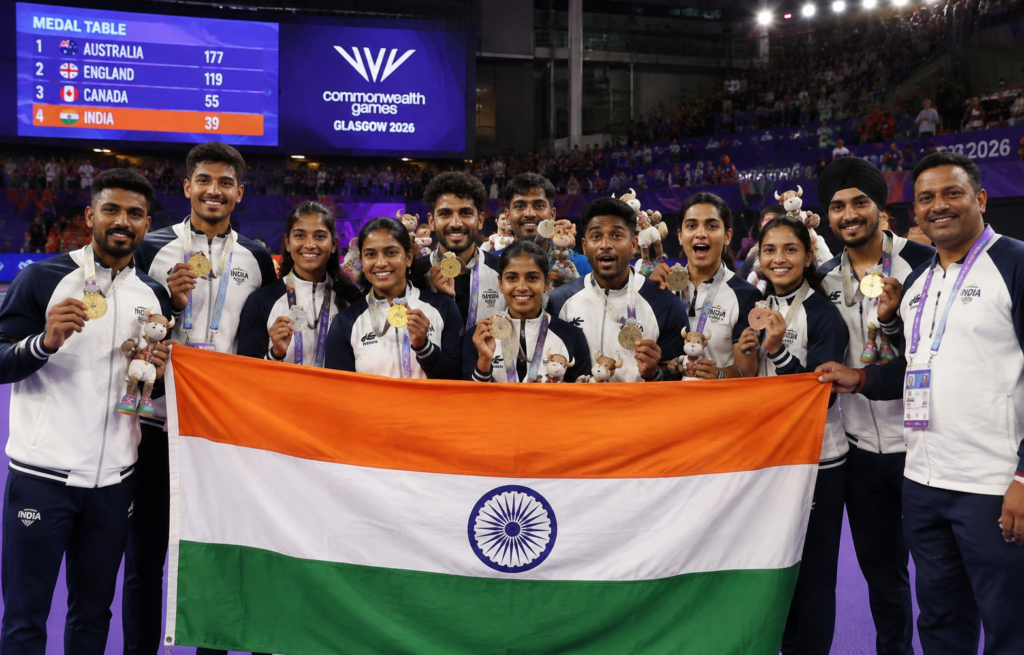
GLASGOW — India finished the Commonwealth Games 2026 fourth in the medal table with 39 medals, and left Glasgow holding the Commonwealth flag as hosts of the 2030 centenary edition in Ahmedabad.
The tally was 13 gold, 17 silver and nine bronze. It came from a sharply reduced sports programme, which makes the number more notable than it first appears.
Where the medals came from
Boxing and judo carried the final week. Preeti Pawar beat Canada’s Scarlett Savannah Delgado in the women’s 54kg final for gold, and Jaismine Lamboria took the women’s 57kg title against Northern Ireland’s Michaela Walsh on the same day. Jadumani Singh lost the men’s 55kg final to Australia’s Jye Dixon and took silver.
Judo produced the historic result. Asmita Dey became the first Indian judoka to win a Commonwealth Games gold, taking the women’s -48kg title, with Harsh Singh doubling the tally soon after and Yamini Mourya adding silver.
Athletics delivered through the middle of the Games. Praveen Chithravel won silver and Selva Prabhu Thirumaran bronze in the men’s triple jump. Neeraj added silver, Tejaswin and Yash Vir took bronze, and Murali Sreeshankar and Basil collected silvers earlier in the week.
India took 16 medals on August 1 alone, the single heaviest day of the campaign.
The number that changed the story
Eight of India’s 13 golds were won by women. The Indian Olympic Association made that the framing of its own campaign review, and the arithmetic supports it: a majority of the country’s gold medals at a Commonwealth Games now come from women’s events.
Lamboria carried the tricolour at the closing ceremony, which is its own comment on where the campaign’s centre of gravity sat.
The final day brought no additions. Ishroop Narang lost the women’s -78kg judo bronze contest to Canada’s Coralie Godbout on a yuko, and Lisha Das competed in the women’s C4-C5 1000m time trial. Avtar Singh, the Rio 2016 Olympian, headlined the men’s -100kg judo challenge.
The handover
The Commonwealth Flag passed to India at the Hydro in the presence of Neeraj Chopra and Indian Olympic Association president P.T. Usha. India’s cultural showcase ran 20 minutes, led by Shankar Mahadevan and Manushi Chhillar, built around the theme of Vasudhaiva Kutumbakam.
Glasgow 2026 chair George Black wished Ahmedabad success in hosting the centenary Games.
Ahmedabad was formally awarded the 2030 Games in November 2025, approved by delegates from 74 Commonwealth nations at the General Assembly in Glasgow. It will be the second time India hosts, after Delhi in 2010.
What Ahmedabad has promised
The bid was submitted jointly by the Government of India, the Government of Gujarat and the Commonwealth Games Association of India.
Sports Minister Mansukh Mandaviya framed the award as a step in a longer plan. “It is a big boost to the Union Government’s vision of hosting the 2036 Olympic Games,” he said, describing the decision as a prestigious moment for a country trying to become a sporting power by 2047.
P.T. Usha set out what the organisers say the 2030 edition will be. “The Centenary Commonwealth Games in Ahmedabad will be Games for the Future: built on sustainability, inclusivity, and innovation,” she said.
Commonwealth Sport president Dr Donald Rukare explained the choice in terms of what India offers the movement. “India brings scale, youth, ambition, rich culture, enormous sporting passion and relevance,” he said.
Amit Shah, when the recommendation was confirmed, framed it as vindication of a decade of policy. “It is a grand endorsement of Prime Minister Narendra Modi’s relentless efforts to place India on the world sports map,” he said, arguing that world-class infrastructure and a nationwide talent pool had made India a serious sporting destination.
Gujarat Chief Minister Bhupendra Patel called it a proud moment for the state and the country.
What Glasgow cost, and why the programme shrank
The Games India just competed in nearly did not happen. Victoria withdrew as host of the 2026 edition on cost grounds, leaving Commonwealth Sport scrambling, and Glasgow stepped in with a deliberately reduced programme built around venues that already existed.
That is the context for the 15-to-17 sport range now proposed for Ahmedabad. The movement is trying to prove the Games can be hosted without bankrupting a city, and every host from here is expected to work within that constraint.
For India the constraint cuts both ways. A smaller programme is cheaper to stage. It also means fewer medal events, and India’s strength has historically come from breadth across shooting, wrestling, weightlifting and boxing rather than dominance in any one.
Commonwealth Sport has said the 2030 edition will feature 15 to 17 sports, with the full programme to be finalised next year.
The problem the programme creates
That range is the detail Indian sport should watch. Glasgow 2026 ran a curtailed programme, and India’s 39 medals came despite the absence of disciplines that have historically been its strongest sources, including shooting and wrestling.
A host has some influence over which optional sports appear. If Ahmedabad restores shooting and wrestling, India’s 2030 tally will look very different from Glasgow’s, and comparisons between the two will not be measuring improvement.
The reverse risk is real too. A 15-sport programme in 2030 leaves little room, and Commonwealth Sport has been shrinking the Games deliberately to make hosting affordable after Victoria withdrew from the 2026 edition on cost grounds.
What it means for India
Ahmedabad 2030 is being positioned openly as a rehearsal for a 2036 Olympic bid, and that is the real stake. The city has spent a decade building sports infrastructure, and the Commonwealth Games is the test of whether it can run an international multi-sport event at scale.
The medal performance in Glasgow gives that argument a foundation. Fourth place, 39 medals, historic firsts in judo, and a women’s contingent producing most of the golds is a stronger platform than the 2022 campaign in Birmingham offered.
What it does not settle is depth. India’s medals remain concentrated in a handful of disciplines, and a Commonwealth Games with a reduced programme is a gentler test than an Olympic cycle. The four years to Ahmedabad are the window to widen that base.