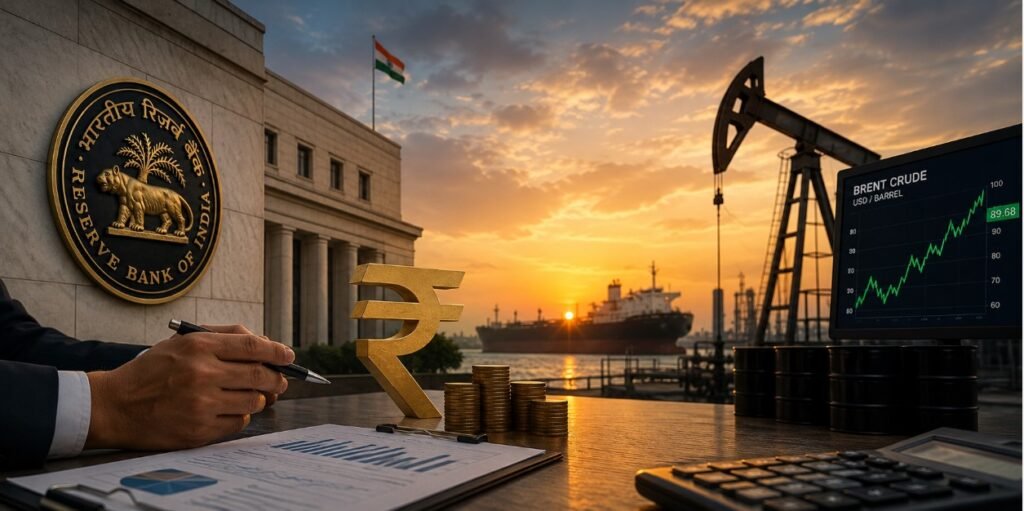
MUMBAI — Six days after the Reserve Bank of India held rates and called itself neither dovish nor hawkish, the case for an RBI rate hike has been rebuilt by a market the central bank does not control.
Brent crude has climbed more than ten per cent in a week and is trading back towards ninety dollars a barrel, after talks to reopen the Strait of Hormuz went backwards. The rupee, which settled at 95.30 to the dollar on Monday, was expected by traders to open in a 95.35 to 95.40 range on Tuesday, with the RBI intervening again to slow the decline.
Neither number on its own forces the Monetary Policy Committee to move in October. Together they undo the assumption the August policy was built on.
What the RBI actually said on 5 August
The MPC held the repo rate at 5.25 per cent, unchanged since December 2025, and kept its neutral stance. The Standing Deposit Facility stayed at 5 per cent and the Marginal Standing Facility and bank rate at 5.5 per cent. The vote was unanimous.
The committee projected consumer price inflation at 5 per cent for 2026-27, with a quarterly path of 4.7 per cent in the second quarter, 5.9 per cent in the third and 5.5 per cent in the fourth. Real GDP growth was projected at 6.7 per cent, with quarterly readings of 7 per cent, 6.4 per cent, 6.5 per cent and 6.8 per cent.
Governor Sanjay Malhotra was clear that the peak was ahead. “Headline inflation is expected to rise further in the near term. It is expected to peak in Q3 of this year, primarily again due to food and fuel,” he said, adding that it should moderate thereafter.
He was equally clear about where the uncertainty came from. “Global oil prices have also remained highly volatile, with sharp two-way movements triggered by geopolitical developments,” he said, noting that this blurs the near-term inflation outlook and that El Nino effects on the distribution of rainfall remain a major risk.
The policy was, in effect, a decision to wait for the fog to clear. “There is a need for greater clarity to emerge, especially regarding inflation, its path and composition before taking any policy action,” Malhotra said.
The forecast that oil is now testing
A 5.9 per cent third-quarter peak is uncomfortable but tolerable. It sits inside the upper tolerance band of six per cent, and a central bank can look through a peak it expects to fade. That is what neutral means in practice.
What breaks the logic is not a higher peak but a longer one. Fuel inflation transmits into Indian consumer prices with a lag, through transport, then through food supply chains, then through the goods that ride on both. June CPI came in at 4.38 per cent, the highest since December 2024, with transport inflation at 4.31 per cent after a period of near-flat readings. That is the delayed energy shock arriving. Food inflation over the same month rose to 5.32 per cent.
Malhotra named the mechanism that worries the committee. “The risk of second-round effects from higher food, fuel and other input costs translating into broader-based inflation persists,” he said.
Second-round effects are what turn a supply shock into a monetary problem. A one-off jump in diesel prices is arithmetic. Wage demands and pricing decisions taken on the assumption that prices will keep rising are not, and those are the only kind of inflation a policy rate can actually address. Fast-moving consumer goods companies have already begun passing through single-digit price increases, which is the earliest visible sign of the transition.
The retail price gap nobody wants to close
There is a buffer in the system that also functions as a delayed bill. Retail petrol and diesel prices have been held at 108.7 and 98.1 rupees a litre respectively, unchanged through June and July, and domestic cooking gas prices have been steady too.
Holding pump prices while crude rises keeps the CPI print lower than the underlying cost picture. It does not make the cost go away. It parks it on the balance sheets of the state-owned oil marketing companies, which absorb the difference until the government decides who pays.
The three routes out are all unattractive. Raising retail prices moves the cost straight into the inflation number the RBI is trying to manage. Cutting excise duty moves it into the fiscal deficit. Leaving it with the oil companies moves it into their capital expenditure, their dividends to the government and eventually their borrowing.
Every month crude stays near ninety dollars, that decision gets more expensive to defer. Upstream producers do gain: ONGC more than doubled its first-quarter profit on higher crude realisations. That helps the exchequer through dividends and does nothing for the household buying diesel.
The rupee is doing two jobs at once
India imports roughly eighty-five per cent of its crude, and that import bill is settled in dollars. A weaker rupee raises the cost of every barrel independently of the barrel’s price, which is why the currency and the commodity compound rather than simply add.
The RBI’s intervention has been keeping the fall orderly rather than stopping it. The rupee traded in a 95.10 to 95.30 range across three sessions with heavy dollar demand around those levels, and briefly firmed to 94.89 ahead of the August policy before giving that back.
Defending a currency and cutting rates are opposing operations. Selling dollars drains rupee liquidity from the banking system, tightening conditions at the short end regardless of where the repo rate sits. In that sense some tightening is already happening, delivered by the foreign exchange desk rather than the MPC.
The RBI has also been repairing the transmission end of the system. Its plan to harmonise and standardise how banks and non-banks price loans, which Diurna set out in our explainer on the October rules, is the plumbing that determines whether any rate decision reaches borrowers at all. Announcing a rate change into a fragmented pricing system is how central banks discover their decisions did not travel.
The external accounts carry the same strain. A sustained ten dollar rise in the crude price adds roughly fifteen billion dollars a year to India’s import bill on current volumes, which widens the current account deficit and increases the dollar demand the central bank is trying to meet. Foreign portfolio investors, meanwhile, tend to reduce Indian debt and equity exposure when the currency is depreciating, because the currency loss eats the return before the asset does. That is the loop the RBI is standing in the middle of.
What the October meeting is really deciding
The MPC next meets from 5 to 7 October. By then it will have July, August and September inflation data, the outcome of the monsoon, and roughly two more months of evidence on whether Hormuz reopens.
A hike is not the base case. Growth at 6.7 per cent is solid but not overheating, and raising rates to counter an imported energy shock punishes domestic demand for something domestic demand did not cause. The textbook answer is to look through it.
The textbook answer holds only while inflation expectations stay anchored. If the third-quarter peak comes in above 5.9 per cent, or if the rupee slides past levels the RBI is willing to defend, the committee will be choosing between two bad options rather than deciding whether to act.
Not every analyst reads the risk the same way. “Food and fuel inflation continue to be a variable that will be closely watched,” said Vivek Iyer, partner at Grant Thornton Bharat, pointing to agricultural dependence on climate and to external supply chain pressure on energy security, and arguing that government action on those two variables is what frees the RBI to focus on growth.
That is the honest summary. The decision in October will be shaped less by the MPC than by the monsoon and by a negotiation in the Gulf that has no scheduled next round.