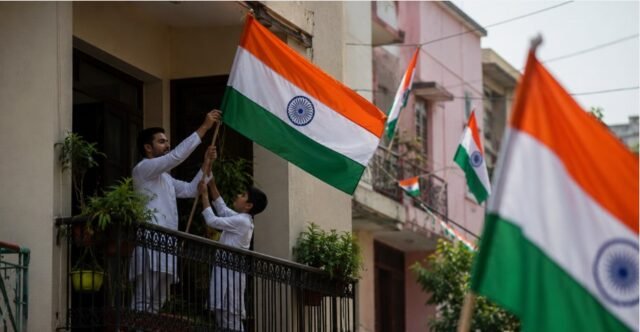
NEW DELHI — The Har Ghar Tiranga campaign began across the country on Sunday and will run until 17 August, in a year when the flag drive has been folded into the 150th anniversary of the national song.
Har Ghar Tiranga 2026 is the fifth edition. It started in 2022 under Azadi Ka Amrit Mahotsav as a request that citizens hoist the Tricolour at home, and it has since become the largest mass-participation exercise the Ministry of Culture runs. What has changed this year is that it now carries a second subject.
Union Culture and Tourism Minister Gajendra Singh Shekhawat launched the campaign in New Delhi on 6 August. This edition, he said, brings together “the National Flag and the National Song in a unique celebration of patriotism.” Randhir Jaiswal, Additional Secretary and spokesperson at the Ministry of External Affairs, and Dr Sachchidanand Joshi of the Indira Gandhi National Centre for the Arts were present.
Vande Mataram at 150
Bankim Chandra Chattopadhyay wrote Vande Mataram on Akshaya Navami, 7 November 1875. It was published in his journal Bangadarshan and later carried into his novel Anandamath. Rabindranath Tagore sang it at the Calcutta session of the Congress in 1896, and from there it moved out of literature and into the freedom movement.
The Union Cabinet approved a year-long commemoration in October 2025. Prime Minister Narendra Modi opened it in Delhi on 7 November 2025, releasing a commemorative coin and stamp and launching a portal where citizens can upload their own recordings. “Today, millions of people from across the country are connected with us,” he said at the event, marking what he called a historic date.
The commemoration closes on 7 November 2026. That is why August falls inside it, and why the flag campaign and the song campaign have been merged for one Independence Day rather than run separately.
What is new in this edition
Mass singing of the full version of Vande Mataram will be organised across states and union territories during the nine days. Most Indians know the first stanza and stop there, so the Ministry of Culture has produced a five-step online tutorial for the complete rendition, hosted on the campaign website and the Har Ghar Tiranga portal.
The Selfie with Tiranga feature, the most-used part of the campaign since 2022, has been rebuilt to carry the lyrics and tune of the song alongside the photograph. Exhibitions organised under the campaign will trace the history of the composition rather than the flag alone.
Suryapath Tiranga
The genuinely new item is a relay. Under Suryapath Tiranga, Indian missions abroad will hoist the national flag in sequence, beginning at the easternmost post to see sunrise and moving west with the daylight. The Ministry of External Affairs has said embassies and consulates in 54 countries will take part, with the hoistings digitally tracked on 14 and 15 August.
It is a piece of choreography aimed at the diaspora, and it is the first time the campaign has been designed to run outside Indian territory as a single connected event rather than as separate embassy functions.
The numbers the ministry works with
Shekhawat has described the exercise in the same terms since 2025. It is “more than a campaign,” he said at last year’s launch, calling it “an emotional movement that unites 1.4 billion Indians,” and the Tricolour “a living symbol of our democracy and independence.”
The participation figures are large and self-reported. More than ten crore selfies were uploaded to the portal during the 2025 edition. Over five lakh young volunteers registered that year to canvass in their neighbourhoods. For the Vande Mataram commemoration, the Ministry of Culture put registered participation across its first two phases at more than nine crore.
This year’s campaign carries more than 200 cultural programmes. Independence Day on 15 August will be India’s 80th.
The rules people usually get wrong
The Flag Code of India was amended in 2021 and 2022 to make the campaign possible. Polyester and machine-made flags were permitted in December 2021, having previously been restricted to hand-spun and hand-woven cloth. In July 2022 the Code was changed again to allow a flag displayed in the open, or on the home of a member of the public, to be flown at night as well as by day.
Both amendments were controversial. Khadi producers in Karnataka objected to the polyester change, which cut them out of a market they had held by law. The night-flying rule removed the older requirement that the flag be lowered at sunset, a discipline many households had learned in school.
The other rule that trips people up is disposal. A damaged or soiled flag is to be destroyed in private, as a whole, preferably by burning. It is not to be thrown away, and it is not to be reused as covering, drapery or clothing. The volume of flags a nine-day campaign puts into circulation makes that a practical question rather than a ceremonial one.
The dates around it
The campaign opens on 9 August, which is August Kranti Diwas, the anniversary of the Quit India resolution of 1942. Modi and Vice President C P Radhakrishnan both posted tributes on Sunday morning to those who took part in that movement, Modi noting that Mahatma Gandhi’s call had given the freedom struggle fresh energy.
On 14 August the country observes Partition Horrors Remembrance Day, with silent marches, exhibitions and documentary screenings planned across states, and larger commemorations in Delhi, Kolkata and Amritsar. The nine-day window therefore runs from a memory of resistance through a memory of loss to a celebration of independence, in that order.
What it is asking of people
A flag campaign is easy to join and easy to measure. A song is harder. Hoisting a Tricolour takes a minute; learning five stanzas of Sanskritised Bengali does not, and the tutorial exists because the ministry knows it.
There is a second difficulty the tutorial cannot solve. The full poem has six stanzas, and only the first two were adopted as the national song in 1950, when the Constituent Assembly gave Vande Mataram equal honour with Jana Gana Mana while stopping short of making it the anthem. The later verses carry imagery that has been contested since the 1930s, when the Congress itself decided to sing only the opening portion at its sessions.
The campaign has stayed with the accepted text. Mass singing events are built around the full version as it is officially rendered, which runs to about a minute and a half, not the whole poem.
Whether the singing target is met will be visible in the uploads to the portal rather than in the selfie count. That is the number worth watching when the campaign closes on 17 August.