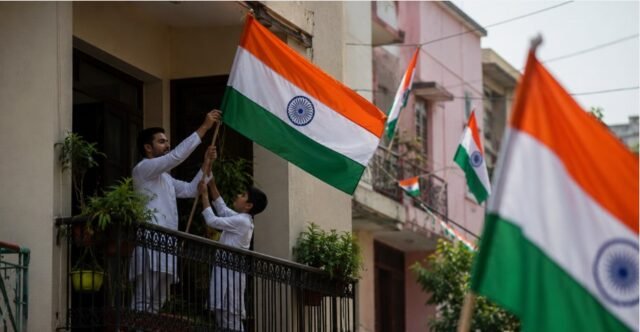
NEW DELHI — India marks 84 years since the Quit India Movement this weekend, and both Houses of Parliament paused on Friday to remember it, in a week when the same chambers had been unable to conduct business for days.
The resolution was passed at Bombay’s Gowalia Tank Maidan on August 8, 1942. Gandhi and the senior Congress leadership were arrested the following morning. What happened after that arrest is the part of the story that gets least attention and matters most.
The tribute in Parliament
Speaker Om Birla paid tribute in the Lok Sabha on Friday morning to the freedom fighters and martyrs of the movement. The Rajya Sabha Chairman made a formal reference in the Upper House, and members observed silence.
The Chairman’s reference described the movement as one of the defining milestones in the country’s freedom struggle. “The clarion call of ‘Do or Die’ inspired millions of Indians across the country to rise above all barriers,” he told the House, recalling that freedom fighters faced severe repression, imprisonment and hardship.
He placed the movement in a direct line to what followed. “Their selfless sacrifices and steadfast resolve strengthened the national movement and paved the way for the country to attain independence in 1947,” the reference said.
The place, and the name it carries now
The venue was Gowalia Tank Maidan in Bombay, a public ground in the Grant Road area that Congress had used before. The AICC session held there on August 8, 1942 passed the resolution in the evening. Gandhi’s speech that night, delivered partly in Hindustani and partly in English, contained the instruction the movement is remembered by.
The maidan is now August Kranti Maidan. A memorial stands on the site. The renaming is one of the few instances where the physical location of a resolution, rather than a battle or a massacre, became the thing commemorated.
What was actually resolved in 1942
The All India Congress Committee met in Bombay in August 1942 against a specific backdrop: the Second World War was going badly for Britain in Asia, Singapore had fallen, and the Cripps Mission had failed to offer anything Congress would accept.
The resolution demanded immediate British withdrawal, not phased transfer or dominion status. One of its key proposals was the formation of an interim Indian government once the British left. It was a sharper demand than anything Congress had put before, and it was made at the moment Britain was least able to concede it.
Gandhi’s instruction to the country was compressed into two words. Do or die. He asked Indians to consider themselves free and to act accordingly.
The line that gets quoted less is the one that mattered constitutionally. Speaking at Gowalia Tank that night, Gandhi told the gathering: “The power, when it comes, will belong to the people of India, and it will be for them to decide to whom it is placed.”
That sentence does something the slogan does not. It settles, before independence was remotely in view, where sovereignty would sit afterwards. Congress was not claiming power for itself. It was asserting that power would pass to the population, which is the principle the Constitution eventually encoded.
The arrests, and what they didn’t stop
The colonial government moved within hours. Gandhi, Nehru, Patel, Azad and effectively the entire Congress leadership were arrested on August 9, 1942, on the calculation that removing the leaders would remove the movement.
It did the opposite. Without a leadership to negotiate through or to restrain the methods used, the movement passed to people who had not been consulted about it. Students walked out of colleges. Workers struck. Peasants attacked railway lines, telegraph wires and police stations across eastern Uttar Pradesh and Bihar. Underground networks ran clandestine radio broadcasts.
Aruna Asaf Ali hoisted the national flag at Gowalia Tank Maidan after the arrests, an act that became the defining image of the phase. Usha Mehta ran the Congress Radio from hidden transmitters. Jayaprakash Narayan escaped from Hazaribagh jail and organised resistance from Nepal.
Mehta’s operation is the one worth dwelling on. She was 22, a student, and she ran a clandestine transmitter that moved between locations in Bombay to stay ahead of detection, broadcasting news the censored press could not carry. The station operated for roughly three months before she was arrested. She served four years.
Ali was 33 and went underground for years afterwards, with a warrant and a reward on her. Narayan’s escape from Hazaribagh, made by scaling the jail wall during Diwali celebrations, turned him into a figure the movement’s younger wing organised around.
The British response was severe: mass arrests, censorship, and force. The movement was suppressed within months by any military measure.
Why it counted anyway
Judged narrowly, Quit India failed. The British did not leave in 1942. The leadership spent most of the remaining war in prison. Congress was banned.
Its significance lies elsewhere. The movement demonstrated that mass resistance in India no longer required Congress to organise it, which changed the colonial administration’s assessment of what governing India after the war would cost. That calculation, more than any single negotiation, shaped what happened in 1947.
It also changed who counted as a participant. The people who kept the movement going after August 9 were students, workers, peasants and women operating without instruction from above. The freedom struggle’s leadership had always been visible. Its base became visible in 1942.
How the day is marked now
August 8 is observed as Quit India Movement Day, with August Kranti Diwas marked on August 9. There is no officially announced national theme. Observance runs mostly through schools and civic institutions: speeches, essays, quizzes, timelines and exhibitions, along with cultural programmes of patriotic songs, skits and poetry.
Delhi has a fuller programme for the 84th. Freedom fighters will be honoured at Rashtrapati Bhavan, followed by a floral tribute at Gandhi’s memorial at Rajghat. The National Archives Museum is holding an exhibition of rare documents from the movement.
Prime Ministers have used the anniversary as a platform. Narendra Modi has previously described the movement in terms of what it started rather than what it achieved. “Their courage lit a spark of patriotism that united countless people in the quest for freedom,” he said in a tribute to those who took part under Gandhi’s leadership.
On the 75th anniversary in 2017 he addressed the nation from the maidan itself and launched the Sankalp Se Siddhi campaign, setting 2022 as its target year.
Gowalia Tank Maidan is now August Kranti Maidan, a name change that records the event on the site itself. A memorial pillar stands there. The Maharashtra government and the Municipal Corporation of Greater Mumbai maintain it as a working public ground, still used for rallies.
What it means for India
There is an awkward symmetry in this year’s commemoration. Parliament observed the anniversary of a movement built on students and ordinary citizens taking to the streets, in the same week that both Houses were paralysed by a standoff over police action against students protesting examination irregularities.
The comparison should not be pushed too far. A colonial administration arresting a national leadership is not the same thing as a democratic government facing a demand that a minister make a statement. The mechanisms available in 1942 and in 2026 are entirely different, and that difference is the achievement being commemorated.
But the commemoration itself carries a specific historical claim worth holding onto: that the movement’s most important phase happened after the recognised leaders were removed from it, driven by people whose names mostly went unrecorded. That is the part the annual speeches tend to compress into a slogan.
The 84th anniversary falls on August 9.