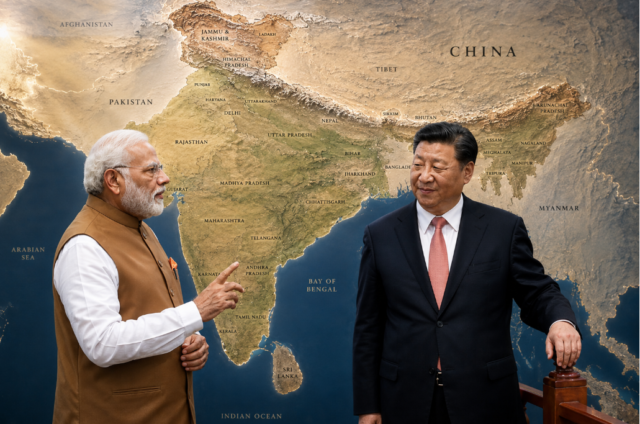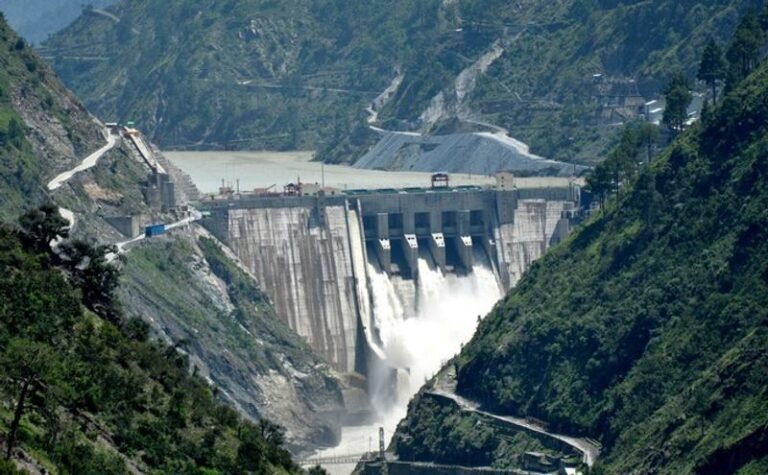
Treaties are suspended with announcements. They are ended with concrete. Since placing the Indus Waters Treaty in abeyance in April 2025, India has been pouring plenty of the latter — quietly converting a diplomatic position into physical infrastructure that no arbitration ruling can undo.
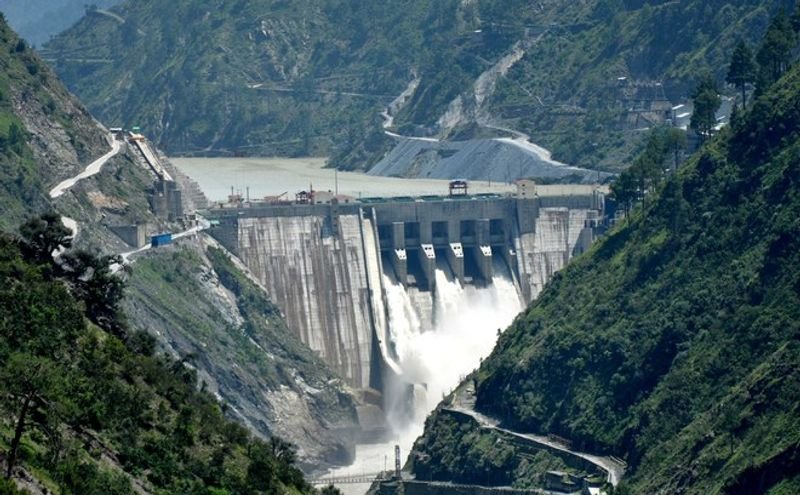
The Project Pipeline
India has steadily ramped up infrastructure development on the western rivers — the Indus, Jhelum and Chenab, allocated largely to Pakistan under the 1960 treaty — since May 2025. Two projects headline the push. The first is the Chenab-Beas Link Tunnel, an inter-basin transfer designed to move Chenab waters toward India’s eastern river system, and ultimately toward the water-scarce states of Punjab, Haryana and Rajasthan. The second is the expansion of the Ranbir Canal, which draws from the Chenab in Jammu and whose enlargement would allow India to divert substantially more water for its own use.
Beyond these headline works sits a broader programme. Bids for new projects have been fast-tracked, and in June 2026 a central panel recommended in-principle forest-diversion approval for the Kirthai-II hydroelectric project — another piece of the western-rivers buildout. India has also floated a feasibility study for a 113-kilometre canal to link the Chenab with the Ravi-Beas-Sutlej system, a project that, if built, would embed the diversion of western-rivers water into permanent national infrastructure.
Alongside the construction, India has stopped sharing hydrological data with Pakistan’s Indus Waters Commissioner, depriving Islamabad of the flow information its irrigation planning has relied on for six decades. The data cutoff is itself a form of pressure: without upstream flow figures, Pakistani planners are left guessing at the timing of the water on which their harvests depend.
The Political Messaging
The infrastructure comes wrapped in unambiguous rhetoric. Home Minister Amit Shah has ruled out any restoration of the treaty and spelled out the diversion plan directly. “We will take water that was flowing to Pakistan to Rajasthan by constructing a canal,” Shah said, adding that “Pakistan will be starved of water that it has been getting unjustifiably,” as reported by Arab News. Water Resources Minister C.R. Patil has put the same aim in even starker terms. “It is certain, not a single drop of water will go [to Pakistan] in the coming years,” Patil told ANI, saying India was “actively working on it” following directives from Prime Minister Modi, as reported by The News. The refrain that not a single drop will flow to Pakistan has become the dispute’s defining phrase — a slogan and a policy statement at once.
That messaging is matched, on the other side, by threats aimed squarely at the projects themselves. Pakistan’s Defence Minister Khawaja Asif has warned that any Indian construction on the Indus would be attacked outright. “Certainly, if they attempt to build any kind of structure, we will strike it,” Asif said on a Geo News programme, as reported by The Tribune — a threat that turns every tunnel and canal from an engineering project into a potential flashpoint.
Capability Versus Declaration
Engineering reality tempers the rhetoric on both sides. Fully stopping the western rivers would require storage and diversion capacity measured in decades of construction, not months of political will, and the recent Court of Arbitration award on pondage — which India rejects — underscores how the treaty was designed precisely to prevent such control. India cannot, today, turn off the Chenab even if it wished to.
But as analysts repeatedly note, India does not need to stop the rivers to matter. Even current and near-term infrastructure enables the manipulation of timing — the difference between water arriving in Pakistani canals during the sowing window or after it, between a full harvest and a failed one. Pakistan’s three formal complaints about abrupt Chenab flow variations suggest the effects are already being felt at the margins, well before any of the large projects are complete.
The Enforcement Gap Cuts Both Ways
What makes India’s infrastructure strategy so potent is the mismatch between legal and physical facts. Pakistan can win awards; it cannot pour them into a riverbed. India can lose awards; it can still dig a tunnel. The tribunal in Europe and the excavators in Jammu operate in separate universes, and only one of them moves water. Every completed structure narrows Pakistan’s options and widens India’s, regardless of what any court has declared.
There is a real risk in this approach, and it is not primarily legal. It is the strike threat. If Pakistan’s leadership concludes that a specific dam or canal crosses a red line, the dispute could escalate from concrete and paperwork to something far more dangerous — which is why every groundbreaking on the western rivers carries a strategic weight far heavier than its cost sheet.
Who Actually Gains Inside India
The strategy has a domestic constituency that is easy to overlook amid the India-Pakistan framing. The states that stand to receive diverted western-rivers water — Punjab, Haryana and Rajasthan — are among India’s most agriculturally significant and, in Rajasthan’s case, its most water-stressed. For decades, the treaty’s allocation meant that western-rivers water India was technically permitted to use flowed largely unused into Pakistan, because the infrastructure to capture and redirect it did not exist. The current programme is, in part, an effort to finally build that capture capacity and put Indian-share water to Indian use.
That reframing matters politically. It allows New Delhi to present the projects not as a hostile act of deprivation but as the belated exercise of rights it always held — optimising its share of both the eastern and western rivers rather than seizing Pakistan’s. Whether Islamabad accepts that distinction is another matter; from downstream, the effect on the water reaching Pakistani fields is the same regardless of how the intent is described.
The Timeline Reality
None of this is fast. Inter-basin transfers, link canals and large hydroelectric projects are among the most complex civil works a state can undertake, tangled in forest clearances, seismic-zone engineering in the Himalayan foothills, financing and construction schedules that stretch across years. The Kirthai-II clearance recommendation in June 2026, more than a year into the abeyance, is a reminder of how slowly even approved projects move. India’s strategy, then, is not a switch to be flipped but a ratchet to be turned — each clearance, each completed segment, each expanded canal tightening the position incrementally and, crucially, irreversibly.
The Long Game
For now, India is betting that facts on the ground beat findings on paper. Whatever courts rule and conferences declare, the future of the Indus basin is being decided in Jammu — one cubic metre of concrete at a time. The declarations are loud, but it is the construction that will prove decisive.