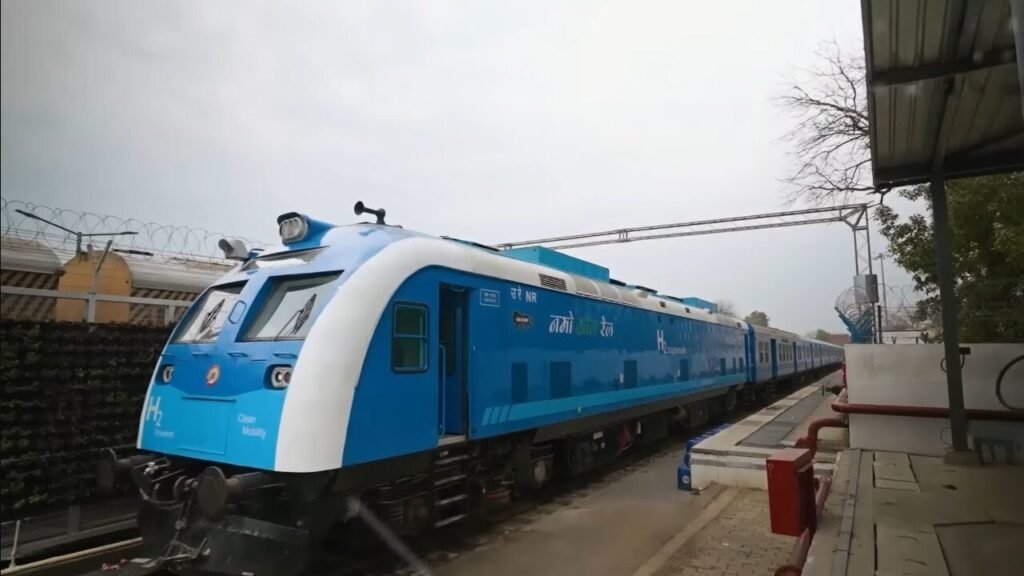
India’s first hydrogen-powered passenger train began running on 17 July, flagged off by Prime Minister Narendra Modi at Jind railway station in Haryana and named NaMo Green Rail. It runs the roughly 89-kilometre Jind–Sonipat section under Northern Railway, making two round trips a day for a total of 356 kilometres.
Modi described it as a new global benchmark, and said India had surpassed several other nations still testing the technology.
The engineering is real and the achievement is not trivial. The claims around it require more care than they have generally received, and the most interesting questions about the project are ones nobody asked at the launch.
What was actually built
The trainset has ten coaches — two hydrogen fuel-cell power cars at either end and eight non-air-conditioned passenger cars — with capacity for close to 2,600 passengers and 682 seats. Officials describe it as the largest-capacity hydrogen train in operation anywhere, which appears to be accurate: the European and Japanese hydrogen trainsets in service are considerably smaller.
Design speed is 110 kmph. Operating speed on the route is 75 kmph.
The train was manufactured at the Integral Coach Factory in Chennai and integrated by Medha Servo Drives in Hyderabad, to specifications framed by the Research, Design and Standards Organisation. The fuel-cell stacks — the component that actually does the work — come from Ballard Power Systems of Canada.
That last detail matters for how the achievement is described. “Designed, engineered and integrated in India” is the official formulation and it is precise: the trainset design, coach manufacture and systems integration are Indian, and the fuel cell technology is imported. Both halves of that sentence are true and the second half tends to disappear from coverage.
Supporting infrastructure at Jind includes a hydrogen production, storage and refuelling facility producing 420 to 430 kg per day via electrolysis, with storage capacity of 3,000 kg and a dedicated 11 kV supply. Safety systems cover hydrogen leak and flame detection, with regulatory clearance from the Petroleum and Explosives Safety Organisation.
The train consumes roughly 300 kg of hydrogen daily at full passenger load.
A discrepancy worth noting
PIB’s approval release of 27 May 2026 described a 10-car train with a 1,200 kW engine operating at a maximum of 75 kmph. Coverage of the July launch, citing officials, described a 3,200-horsepower — approximately 2,400 kW — hybrid propulsion system combining a proton exchange membrane fuel cell with lithium iron phosphate battery storage.
Those two figures have not been publicly reconciled. The 75 kmph maximum operating speed is consistent across both. The most likely explanation is that the 1,200 kW figure refers to fuel-cell output and the 2,400 kW figure to combined fuel-cell and battery peak output in the hybrid configuration, but Indian Railways has not clarified it.
Worth flagging rather than glossing, because the hybrid architecture is itself significant — a fuel cell paired with battery storage is a fundamentally different system from a pure fuel-cell drive, and it is the design most operators have converged on for exactly the reason that fuel cells respond poorly to rapid load changes.
The question the launch did not address
Hydrogen is only a clean fuel if the hydrogen is clean.
The Jind plant produces hydrogen by electrolysis — splitting water using electricity. Railway Minister Ashwini Vaishnaw has described electrolysis as a key element of green hydrogen generation, and it is: green hydrogen is defined by the electrolysis route combined with renewable electricity input.
The plant draws from an 11 kV grid connection. Haryana’s grid, like most of India’s, is predominantly coal-fired. Electricity generated from coal, used to split water, produces hydrogen with a carbon footprint that can exceed simply burning diesel — because electrolysis is energy-intensive and every conversion step loses energy.
The chain runs: coal to electricity, roughly 35 per cent efficient; electricity to hydrogen via electrolysis, roughly 60 to 70 per cent; hydrogen compression and storage, further losses; hydrogen back to electricity in the fuel cell, roughly 50 to 60 per cent. Multiply those and the well-to-wheel efficiency is poor.
None of this makes the project pointless. Demonstrator projects exist to prove technology, and the hydrogen supply can be greened later by contracting renewable power or co-locating solar. But describing the train as a clean-rail benchmark without specifying the electricity source is incomplete, and Indian Railways has not published the carbon accounting.
The production margin is also tight. The plant makes 420 to 430 kg a day; the train consumes about 300 kg at full load. That leaves limited headroom for a second trainset or for production interruption, and it is the kind of constraint that determines whether a pilot scales.
Why hydrogen at all, given electrification
This is the strategic question, and the answer is not obvious.
Indian Railways has electrified the overwhelming majority of its broad-gauge network — a programme that has moved faster than almost any comparable national effort. Where overhead lines exist, electric traction is cheaper, more efficient and already decarbonising as the grid does.
The case for hydrogen is confined to what electrification leaves behind: branch lines, heritage sections, hill routes and low-density corridors where the capital cost of overhead equipment cannot be justified against traffic. Those routes currently run diesel. Replacing that diesel is a genuine objective, and hydrogen is one of the few options for it.
The complication is that Jind–Sonipat is a mainline section in Haryana, not a remote branch line. The pilot is being run where the infrastructure and support exist, which is sensible for a demonstrator and does not represent the use case the technology is meant to serve.
The other complication is battery-electric trains, which are advancing quickly, avoid the hydrogen production and storage problem entirely, and are already being deployed on short non-electrified sections in Europe. For an 89-kilometre route, a battery trainset charging at either terminus is a plausible competitor and considerably simpler.
Where this sits internationally
India joins Germany, Japan, China and the United States among countries operating hydrogen-powered passenger rail. That list is shorter than it sounds — Germany’s Lower Saxony fleet, the most established deployment, has faced questions about operating costs, and some operators have reverted to alternatives after trials.
The Indian trainset’s scale genuinely is a differentiator. A 2,600-passenger hydrogen train is substantially larger than anything else running, and if it operates reliably over a sustained period it will be a meaningful data point for the technology globally.
That is the standard by which this should be judged, and it will take a year of service data rather than a launch ceremony to establish. The relevant numbers are availability, cost per kilometre against diesel and electric traction, fuel-cell stack degradation rate, and whether the hydrogen supply chain holds up. Indian Railways has committed to a pilot; publishing that data is what would make it useful.