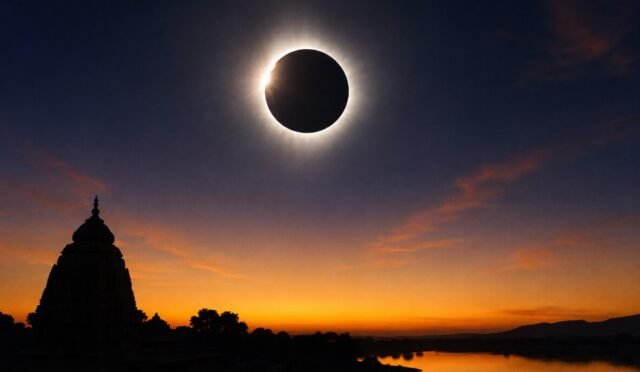
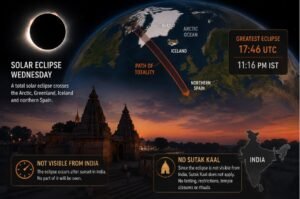
NEW DELHI — A total solar eclipse crosses the Arctic, Greenland, Iceland and northern Spain on Wednesday, and not one person in India will see any part of it. The reason is a clock, not a cloud.
Greatest eclipse falls at 17.46 UTC, which is 11.16 pm Indian Standard Time. The sun set over India hours earlier. There is nothing in the sky for the moon to cover, and no location in the country falls inside either the path of totality or the surrounding partial zone.
Because the eclipse is not visible from India, Sutak Kaal does not apply. Traditional practice ties the observance to actual visibility from a given place, so there are no fasting restrictions, temple closures or ritual observances attached to this one.
Where the shadow actually goes
The path of totality technically makes landfall first in a remote corner of north-eastern Siberia, then opens across the Arctic coastline at 17.00 UTC and passes close to the North Pole six minutes later, where totality runs one minute and 54 seconds. It reaches the Greenland coast at 17.15 UTC with two minutes and six seconds.
Greatest eclipse, two minutes and 18.2 seconds, occurs at 17.45.57 UTC near the Denmark Strait, over open water between Greenland and Iceland. The shadow then crosses western Iceland, including Reykjavik, runs out across the North Atlantic and makes landfall in northern Spain and the extreme north-eastern corner of Portugal, before ending over the Balearic Islands at 18.34.05 UTC.
The whole crossing takes just over 92 minutes and covers about 8,300 kilometres, which is 0.47 per cent of the Earth’s surface. The band is at most 294 kilometres wide. Roughly 15 million people live inside it, and August is peak tourist season across most of the route.
In Spain the corridor takes in A Coruna, Oviedo, Leon, Bilbao, Zaragoza, Valencia and Palma, and narrowly misses both Madrid and Barcelona. Totality reaches Leon at about 18.28 UTC, Zaragoza a minute later and Valencia around 18.32 UTC. Spain gets at most one minute and 50 seconds, and parts of the north that scrape inside the edge see about twenty seconds.
The trade-off is that the sun will be only a few degrees above the western horizon at totality. In A Coruna it will be about 12 degrees up, with 76 seconds of totality. That produces a darkened landscape beneath an eclipsed sun, which photographers rate above a longer eclipse seen overhead, and it also means a low bank of cloud or a hill in the wrong place ruins everything.
Why the experts are nervous about Spain
This is the first total solar eclipse over mainland Europe since 1999, the first in Iceland since June 1954, and the first over mainland Spain since 30 August 1905. Spain’s Instituto Geografico Nacional has described it as the first total eclipse visible from the Iberian Peninsula in more than a century.
The low sun makes it a difficult forecast. “This is one of the trickiest solar eclipses in terms of weather that I’ve seen for a long time,” said Dr John Mason, the British astronomer and eclipse guide, speaking to The Independent’s travel podcast.
Terrain is the other problem. “Many national parks are in mountainous regions, which could block your view,” said Oscar Martin Mesonero, an astrotourism specialist who runs Startrails in Salamanca, in comments to Space.com.
Iceland has the opposite issue, which is that its weather changes faster than any forecast. For Icelanders the event is close to unprecedented. “Most people in Iceland don’t know what they are about to witness,” said Saevar Helgi Bragason, an Icelandic science communicator, in an interview with Sky and Telescope, noting that Reykjavik has not seen totality since 1433.
Why this one is short
Two minutes and 18 seconds is modest. The North American eclipse of April 2024 delivered four minutes and 28 seconds at its maximum, and the eclipse of 2 August 2027 over North Africa will run six minutes and 23 seconds, one of the longest of this century.
The length depends on how large the moon appears against the sun and how fast its shadow travels across the ground. This eclipse has a magnitude of 1.0386, meaning the moon’s disc covers the sun’s with only a small margin to spare. It occurs about a day after the moon reaches perigee, its closest approach to Earth for the month, which enlarges the moon in the sky and is the only reason totality happens at all rather than a ring of fire.
The shadow also crosses at high latitude, striking the Earth at a shallow angle, which stretches the path but moves the shadow across the ground quickly. It belongs to Saros 126 and is the 48th of 72 eclipses in that series. The sun sits in the direction of the constellation Leo.
Who gets a partial view, and why 99 per cent is not enough
Roughly a billion people will see the sun partly covered. Approximate maximum obscuration runs from more than 90 per cent in Madrid, just outside the path, to 70 to 80 per cent in Lisbon, 45 to 55 per cent in Paris, 30 to 40 per cent in London and 20 to 30 per cent in Rome and Dublin.
North America barely registers. Maine gets the best view in the contiguous United States at about 29 per cent, Boston 16 per cent, New York City 9.5 per cent and Washington 3.7 per cent. Alaska does better, with 37 per cent at Fairbanks.
Anyone tempted to settle for a deep partial should hear the standard warning from eclipse chasers. “The biggest wrong idea about eclipses is that if you’ve seen a 90% eclipse, you’ve seen most of the show,” said Dr Doug Duncan, an astronomer at the University of Colorado and former director of the Fiske Planetarium. Even a sliver of exposed solar disk is bright enough to hide the corona entirely.
The one safety rule holds everywhere. Only the total phase can be viewed without a filter, and only from inside the path. A partial eclipse, however thin the remaining crescent, will damage eyes without certified filters.
What India gets, and when
The next solar eclipse visible from India is a partial one on 2 August 2027, seen from western and north-western India close to sunset. Cities including Jaisalmer, Bhuj and Mumbai will see a substantial bite taken out of the sun. That event is a total eclipse elsewhere, sweeping across southern Spain, Morocco, Algeria, Tunisia, Libya, Egypt, Saudi Arabia and Yemen, and it is the six-minute one.
For totality on Indian soil, the wait is longer. Current projections put the next total solar eclipse visible from India on 20 March 2034, about eight years away. The last ones were in 1995, 1999 and July 2009, when the shadow entered at Surat and ran across Madhya Pradesh, Chhattisgarh, Uttar Pradesh, Bihar, Sikkim and Assam.
Delhi is a special case, and an unlucky one. Timeanddate’s catalogue lists no total solar eclipse visible from Delhi before the year 2200. The capital sits in a gap in the geometry that will not close in any reader’s lifetime.
The consolation prize is genuinely good
India misses the eclipse but not the night. The Perseid meteor shower peaks on the same date, and this year the moon is new, which means no moonlight washing out the fainter meteors. That is the best possible configuration for the Perseids, and India’s viewing conditions for it are as good as anywhere.
Observers inside the path get both at once. “Every eclipse is unique. The geography of where you are on the planet really influences it,” said Dr Michael Kirk, a NASA solar physicist and eclipse specialist, who has said bright meteors may even be visible during totality itself.
The catch in India is the monsoon. August cloud cover over most of the subcontinent is the usual obstacle, and the shower is best seen after midnight from a dark site away from city lights, looking north-east.
There is also a planetary alignment before sunrise, with six planets visible from mid-northern latitudes roughly 30 to 60 minutes before local sunrise. Mercury and Jupiter sit low and need a clear horizon and, ideally, binoculars pointed nowhere near the sun.
Two weeks after the eclipse, on 27 and 28 August, a partial lunar eclipse follows. Solar and lunar eclipses arrive in pairs inside an eclipse season, an approximately 35-day window in which at least two are unavoidable. The first season of 2026 produced an annular solar eclipse on 17 February and a total lunar eclipse on 2 and 3 March.
For anyone who wants to watch Wednesday’s eclipse anyway, NASA, timeanddate and several observatories are streaming it live from the path of totality. That is the only way to see it from India, and it costs nothing but a late night.