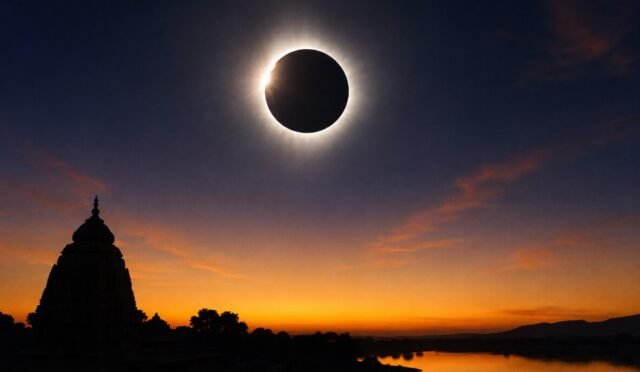
LONDON — The partial solar eclipse of 12 August 2026 is the deepest Britain has seen in eleven years, covering up to 96 per cent of the Sun over Cornwall, and yet the total phase it belongs to lands on almost nobody at all.
The shadow itself lands almost nowhere. Totality falls on a strip roughly 8,260 km long and up to 293 km wide, and most of that strip is Arctic ocean, Greenland ice and open Atlantic. Only two places on the track have real populations: the west coast of Iceland and a band of northern and eastern Spain.
What Britain actually sees
No part of the United Kingdom is inside the path. What Britain gets instead is a very deep partial eclipse, between roughly 90 and 96 per cent of the solar disc covered, and the last one this close to total was on March 20, 2015.
The coverage rises as you go south-west. Plymouth reaches about 95.1 per cent and Cornwall roughly 95. Pembrokeshire is near 94, Cardiff 93.21, Bristol 92.86, Liverpool 91.85, London 91.38 and Manchester 91.36.
In London the partial phase runs from 6.17pm to 8.06pm BST with maximum at about 7.13pm. Across the country the window sits broadly between 5.59pm and 8.10pm, though every town has its own clock. From the UK and Ireland the whole event lasts around an hour and 50 minutes.
One quirk is worth knowing before you look up. The Moon crosses from right to left, which at maximum produces a crescent shaped like a frown, horns pointing down, rather than the smile most people picture.
Where totality falls
The track is unusual. It begins at sunrise over the Taymyr Peninsula in Siberia, where above the Arctic Circle in August sunrise is a technicality, arcs over the top of the planet, drops onto eastern Greenland, clips Iceland’s north-west, crosses the Atlantic and comes ashore in Spain at sunset.
Maximum totality is 2 minutes 18 seconds, and it falls over water off Iceland’s west coast. Reykjavik is inside the path. In Spain the total phase runs closer to one to two minutes, arriving after 8.25pm local time with the Sun very low.
The anniversaries do the marketing. This is the first total solar eclipse over mainland Europe since August 1999, the first visible from mainland Spain since 1905, and the first from Iceland since 1954. About 230 million people are within reach of 90 per cent coverage, according to population data from Columbia University’s Center for International Earth Science Information Network.
Where the broadcasts are
Several institutions are broadcasting the event free. Diurna is not among them, and none of these feeds are ours. The Royal Observatory Greenwich is putting the London partial online through one of its telescopes, with coverage beginning on YouTube and Facebook from 6.10pm BST.
NASA is covering the path from several cameras with commentary on what eclipses reveal about the Sun. The European Space Agency is broadcasting from the Observatorio Astrofisico de Javalambre in Spain. Time and Date runs a hosted feed of its own, and the Virtual Telescope Project is carrying the partial phase from Italy alongside totality from Spain. Amateur astronomers in Edinburgh are putting out the Scottish view.
For anyone in India, where none of it is visible, those broadcasts are the whole event.
The weather is the real risk
Cloud, not timing, is what will decide the day for most observers in Europe. The Sun sits very low for the whole event, which means the sightline runs through hundreds of kilometres of atmosphere and past weather systems nowhere near the observer.
Dr John Mason, the British astronomer who has chased eclipses for decades, called it “one of the trickiest solar eclipses in terms of weather” he had seen in a long time, in an interview with The Independent’s travel podcast. An unobstructed west or north-west horizon matters more than any telescope.
Clear-sky odds are why the serious chasers picked inland Spain. Gordon Telepun, an American amateur astronomer who has photographed six total eclipses, told Reuters he chose Mallorca because Spain met every test: “It has pretty reasonable weather chances in August,” he said, with totality over a minute and a half and easy travel.
Spain has been planning this for years
Spain’s economy ministry expects the eclipse to bring more than 446,000 additional visitors and generate close to 350 million euros in net benefit. Rural hotels and guesthouses along the track in Leon, Palencia, Burgos, Soria and southern Aragon have been fully booked for over a year.
The traffic authority estimates up to 1.5 million extra journeys on eclipse day, comparable to a peak holiday weekend, and 24,000 Guardia Civil officers have been deployed. Several regions banned vehicles from protected natural areas, prohibited bonfires and cancelled large festivals because the event lands in the middle of a dry, hot Spanish summer with high wildfire risk.
The Starlight Foundation’s director asked crowds to treat the sites they use as borrowed. “An eclipse should be enjoyed safely, responsibly, and with respect for the environment,” she said.
Juan Cruz, Spain’s Secretary of State for Science, framed the day as recruitment. “I hope that tonight will see the emergence of a wonderful generation of astrophysicists,” he said, as quoted by Reuters.
Never look without a filter
The rule is simple and there are no exceptions for a deep partial. Certified eclipse glasses or a proper solar filter are required at all times outside the path of totality, and during every partial phase inside it. Ordinary sunglasses do nothing. A pinhole projector costs nothing and is completely safe.
Only inside the path, and only during the brief total phase when the disc is fully covered, is the unaided eye safe. Jake Foster, an astronomer at the Royal Observatory Greenwich, describes a total eclipse as a “bucket list event” that people return to repeatedly, and notes how rarely one recurs over the same spot.
When Britain gets another
Not soon. The next total solar eclipse visible from the UK is in 2090. The closest call before that is September 3, 2081, when up to 99 per cent of the Sun will be covered and Cornwall and the south coast will again have the best view.
In between there are partials: roughly 50 per cent in 2030, 40 in 2053, 60 in 2066, 70 in 2075, 70 again in 2082 and 40 in 2088. Today’s eclipse is the closest to total the British Isles will see for the rest of this century.
India sees none of it, for reasons of timing rather than weather, and Delhi’s own wait runs a great deal longer, as Diurna explained earlier today. Watching a screen is not the same as standing in the shadow. For almost everyone alive tonight, it is the closest they will get.