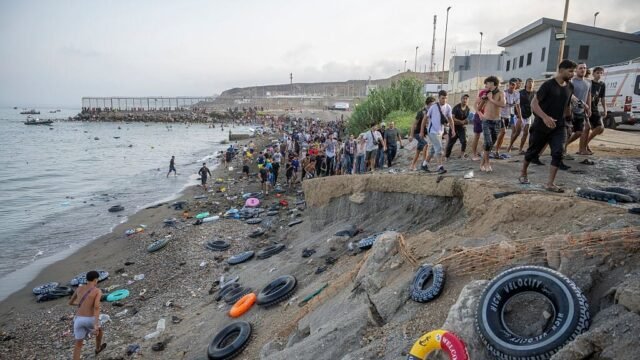
MADRID — In the space of little more than a day, tens of thousands of people crossed from Morocco into the Spanish enclave of Ceuta, a sliver of European territory on the North African coast that is home to about 85,000 residents. At least 34 died in the attempt. Spain sent in the army, its prime minister flew to the scene, and a diplomatic quarrel erupted across the European Union.
The images were dramatic, but the underlying story is not new. Ceuta has been a pressure point in Europe’s migration politics for years, shaped by an unusual geography, a border controlled by two governments at once, a recent court ruling, and the long shadow of a territorial dispute over Western Sahara. Here is why the enclave keeps erupting.
A city on the wrong side of a fence
Ceuta is a Spanish possession that has been under Madrid’s control since 1580. It sits on a historical isthmus jutting into the Mediterranean, bordered entirely by Morocco on land and by the sea on its other flanks. Together with Melilla, a second Spanish autonomous city farther east, it forms the only place where the European Union shares a land border with the African continent.
That makes both cities uniquely tempting to people hoping to reach Europe. Set foot on the Ceuta side of the frontier and, legally, you have arrived on EU soil. Morocco, for its part, has never recognised Spanish sovereignty over the two enclaves; many Moroccans regard them as occupied territory, a fact that colours every dispute over the border.
Cut off from the Spanish mainland, Ceuta is reached from the Iberian peninsula only by ferry across the Strait of Gibraltar, yet it is fused to Africa, sharing an eight-kilometre land border with Morocco. That paradox — European jurisdiction on African soil — is the source of both its strategic value to Madrid and its permanent friction with Rabat, which has never dropped its claim to the two cities.
The frontier itself is heavily fortified, with fences and breakwaters, but it can be breached in numbers. This week most people did not go over the land fence at all. They swam around the sea barrier at Tarajal beach or floated across on inner tubes, phones sealed in waterproof pouches, in a crossing that proved deadly for dozens.
The border both countries control
The central, uncomfortable truth of Ceuta is that the flow of people across its frontier is regulated not by Spain alone but by Morocco too. In practice, Moroccan security forces decide how tightly the border is policed on their side, and that gives Rabat a lever it has used before.
When relations are warm, Moroccan gendarmes turn people back before they reach the water. When relations sour, enforcement can quietly slacken, and crossings spike. This week Moroccan police did eventually move against crowds gathering near Fnideq, firing tear gas and water cannon and detaining people, but only after very large numbers had already surged through.
The statistics underline how localised this crisis is. Irregular arrivals to the rest of Spain actually fell in the first half of 2026, from 17,990 a year earlier to 12,138, according to interior ministry figures. Ceuta bucked the trend: land arrivals there rose 164 percent over the same period. Vivas, the enclave’s president, put the scale in stark terms in an interview with the broadcaster Cadena SER, saying that for the rest of the country an equivalent influx would mean “like a million people entering Spain irregularly,”.
The court ruling that lit the fuse
The immediate trigger, Spanish officials believe, was legal rather than geopolitical. Weeks before the surge, Spain’s Supreme Court ruled that the practice known as summary return — the on-the-spot pushback of migrants across the border without individual processing — could not be applied to people intercepted at sea while trying to reach Ceuta or Melilla. Instead, the court said, the ordinary immigration procedure had to be used.
The interior ministry has argued that smuggling networks seized on the ruling, marketing the sea route as a safer bet because arrivals could no longer be turned back instantly. Whether or not that is the whole explanation, the ruling created a window, and this week it was exploited on a mass scale. Spain has said it will still try to expel those who entered irregularly as fast as it can, and by Friday more than half had already returned to Morocco.
Deadly by design
Whatever opens the border, the crossing itself is lethal. This week most people did not attempt the fortified land fence but swam around the sea barrier at Tarajal beach or floated across on inner tubes, often at night and in strong currents. At least 34 died; many drowned, and others were crushed at the breakwater as thousands tried to reach the same narrow point at once.
The danger is not unique to Ceuta. At Melilla, the second enclave, migrants have long tried to scale a fence some six metres high, and in 2022 dozens died in a single crush at the barrier in one of the deadliest incidents ever recorded on the route. The fortifications, built to deter crossings, have repeatedly turned surges into mass-casualty events — a pattern rights groups call the predictable result of funnelling desperate people toward a handful of heavily defended chokepoints.
Morocco’s lever: Western Sahara
To understand why Rabat might allow a surge, look to Western Sahara, the disputed former Spanish colony that Morocco largely controls and claims as its own, and where the pro-independence Polisario Front demands a state.
The precedent is the crisis of May 2021, when between 8,000 and 10,000 people poured into Ceuta over two days. That breach came as Madrid and Rabat were locked in a furious row after Spain allowed the Polisario leader, Brahim Ghali, to be treated in a Spanish hospital. The message from the sudden influx was widely read as a warning about the cost of crossing Morocco.
The rupture healed only in 2022, when Spain reversed decades of neutrality and endorsed Morocco’s plan for autonomy in Western Sahara under Moroccan sovereignty — a diplomatic prize for Rabat. This week Moroccan officials insisted the country “does not support or encourage the irregular migration of its nationals,” and blamed criminal organisations for exploiting people’s desperation. But the history means that every Ceuta crisis is now read, rightly or wrongly, through the lens of leverage.
The geopolitics have shifted since then. This crisis unfolds with Donald Trump back in the White House, and Morocco counts Washington among its closest allies: it was the first Trump administration that recognised Moroccan sovereignty over Western Sahara in 2020, in return for Rabat normalising relations with Israel. That gives Morocco a powerful patron as it presses its claims, and narrows the room Madrid has to push back when the border comes under strain.
The amnesty and the politics
The crisis has detonated inside an already tense domestic debate in Spain. Earlier this year, Sanchez’s government moved to regularise the status of roughly half a million undocumented migrants, a policy his opponents on the right — and their allies across Europe — have seized on as a magnet for irregular migration. Critics, including in the governing parties of Italy and France, argue the amnesty sent a signal that Spain’s doors were open.
Supporters counter that Ceuta’s geography and Morocco’s border management, not asylum policy, drive these surges, and note that the amnesty’s beneficiaries are people already living and working in Spain. But the politics have overwhelmed the nuance: the enclave’s turmoil has become a proxy battle over immigration itself.
The row has drawn in Europe’s political families. Leaders of the governing parties in Italy and France, and the centre-right bloc in the European Parliament, have all pointed to the regularisation as evidence that Madrid invited the surge, while Spain’s government insists the beneficiaries are long-settled residents and that the trigger was legal and geographic. A policy about people already inside Spain has become a lightning rod in a continent-wide argument over who gets to enter.
What happens next
In the short term, Spain is racing to return those who crossed and to reinforce the border with soldiers. Vivas is pressing for a formal emergency declaration, which Madrid has so far declined on the grounds that its emergency laws do not classify migration as a national-security threat. The opposition wants the EU’s border agency, Frontex, deployed to the enclave.
The dispute has also reached Brussels, reviving a bloc-wide argument over whether Schengen, the system of open internal borders, can withstand repeated shocks at its external edge.
In the longer term, the episode is a reminder that Europe’s southern frontier can be opened and closed by decisions taken in Rabat as much as in Madrid or Brussels — and that a court ruling, a diplomatic slight, or a shift in the winds over Western Sahara can turn a quiet border into a crisis overnight. Sanchez, who in 2021 called a comparable surge “a serious crisis for Spain and for Europe,”, now faces the same test again, with a more hostile European chorus and a weaker hand at home.