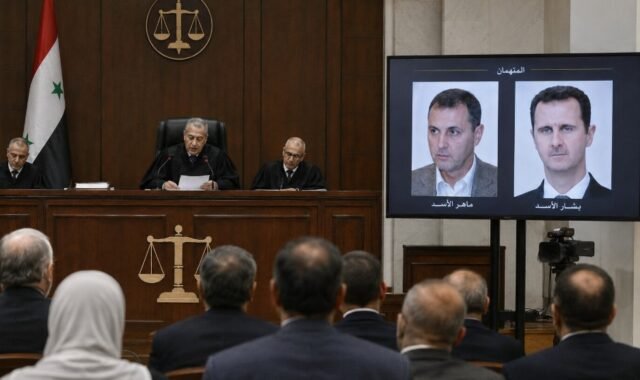
DAMASCUS — The Fourth Criminal Court in Damascus sentenced Bashar al-Assad to death in absentia on Tuesday, twenty months after his government fell, in the first verdict against the former president or anyone in his inner circle.
The Assad death sentence covers crimes against humanity and war crimes committed during a conflict that killed roughly half a million people over fourteen years. His younger brother Maher received the same sentence, also in absentia. Both men have been in Russia since December 2024, where they were granted political asylum.
The session was broadcast live on Syrian state television. “Bashar Assad used state agencies to commit war crimes and crimes against humanity,” judge Fakhareddine al-Aryan said as he delivered the verdict, in remarks carried by the Associated Press.
The man in the cage matters more than the men in Moscow
A third defendant was sentenced to death in the same case, and he was in the room. Atef Najib, Assad’s maternal cousin, stood inside a defendants’ cage in a prisoner’s uniform while the judge read out the sentence. His lawyer can appeal.
Najib was a brigadier general who ran the Political Security Branch in Daraa province in 2011. During his tenure, more than a dozen teenagers who had scrawled anti-government graffiti on a school wall were arrested and tortured. Their treatment is the event that turned local anger into national protest and then into civil war. The United States Treasury sanctioned him in April 2011, and he was detained after the government fell.
He is the highest-ranking Assad-era official yet to stand trial in Syria, and the only one of the three men sentenced on Tuesday over whom the Syrian state has any physical power. That asymmetry is the whole story of this verdict. Two sentences are declarations. One is an actual criminal proceeding with a defendant, a defence and an appeal.
It also explains the choice of case. Prosecutors could have started anywhere in fourteen years of atrocity. They started in Daraa, with the schoolboys, because it is the origin story every Syrian knows and because the officer responsible was in custody. A first trial that can be finished is worth more to a new judiciary than a first trial that is comprehensive.
What a trial in absentia actually buys
Trying an absent defendant is legally normal in much of the civil-law world and practically useless for punishment. Syria’s new rulers have asked Russia to hand over the Assads. Moscow has not, and there is no legal instrument that compels it to.
What the verdict does produce is a formal record. Once a court has ruled that the head of state directed the killing, torture and arbitrary detention of civilians as state policy, that finding exists as a document. It can be cited in asset-recovery proceedings, in sanctions listings, in extradition arguments and in the universal-jurisdiction cases that European courts have been running for years.
Those cases have already produced convictions. A Paris court sentenced three senior Syrian intelligence officials to life in absentia in 2024 over the deaths of a French-Syrian father and son, Mazen and Patrick Dabbagh, who were taken from their home in Damascus in 2013.
The lawyer for the Dabbagh family called it “a message of hope for all Syrian victims who are waiting for justice,” in comments reported at the time by the Associated Press. Clemence Bectarte, of the International Federation for Human Rights, was describing a verdict that changed nothing about where the convicted men lived and a great deal about how the case was argued internationally.
Bectarte also called that ruling “the first recognition in France of the crimes against humanity of the Syrian regime,” which is the function these judgments perform: they move a contested claim into the category of adjudicated fact.
A German court had already convicted a former Syrian intelligence officer, Anwar Raslan, of crimes against humanity in Koblenz in 2022, in the first such verdict anywhere. What was missing from that body of law until Tuesday was a Syrian court saying the same thing about the man at the top.
The evidentiary base for all of it is unusually strong. Some 55,000 photographs smuggled out of Syria by a military police photographer working under the codename Caesar documented thousands of deaths in government detention, and formed the basis of American sanctions legislation named after him. Since December 2024 investigators have added to that record directly, working through the files left behind at Sednaya prison and at branch offices of the security services that emptied overnight when the government fell.
The crowd outside the courthouse
People gathered in central Damascus to hear the verdict read, some carrying photographs of relatives killed during the war. The scene has been repeated across Syria since December 2024, in prisons, morgues and mass grave sites, where families have searched for the several hundred thousand people who disappeared into the security apparatus.
An attorney representing families of Najib’s victims described the day in terms that had nothing to do with extradition law.
“Today is the day of justice for all the wounded, martyrs, detainees and Syrians who were forced to leave their country,” said Adnan al-Masalmeh, in comments reported by the Associated Press. He called the verdict a victory of right against injustice.
That is the domestic function of this trial, and it should not be dismissed as symbolism. A government twenty months old, holding together a country with contested territory, competing armed factions and an economy in ruins, needs to demonstrate that it can process the past through courts rather than through reprisal. Every month that passes without a formal accounting increases the pressure for the informal kind, and Syria has seen enough of that on the coast and in the south since the transition.
Maher al-Assad and the 4th Division
The inclusion of Maher al-Assad is not incidental. He commanded the Syrian military’s 4th Armoured Division, which opposition activists have accused of killings, torture, extortion and drug trafficking, and which ran its own detention centres.
The 4th Division was also the institutional centre of the captagon trade, the amphetamine industry that became one of the Assad government’s largest sources of foreign currency and which flooded Gulf markets for a decade. Estimates of its annual value ran into billions of dollars, exceeding Syria’s legitimate exports several times over.
Gulf states that spent years negotiating with Damascus over captagon interdiction now have a Syrian court finding that the brother who ran the division was a war criminal. That is a useful document for Riyadh and Abu Dhabi, both of which have been recalibrating their approach to Damascus, and an awkward one for Moscow, which is hosting him.
The Russian problem is not going away
Russia’s calculation on the Assads has been consistent since 2024. Handing over a leader it protected for a decade would signal to every other client government that Russian protection expires. Keeping him costs almost nothing beyond periodic irritation from Damascus.
Syria’s leverage is thin but not zero. Russia retains interests at the Tartus naval facility and the Hmeimim air base, and their status has been under negotiation since the government changed. Tartus is Russia’s only warm-water naval facility on the Mediterranean, which makes it the single asset Moscow is least willing to lose.
A death sentence handed down by a Syrian court gives Damascus a new item to put on that table. Whether it uses it is a separate question, because the bases are also a bargaining chip with Washington, and because a government trying to attract reconstruction money has more urgent uses for its negotiating capital than a man it cannot reach.
There is one more constraint worth naming. Syria has not carried out a judicial execution since the transition, and the new authorities have faced steady pressure from European governments and UN bodies over the death penalty. A sentence that cannot be carried out on two defendants and might not be carried out on the third is, for now, a statement of what the state believes rather than what it intends to do.
For the moment, Bashar and Maher al-Assad remain in Moscow, convicted in a country they cannot enter, and Atef Najib remains in a Damascus cell, convicted in a country that can hang him. The sentence that stands the best chance of being carried out is the one nobody outside Syria was watching.