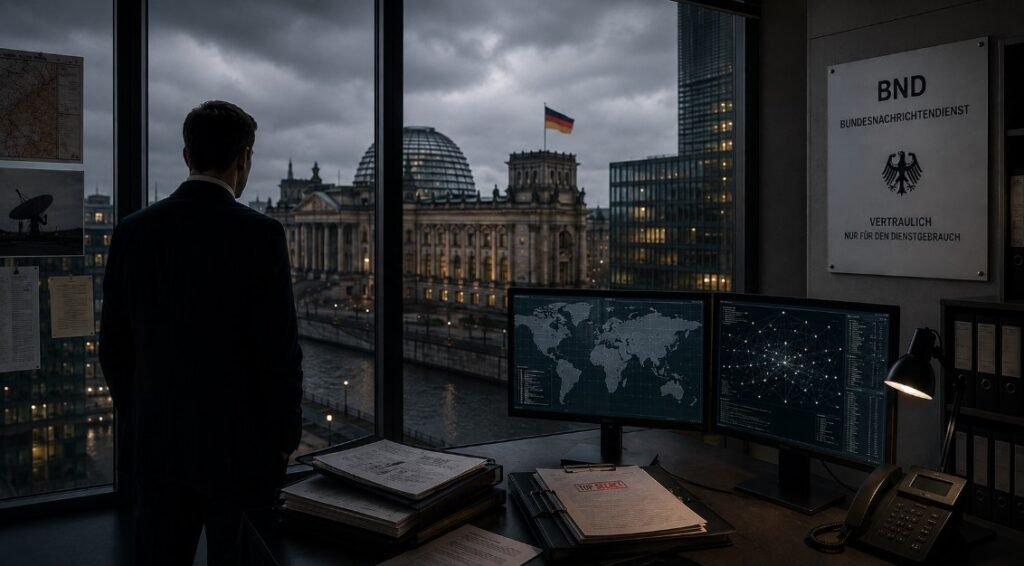
BERLIN — The most consequential thing about the intelligence Bill that Friedrich Merz’s cabinet approved on 12 August is not the cyber weapons or the sabotage clauses. It is that Germany is doing it at all. For eighty years, the country built its intelligence services to be weak on purpose. The German intelligence reform now moving toward parliament is the moment Berlin decides that the lesson of 1945 and the demands of 2026 can no longer both be obeyed, and that the second one wins.
A postwar design, by intention
Germany’s spy agencies were created in the 1950s in the shadow of the Gestapo, and the memory of a state that had turned its surveillance apparatus against its own people shaped every line of their mandate. The BND abroad and the BfV at home were given narrow, defensive roles: gather information, analyse it, warn the government. They were deliberately denied the operational reach that the services of France, Britain and the United States take for granted. The weakness was not an oversight. It was the design.
The caution had two sources, not one. There was the Gestapo, the secret police of the Nazi state, and then, after 1949, the Stasi of communist East Germany, one of the most intrusive surveillance machines ever built. A unified Germany inherited the memory of both, and wrote its intelligence law as a promise that neither would return. Limited powers were not timidity. They were a constitutional apology.
That is the settlement the new Bill overturns. Interior Minister Alexander Dobrindt, who has led the push, was explicit about the scale of the break. He said Germany needs services able to master challenges from “espionage, sabotage, cyberattacks and hidden actions by foreign powers with the aim of destabilising our country,” and added, “we are turning our agencies into a real secret service.” The phrasing is a quiet admission that, until now, they were something less, and that the country had decided it could finally afford to change that.
The one-way street
The argument that finally moved Berlin is dependence. German agencies have for decades leaned on allies, above all the CIA and the NSA, to fill the gaps their limited powers left. Many terrorist plots on German soil were thwarted only by foreign tip-offs. The calls for reform trace back a quarter of a century, to the discovery that the 11 September 2001 attacks were planned by a cell in Hamburg, under the noses of agencies that had neither the tools nor the mandate to see it. Repeated later attacks sharpened the same lesson.
Dependence also carries a political price. A country that leans on foreign services for its most sensitive warnings cedes a measure of sovereignty over its own security, and owes favours it may not wish to owe. That argument, long made quietly by German intelligence chiefs, has now been made openly by the government itself.
Nina Warken, who runs Merz’s Chancellery and oversees the services, put the case in terms of national self-respect. “These days Germany is constantly a target of hybrid attacks by foreign powers and that is a real, very acute danger,” she said, adding that the country is “simply too dependent on the intelligence services of other countries,” and that in many areas the assistance runs only one way. A great economic power that cannot see its own threats without help had come to look, in Berlin’s own telling, like a strategic liability.
Russia, Iran and the hybrid war
What turned an old argument urgent was the arrival of a war that never formally began. Since Russia’s 2022 invasion of Ukraine, Germany has faced a steady campaign short of open conflict: cyber intrusions, disinformation, sabotage of infrastructure, unexplained drones over military sites, and the severing of undersea cables in the Baltic. Iran has added its own layer of threat, including alleged plots against individuals on German soil. None of it fits the tidy categories the old law was written for, and German agencies found themselves legally equipped to describe attacks they were not equipped to stop.
The Bill’s active-measures powers, the authority to disable a hostile server or corrupt the supply chain of a drone factory, are the direct answer to that gap. They convert intelligence from a warning system into an instrument of disruption, which is precisely what a hybrid war demands and precisely what postwar Germany had sworn off. The country is, in effect, admitting that deterrence now requires the capacity to reach out and break things. The list of incidents is long enough that officials no longer treat them as isolated: arson at defence suppliers, unexplained drones over bases, and cables cut on the Baltic floor.
The courts and the constitution
The restraint being undone was not only political. It was legal, enforced by a Federal Constitutional Court that has repeatedly trimmed back intelligence powers in the name of privacy and proportionality, and by a public made wary of surveillance by history and then by the Snowden revelations, which exposed BND cooperation with the NSA. Earlier, milder reforms were watered down in Karlsruhe. This one, far more ambitious, will almost certainly be challenged there too.
That is why the opposition’s objections carry weight beyond the parliamentary arithmetic. When the Greens’ Konstantin von Notz calls expanded domestic powers “a cause for concern in terms of the rule of law,” he is invoking the exact tradition the Bill is straining against. The coalition has the votes. Whether it has the constitution is a separate question, and one Karlsruhe, not the Bundestag, will answer.
Europe rearms its spies
Germany is not moving alone, and that is the larger story. Across Europe, governments that spent the post-Cold-War decades shrinking their security establishments are rebuilding them, in intelligence as in armies. A continent that assumed the American umbrella was permanent is hedging against the day it is not. Berlin’s decision to give its agencies teeth is the intelligence chapter of the same rearmament that has already transformed European defence budgets since 2022. The pattern repeats across the continent. Sweden and Finland reoriented their security services on joining NATO, France and Britain have poured money into cyber and counter-sabotage units, and Poland and the Baltic states, closest to Russia, have expanded intelligence budgets fastest of all. Germany, the largest economy of them all, was conspicuously the laggard, and its reform closes a gap its neighbours had already begun to shut. The country that was designed, after its own catastrophe, to be the least threatening power on the continent is quietly deciding it can no longer afford to be the least capable one. That is a large thing for Germany to conclude, and it has concluded it almost without argument.