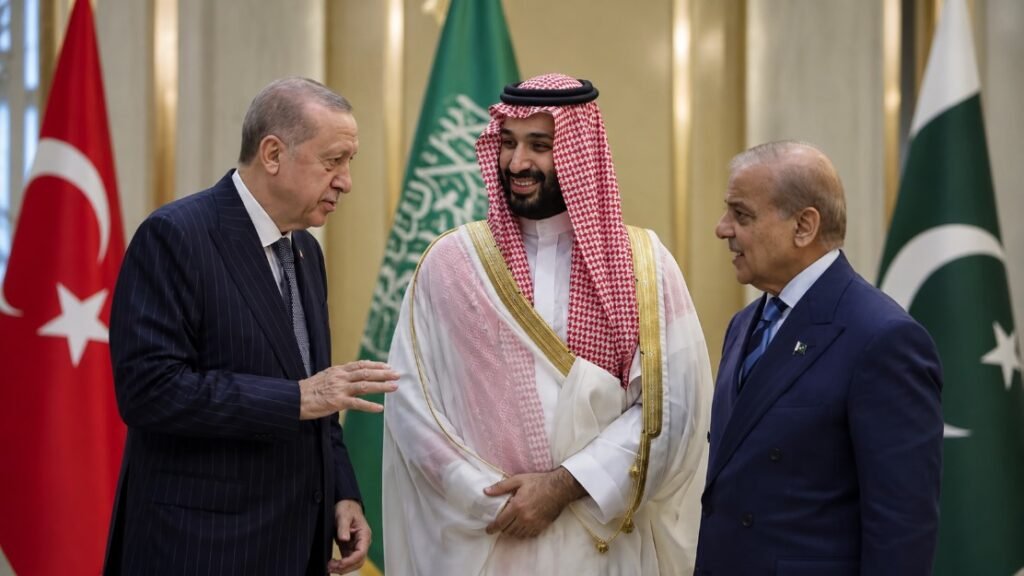
When Saudi Arabia, Turkey and Pakistan signed the Mecca Joint Defence Agreement on 7 August, the calculation that mattered most in South Block was not about the Gulf at all. It was about Pakistan, and about what a formal three-way pact does to India in the Gulf, a region that holds roughly nine million Indian workers, supplies much of the country’s oil, and has spent a decade being courted assiduously by New Delhi. The pact puts no army on India’s border. It complicates a relationship India had worked hard to make its own.
What Delhi said, and what it did not
India’s response was measured to the point of flatness. At the Ministry of External Affairs briefing on 11 August, spokesperson Randhir Jaiswal said New Delhi was watching the West Asia conflict closely and weighing the agreement’s effect. “As far as this particular agreement is concerned, we are examining its implications, both from the perspective of our national security as well as considerations of regional stability,” he said, adding that “India remains fully committed to safeguarding its national interests and will take all necessary measures in this regard.”
What Jaiswal did not do was object. There was no protest, no summons, no warning. That restraint is itself a position, and it is a learned one. When Riyadh and Islamabad signed their bilateral pact in September 2025, the MEA said much the same, that it would study the implications for national security and for regional stability. In the days that followed, New Delhi went a step further and asked Saudi Arabia to weigh Indian sensitivities in its strategic choices, while pressing its now-familiar line on cross-border terrorism. India has learned that Gulf capitals will not choose between New Delhi and Islamabad, and that a public tantrum only hands Pakistan the win it wants.
The Pakistan counterweight
The uncomfortable truth for India is baked into the pact’s logic. The Atlantic Council’s reading is blunt: Saudi Arabia values Pakistan in part as a counterweight to India, just as it values Turkey as a counterweight to Iran. For two decades India has narrowed Pakistan’s room in the Gulf, converting old Islamic-solidarity ties into a transactional partnership built on energy, remittances and investment. Modi has been feted in Riyadh and Abu Dhabi; India and the UAE run a free-trade agreement and a payments link; Saudi Arabia has pledged tens of billions in investment. A treaty that re-anchors Pakistan inside the region’s emerging security architecture pushes against that patient work.
It also hands Islamabad a talking point it has already begun using. When Pakistan’s foreign minister raised India and Israel in the days after the signing, the MEA declined to be drawn, saying “it did not need to emphasise which country was responsible for cross-border terrorism.” The exchange previews the argument to come. Pakistan will present the bloc as pan-Islamic strength, and India will keep steering the conversation back to terrorism and to its own record as a stable partner the Gulf can bank on.
The Israel hedge
India’s answer to the realignment is not confrontation but insurance, and its name is Israel. The day before the Mecca signing became public, Prime Minister Narendra Modi posted that he had spoken with Netanyahu, and that the two had reviewed progress on the India-Israel Special Strategic Partnership, which he said “continues to grow from strength to strength.” The timing was not accidental. As Riyadh, Ankara and Islamabad drew closer, New Delhi and Jerusalem signalled that they were drawing closer too, on defence technology, intelligence and trade.
Erdogan’s framing sharpens the point for India. He said the pact backs joint defence manufacturing and anti-terror cooperation, language that, from a leader who has repeatedly raised Kashmir at the United Nations, Delhi does not read as neutral. A Turkey-Pakistan defence-industrial axis, financed by Saudi money, is exactly the combination India’s planners have wanted to avoid, because it gives Islamabad access to drones, ships and production know-how it could not build alone.
The exposure India cannot wish away
For all the strategic discomfort, India’s deepest stake in the Gulf is human and economic, and that is what constrains its options. Around nine million Indians live and work across the Gulf states, and the region is the single largest source of the remittances that steady India’s current account. Saudi Arabia and the UAE are central to India’s crude supply and to a widening web of investment, from refineries to ports to sovereign-fund commitments. Qatar keeps India’s gas flowing. None of that can be risked to make a point about Pakistan.
So India will do what it has done since 2025. It will keep the relationships transactional, keep the Israel channel warm, keep courting the UAE and Saudi Arabia bilaterally, and keep reminding the Gulf that its quarrel with terrorism is not rhetorical. The Mecca pact is a setback in the narrow contest with Pakistan for Gulf affection. It is not a rupture, because neither India nor the Gulf can afford one.
India’s own map: the IMEC counter
India is not only defending old ground; it is drawing a new map. The India-Middle East-Europe Economic Corridor, unveiled at the 2023 G20 in New Delhi and backed by Saudi Arabia, the UAE, the United States and the European Union, threads a rail-and-shipping route from India through the Gulf to Europe, deliberately routing around both Pakistan and China. Every kilometre of that corridor ties the Gulf monarchies to Indian trade in ways a Pakistan-facing defence pact does not touch. The corridor slowed during the wider regional war, but its logic survives: the Gulf’s rulers want India’s market and capital as much as India wants their energy.
That is the deeper reason Delhi could afford its flat, unbothered statement. A defence treaty is a security instrument. IMEC, the free-trade deal with the UAE and the Saudi investment pledges are economic ones, and the Gulf has shown it intends to keep both ledgers open at once. Pakistan gains a seat at a security table. India keeps its seat at the commercial one, which in the Gulf’s own arithmetic may matter more.
What it means for India
The pact changes the weather, not the map. India keeps its energy, its diaspora and its investment ties intact, and its Israel partnership gives it a hedge against any tilt in the balance. But the era in which New Delhi could assume the Gulf was quietly drifting its way, and away from Islamabad, is over. Pakistan has a bloc now. India’s task, patiently and without drama, is to make sure the bloc stays a diplomatic fact rather than a strategic one.