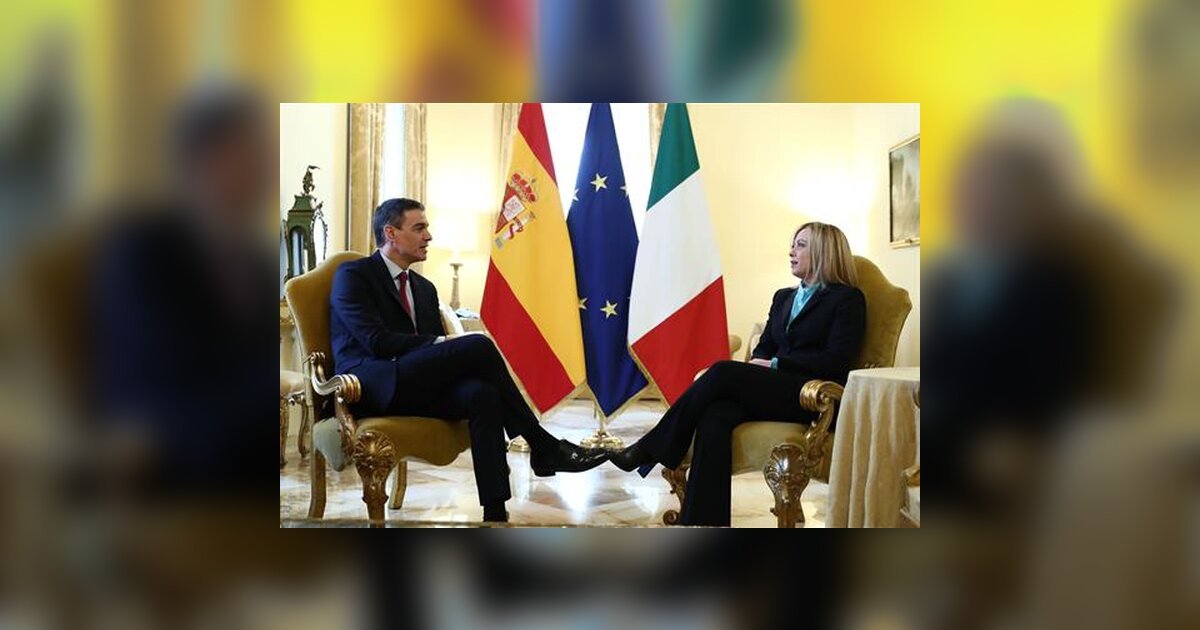
ROME – Italy’s put the brakes on its open-border deal with Spain for the next month. The move comes after Morocco’s neighbor Ceuta saw a massive surge in migrant crossings that spilled into Spanish territory.
Here’s the thing though—Italian citizens and other EU travelers won’t actually feel the impact. The government’s specifically ramping up checks on non-EU citizens entering Italy from Spain by plane or boat, but everyone else moves through normally.
Prime Minister Giorgia Meloni was pretty clear about why they’re doing this: “This is an extraordinary measure, adopted to safeguard national security and prevent possible repercussions for our nation.” She also made a point to add that “The measure will be kept in force only for the time necessary, with particular attention to limiting any impact on summer tourist flows.”
On top of that, Italy’s coordinated with France to tighten things up along their shared border too, trying to stop undocumented migrants from slipping through. Since Italy doesn’t even touch Spain by land, this is really about monitoring who’s coming in through the ports and airports.
Spanish officials accused Rome of exploiting a humanitarian emergency for domestic political gain, and noted that the surge had been shaped by a Spanish court ruling on returns rather than by asylum policy.
France moved to tighten its own frontier. The country’s interior minister said he had ordered controls at the border with Spain to be stepped up immediately and was mobilising a rapid border intervention force to carry out thorough checks, as Paris braced for onward movement from the enclave.
The reaction was not confined to governments. Manfred Weber, the German head of the centre-right European People’s Party, said the scenes at Tarajal beach were a direct consequence of what he called the mass regularisation of migrants and the weaponisation of illegal immigration, and demanded that Sanchez act with speed and firmness to protect the bloc’s shared external border. The EPP said the European Commission “must hold Sanchez accountable” over what it described as a failure to secure Spain’s frontier.
From France’s far right, Jordan Bardella, president of Marine Le Pen’s National Rally, replied directly to Spanish counterparts on X, arguing that by regularising hundreds of thousands of undocumented people, Spain’s socialist prime minister had “opened Europe’s doors to all dangers.”
The images from Ceuta — young men wading ashore, some cheering — spread rapidly on social media, amplified by right-wing commentators. Elon Musk, posting repeatedly about the enclave, called the influx “absolutely an invasion,” and warned that Spain’s public finances would buckle under the strain. Two senior officials in US President Donald Trump’s White House also seized on footage of the crossings to restate their own anti-immigration line.
Within Spain, the opposition turned the European criticism to its own ends, with the People’s Party demanding that Frontex be deployed to Ceuta and that Madrid activate extraordinary measures to regain control of the frontier. The government, wary of conceding that its border depends on outside help, insisted Spain’s European partners were allies rather than adversaries in defending the bloc’s external edge.
Spain’s government sought to project control. Sanchez, who travelled to Ceuta, said on X that his administration was “mobilizing all necessary resources” and was working with Moroccan and international authorities, while insisting the mass breach amounted to “a violation of Spain’s territorial integrity.”
Beneath the rhetoric lies a genuine institutional question. The Schengen area allows passport-free travel across 29 European countries, and its rules permit the temporary reintroduction of internal border checks only under narrow conditions. Italy’s threat to suspend free movement with a fellow member state is legally fraught and, analysts note, would be difficult to enact unilaterally — but the fact that it was made at all signals how combustible migration has become for the bloc.
For now, the diplomatic damage is concentrated between Rome and Madrid, two governments led by rival political families who have clashed before over migration. But with Ceuta’s turmoil feeding a wider European argument about open borders, and with the enclave still counting its dead, the row shows little sign of cooling.