The 2026 Iran war began with a decapitation. The opening US-Israeli strike on February 28 killed Supreme Leader Ayatollah Ali Khamenei — who had ruled Iran since 1989 — along with members of his family at his Tehran compound. His death, confirmed by the government on March 1, was only the second time the Islamic Republic has lost a supreme leader since the 1979 revolution.
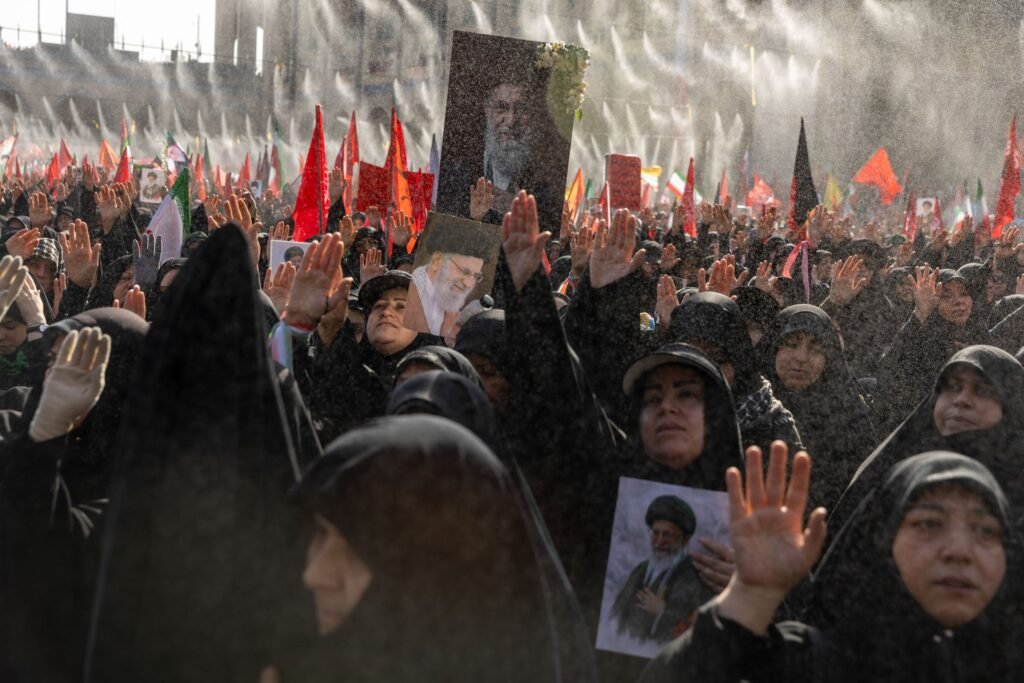
More than four months later, in early July, Iran held his funeral: a six-day national mourning that carried his coffin from Tehran to the seminary city of Qom, on to Najaf and Karbala in Iraq, and finally to burial at the Imam Reza shrine in Mashhad on July 9. Millions turned out. Iran’s metro network alone clocked seven million trips in a single overnight period as crowds flooded central Tehran. The sheer duration and geographic sweep of the ceremonies — spanning two countries and the holiest sites of Shia Islam — were themselves a statement, an assertion of continuity and defiance at the very moment the state that Khamenei built was fighting for its survival.
A Grief Turned Toward Vengeance
The scale of mourning was itself a message. “Imam Khamenei was our heart, our father, our everything. We will not rest until we avenge his death,” one mourner, Masoumeh Mohammadi, told the Associated Press, in comments carried by PBS, as processions filled with red flags symbolising martyrdom and revenge. President Masoud Pezeshkian had set the tone at the outset, condemning the killing as a “great crime” that “would not go unanswered” — a vow that framed Iran’s conduct for the months of fighting that followed.
The Doctrine He Leaves Behind
Whoever leads Iran now inherits Khamenei’s worldview — above all his deep distrust of Washington, articulated over decades. “Negotiating with America will solve no problem. Proof? [Past] experience!” he said in a February 2025 address, as reported by Iran’s IRNA news agency, calling any deal with the United States unwise and dishonourable. That conviction now shapes the choice facing his successors: negotiate the strait and the nuclear file, or resist. Every US strike on Iranian soil strengthens the hardliners’ argument that compromise equals surrender.
The Successor No One Has Seen
The succession itself is extraordinary. The Assembly of Experts appointed Khamenei’s son, Mojtaba Khamenei, on March 8 — but he was wounded in the same strike that killed his father and has not appeared in public since, reportedly recovering in hiding. His conspicuous absence from his own father’s funeral fed unease on Tehran’s streets about who, exactly, is steering the country through its gravest crisis in a generation. Analysts read the elaborate ceremonies as an attempt, as Iran specialist Negar Mortazavi put it, to “reassure both domestic and regional audiences that the transition is under control,” she told Time.
What It Means for the Region
A wounded, partly hidden leadership fighting a war may be more unpredictable than a stable one, with decisions on escalation increasingly shaped by the military and the Revolutionary Guard. The concentration of wartime authority in the security establishment, rather than a settled clerical leadership, raises the risk of miscalculation precisely when the stakes — a contested strait, a battered nuclear programme, a region on edge — are highest.
For countries like India — with deep energy stakes in the Gulf, a vast diaspora, and its Chabahar port investment caught in the crossfire — the succession is not an abstraction. Whoever consolidates power in Tehran will decide whether the Gulf gets a negotiated settlement or a war without end, and whether the doctrine of implacable resistance to Washington that Khamenei spent three decades entrenching outlives him or softens under the weight of the war his death began. On that question hangs not only Iran’s future, but the price of oil, the safety of sea lanes, and the security of millions across a region that has learned in 2026 how quickly its fragile calm can shatter.