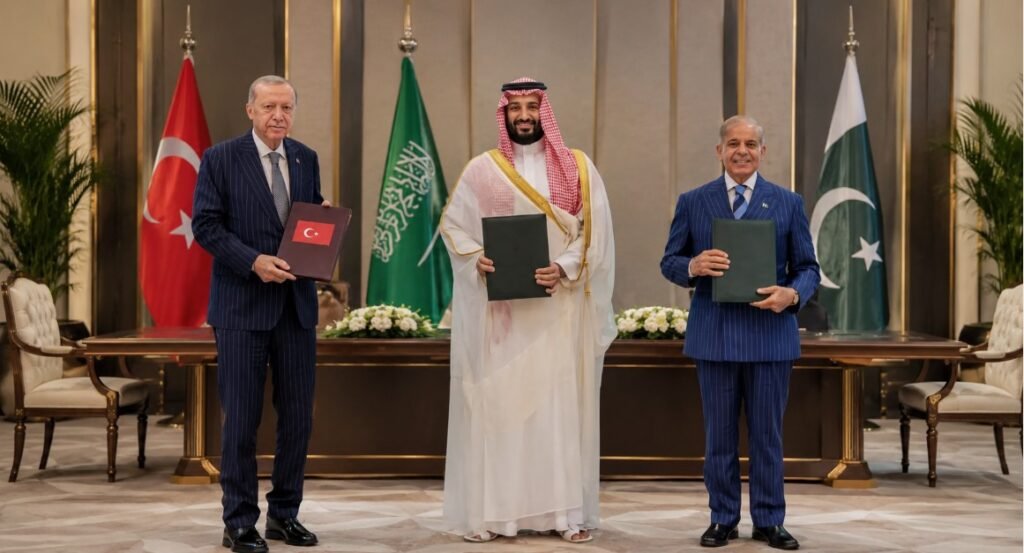
On 7 August, in Islam’s holiest city, Saudi Crown Prince Mohammed bin Salman, Turkish President Recep Tayyip Erdogan and Pakistani Prime Minister Shehbaz Sharif signed the Mecca Joint Defence Agreement, a treaty that binds three of the Muslim world’s largest militaries to treat an attack on one as an attack on all. Within hours it had a nickname, the “Mecca pact,” and a bigger label, a “Middle Eastern NATO.” As Diurna reported when the accord was signed, the Mecca pact is real, signed and in force. Whether it is an alliance in the sense that word usually carries is the harder question, and the single sharpest version of it is nuclear: does Pakistan’s arsenal now stand behind Saudi Arabia?
What the three actually signed
The heart of the agreement is a single sentence. According to the trilateral statement issued after the signing, “the agreement is intended to strengthen collective deterrence against any act of aggression, and stipulates that any armed attack against any one of the three states shall be regarded as an attack against them all.” That is the grammar of mutual defence, and it consciously echoes Article 5 of the North Atlantic Treaty.
The pact does not begin from nothing. It builds on the Strategic Mutual Defence Agreement that Riyadh and Islamabad signed on 17 September 2025, which formalised a military relationship stretching back decades, one in which Pakistan trained Saudi forces and stationed troops in the kingdom. The joint statement that day spoke of a partnership “extending nearly eight decades, and grounded in bonds of brotherhood, Islamic solidarity and shared strategic interests.” Turkey and Pakistan had separately exchanged warships and trainer aircraft, and in 2023 Riyadh bought Turkish drones in what Ankara called its largest defence export deal. Mecca folds all of that into one frame and writes Turkey into the collective-defence clause. By mid-2026, Pakistan had already sent several thousand troops, fighter aircraft, drones and an air-defence system to Saudi Arabia.
The NATO comparison, and why it strains
The “Muslim NATO” shorthand is useful and misleading in equal measure. NATO rests on an integrated command, standing forces, joint planning and seventy years of interoperability. The Mecca pact has none of that yet. It is a political commitment among three states whose priorities only partly overlap. Saudi Arabia is fixed on Iran and the Houthis. Turkey is absorbed by its rivalry with Israel and its standing in the eastern Mediterranean. Pakistan watches India, and the Gulf capital that keeps its economy breathing.
The document itself is thin on machinery. There is no named headquarters, no combined command, no published schedule of forces each country would commit or automatic trigger that removes a government’s choice. What the three have built is a framework for closer cooperation, including joint defence manufacturing, rather than a standing war-fighting bloc. Erdogan kept his own description broad. He said the pact rests on collective deterrence, that it aims to widen defence cooperation and back joint production, and, pointedly, that “it upholds the inherent right of self-defence under Article 51 of the UN Charter, does not target any specific nation, and welcomes participation from other states committed to regional peace.” An agreement that names no enemy and invites all comers is a diplomatic instrument first and an alliance second.
The nuclear question nobody will answer
The reason the pact draws attention out of proportion to its thin institutional body is Pakistan. Islamabad is the only Muslim-majority nuclear-weapons state, and the instant its collective-defence umbrella reaches Riyadh, the question of whether that umbrella is nuclear becomes impossible to avoid. Pakistan brings to the table a battle-hardened military, a large munitions industry and an arsenal, and no partner can un-know that.
Saudi Arabia moved quickly to close the question down. In a statement after the signing, the kingdom said the arrangement is no military axis and no religious bloc, and that it is “not linked to nuclear activity or an arms race,” describing the aim instead as building sustainable, self-reliant capabilities without disturbing its existing Gulf, Arab and international ties. Islamabad has been just as guarded, maintaining that the 2025 bilateral agreement carried no nuclear guarantee, a position nothing in the public Mecca text alters. The ambiguity serves everyone. It lets Riyadh gesture at deterrence without triggering a proliferation crisis, and it lets Islamabad trade on the weight of its arsenal without formally placing it on the line for anyone else. Ambiguity, though, is not the same as a guarantee, and in a real crisis the gap between the two is where miscalculation lives.
Who is in, and who is watching
The treaty is written to grow. Egypt joined the early rounds of talks but did not sign in Mecca, and Pakistan opened a separate conversation with Kuwait in July on an expanded security arrangement. The door is deliberately left ajar for other Sunni-majority states, which is part of the deterrent value: an adversary cannot be certain where the perimeter ends.
Israel, the party most often named as the unspoken subject, stayed publicly quiet. Neither Prime Minister Benjamin Netanyahu’s office nor the foreign ministry commented in the immediate aftermath, and a Turkish official told Reuters the agreement is defensive and aimed at no specific actor. That silence is its own signal. The pact does not threaten Israel on any battlefield tomorrow. It changes the arithmetic of the region Israel lives in, by placing an economic heavyweight, a NATO army and a nuclear power in a single column.
A message to Washington and Tehran
Read as diplomacy rather than doctrine, the pact makes more sense. It was sealed during a war that began with US and Israeli strikes on Iran and spread to Iranian attacks on Gulf installations. For years Washington pressed a vision of a US-led order tying Israel to the Gulf Arab states. What surfaced in Mecca is a different alignment, one that runs through Ankara and Islamabad rather than through Washington and Jerusalem. Analysts at the Atlantic Council read Saudi Arabia as seeking counterweights, to Iran on one side and to India on the other, while for Turkey, adding an economic heavyweight and a nuclear power to its column sharpens deterrence against a neighbour whose leaders increasingly speak of enmity.
The tangible military effect may prove modest. Pakistani or Turkish help in a future confrontation would be highly context-specific and rarely decisive on its own. The diplomatic effect is already visible. At the start of the Iran war, Riyadh leaned on its deepened partnership with Islamabad to manage escalation quietly with Tehran. That, far more than any Article 5 clause, is what the Mecca pact buys: a wider set of levers for three governments that have decided the old order no longer keeps them safe. The alliance may be more signal than sword. In this region, at this moment, the signal is the point.