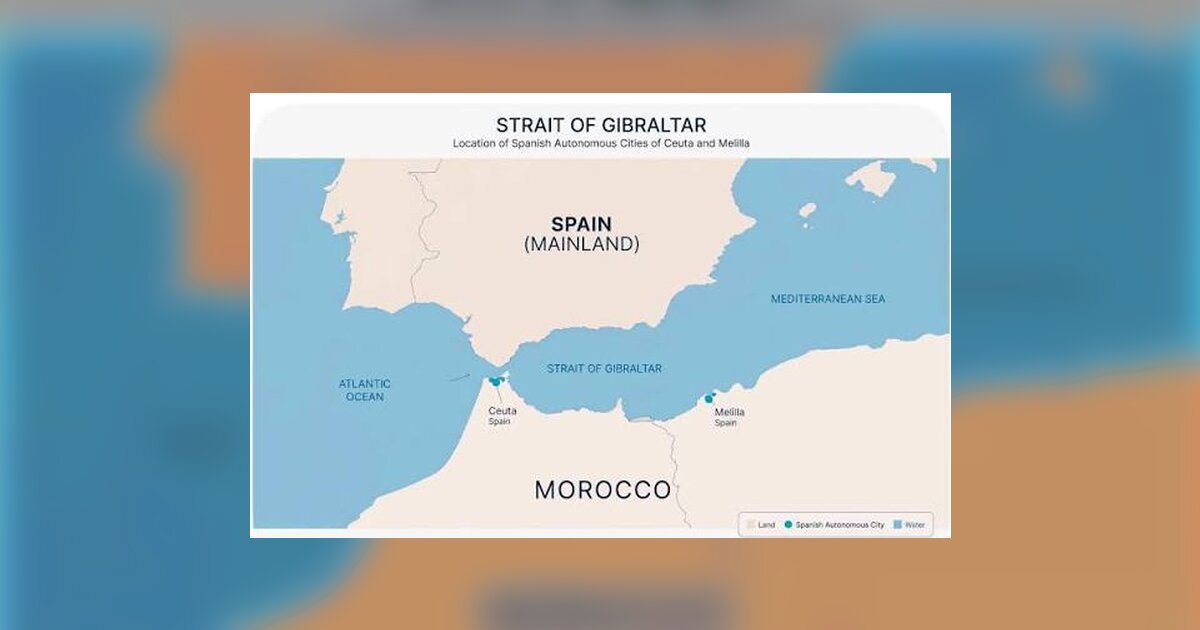
RABAT — As tens of thousands of people streamed into the Spanish enclave of Ceuta this week, the government whose territory they crossed from said little at first, then insisted it was not to blame. But the crisis has revived an old and uncomfortable question in Madrid and Brussels: how much of Europe’s southern border is, in effect, controlled from Morocco?
Moroccan officials, quoted by local media as the surge unfolded, said the country “does not support or encourage the irregular migration of its nationals,”, adding that criminal organisations exploit the vulnerability of would-be migrants and put their lives at risk. Rabat’s interior ministry did not initially respond publicly to the crossings, and there is no evidence that the Moroccan state directed people to the frontier.
Yet the mechanics of the border make the denial only part of the story. The flow of people across the Ceuta and Melilla frontiers is regulated jointly by Spain and Morocco, and Moroccan security forces decide how tightly their side is policed. When Rabat wants crossings stopped, its gendarmes turn people back at the beach; this week, they did so only after very large numbers had already gone through, using tear gas and water cannon against crowds near Fnideq and detaining about 30 people, according to an AFP journalist at the scene.
A pattern, not an accident
Spain has been here before, and the precedent shapes how this crisis is read. In May 2021, between 8,000 and 10,000 people crossed into Ceuta over two days at the height of a diplomatic rupture, after Spain allowed the leader of the pro-independence Polisario Front, Brahim Ghali, to receive hospital treatment on Spanish soil. Moroccan enforcement melted away, the border filled, and the point was made.
The dispute at the heart of that standoff was Western Sahara, the former Spanish colony that Morocco controls and claims, and over which it has spent decades seeking international recognition of its sovereignty. The 2021 crisis ended only in 2022, when Madrid abandoned its long-standing neutrality and endorsed Morocco’s autonomy plan for the territory — a major diplomatic victory for Rabat, extracted in the shadow of the border.
Analysts have long described this dynamic as migration diplomacy, in which control of a frontier becomes a bargaining chip. Morocco denies operating any such lever, and Spanish officials this week pointed instead to a domestic court ruling on returns as the trigger. But the enclaves’ peculiar status — European soil that Morocco says is occupied — ensures that any surge is inseparable from the wider relationship.
Washington’s ally
The geopolitical backdrop has shifted since the last major crisis. Where the 2021 surge unfolded early in Joe Biden’s presidency, this one arrives with Donald Trump back in the White House — and Morocco counts the United States among its closest partners. It was the first Trump administration that recognised Moroccan sovereignty over Western Sahara in 2020, in exchange for Rabat normalising ties with Israel, giving Morocco a powerful patron in Washington as it presses its claims in Europe.
That alignment complicates Madrid’s room for manoeuvre. Spain needs Moroccan cooperation to police the border and to manage returns, and it has already paid a diplomatic price once to secure it. The opposition in Spain has seized on precisely this dependency. Alberto Nunez Feijoo, leader of the conservative People’s Party, said after Sanchez’s visit to Ceuta that Spain “cannot accept that control of its border depends on someone else’s decision,”, calling the situation not a technical problem but “a humiliation.”
The valve, and its cost
For Rabat, the enclaves are a source of leverage but also a liability. Morocco has invested heavily in projecting itself as a reliable partner on migration, and uncontrolled surges undercut that image while stirring anger at home, where the enclaves are widely seen as occupied land. Spain’s interior minister, Fernando Grande-Marlaska, made a point this week of thanking Morocco for its efforts to prevent crossings and pledged to stay in constant contact with his counterpart, Abdelouafi Laftit — the language of partners eager to keep the relationship intact.
The two interior ministries agreed to strengthen cooperation and to return those who had entered Ceuta irregularly, and by Friday more than half had already gone back across the border. That speed of reversal is itself a reminder of how quickly the flow can be switched off when both governments choose to act.
The deeper lesson for Europe is one it has been reluctant to absorb: that a stretch of its external frontier depends on decisions taken in a capital outside the bloc, where a slight over Western Sahara, a court ruling in Madrid or a calculation about US backing can determine whether the border holds. Whatever Rabat’s intentions this week, the crisis has again shown that in Ceuta, Morocco holds the valve.