CEUTA — Spain deployed the army to its North African enclave of Ceuta on Friday and Prime Minister Pedro Sanchez flew to the territory after one of the largest single-day migrant crossings in the country’s history left at least 34 people dead and the tiny city overwhelmed.
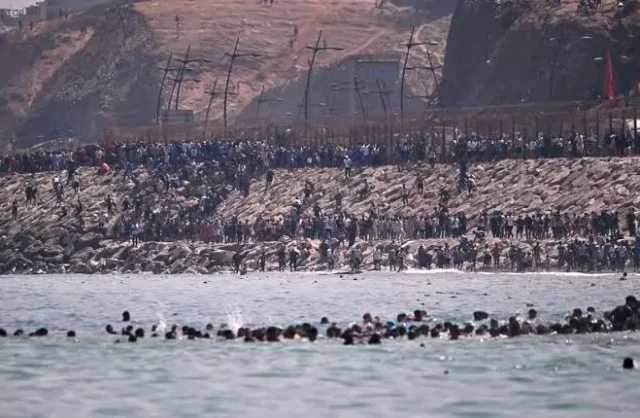
An estimated 50,000 people — and as many as 60,000, by the account of Ceuta’s regional president — surged across the frontier from neighbouring Morocco in little more than a day, swimming around the border breakwater and scaling barriers by land and sea, according to figures released by Spanish authorities on Friday and reported by AFP.
Sanchez, arriving in the enclave to manage the fallout, described the mass breach as “a violation of Spain’s territorial integrity,”, and said his government would use every instrument of the state to restore order. The interior ministry said the military had been sent to reinforce a border force that local officials said had been left badly outnumbered when the crossings began.
The death toll climbed through Friday, from an initial nine to 18 and then to at least 34, as bodies were recovered from the water off Tarajal beach, where many migrants drowned and others were killed in a crush at the breakwater fence. Local authorities said most of the dead were young men, though the crowds also included women and unaccompanied children.
Juan Jesus Vivas, the head of Ceuta’s regional government, said the influx — equivalent to more than half the enclave’s population of roughly 85,000 — had left the city’s services collapsing. He called the situation “absolutely unsustainable,” and, before Madrid acted, had demanded that the central government declare a national emergency and send troops.
Rachid Sbihi, who leads a local association representing Civil Guard officers in Ceuta, told the Associated Press that thousands of people were still arriving and that the frontier had “totally collapsed.”. He described unaccompanied minors sleeping in parks and on pavements while others wandered the streets with nowhere to go.
By Friday afternoon, the interior ministry said more than 25,000 people — roughly half of those who had crossed — had already returned to Morocco, many of them voluntarily, as Spanish and Moroccan authorities coordinated to reverse the flow. Spain said it would seek to expel those who had entered irregularly as quickly as possible, despite a recent ruling by the country’s Supreme Court that migrants intercepted at sea while trying to reach Ceuta or Melilla cannot be summarily returned.
That ruling, handed down by Spain’s Supreme Court weeks before the surge, barred the on-the-spot pushback of migrants intercepted at sea and required each case to be handled under the ordinary immigration procedure. The interior ministry has argued that smuggling networks seized on the change, promoting the sea route on the promise that arrivals could no longer be turned back instantly.
The crisis was also strikingly localised. Irregular arrivals to the rest of Spain fell in the first half of 2026, from 17,990 a year earlier to 12,138, according to interior ministry figures. Ceuta ran the other way: land arrivals there rose 164 percent over the same period, from 978 to 2,582, before this week’s crossings dwarfed even that increase. The ministry said it would publish its next migration report on Monday.
The interior ministry said its emergency legislation does not treat migration flows as a threat to national security and that it could not, for that reason, declare a national emergency. Government agencies, it said, were “coordinating to respond with speed and efficacy to the situation in Ceuta,”.
Sanchez said his government was mobilising all necessary resources and working with Moroccan and international authorities to bring the situation under control. He had posted earlier that Spain was fully committed to an immediate response, even as opponents accused him of reacting too slowly.
Scenes from the enclave, broadcast on Spanish television and circulated widely on social media, showed exhausted arrivals climbing ashore, some kissing the ground and cheering. Several were filmed chanting “Bye bye Morocco, hello Spain” as they walked into the city, while police and Civil Guards, heavily outnumbered, tried to direct them toward an overflowing reception centre.
On the Moroccan side of the frontier, near the town of Fnideq, security forces used tear gas and water cannon to disperse crowds of mostly young men still gathering to cross, and an AFP journalist saw about 30 people detained. Moroccan authorities did not immediately comment publicly on the crossings, though officials in Rabat later said the country does not encourage irregular migration and blamed criminal smuggling networks.
The Spanish and Moroccan interior ministries agreed to step up cooperation to manage the flows. Spain’s Interior Minister Fernando Grande-Marlaska thanked Morocco for its efforts to prevent crossings and said he would remain in constant contact with his Moroccan counterpart, Abdelouafi Laftit.
Vivas kept pressing for a formal emergency declaration, which Madrid declined, and the conservative opposition demanded that the European Union’s border agency, Frontex, be sent to the enclave. Spain said its immediate priorities were to return those who had entered irregularly and to reinforce the frontier while the flow was reversed.
The crisis is the most severe of its kind since May 2021, when some 8,000 to 10,000 people crossed into Ceuta over two days amid a diplomatic rupture between Madrid and Rabat. That standoff eased only after Spain shifted its position to back Morocco’s autonomy plan for the disputed territory of Western Sahara the following year.
Ceuta and Melilla, Spain’s two enclaves on the North African coast, form the European Union’s only land borders with Africa, and both have long been flashpoints for irregular migration. Melilla, ringed by a fence some six metres high, saw dozens of people die in a single crush at its barrier in 2022, one of the deadliest incidents recorded on the route. The latest surge has already spilled into a wider European row, with Italy calling for Spain’s suspension from the passport-free Schengen zone and France announcing tighter checks at its own borders.