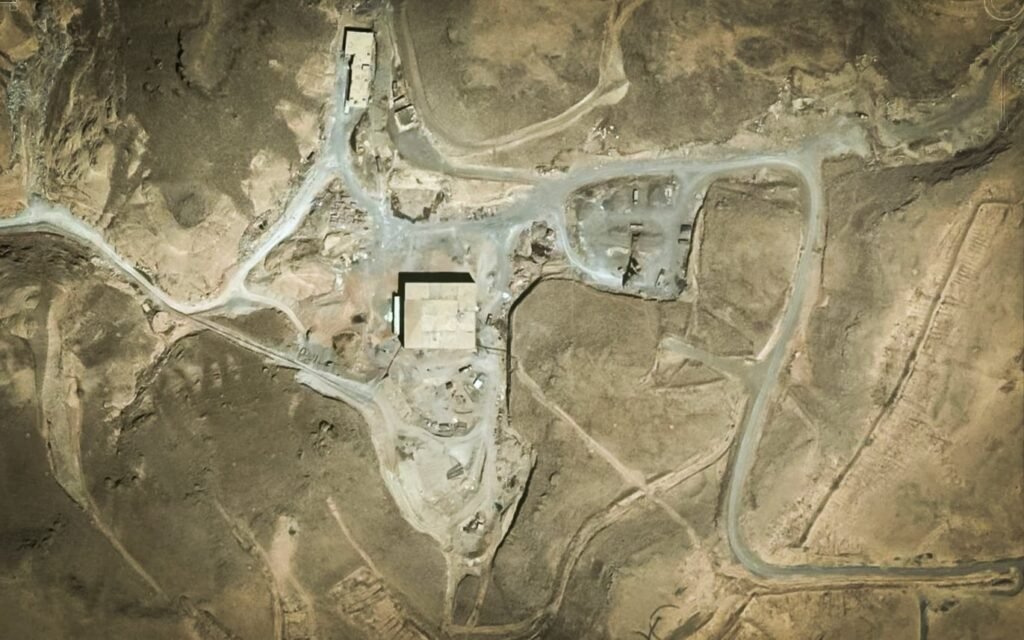
DAMASCUS — The Syria nuclear site known as Site 99 has been sitting a few kilometres from a war for two years, holding uranium powder left over from a reactor Israel destroyed in 2007. It is now being emptied, and the reason is that Israel told Washington it would bomb the place again if it was not.
The account comes from Axios, which reported on Monday that the Trump administration brokered understandings between Israel, Syria’s post-Assad government and the International Atomic Energy Agency to have the material removed. Syria’s Atomic Energy Commission confirmed on Tuesday that an IAEA delegation would visit in the coming days.
None of this had been reported before. What follows is what the disclosure actually establishes, and what it does not.
What is at Site 99
The material is yellowcake, a coarse powder produced from uranium ore, together with residues and other leftovers from the al-Kibar project. Al-Kibar was the clandestine reactor at Deir Ezzor that Israel bombed in September 2007, in a strike it refused to acknowledge until 2018.
Yellowcake is early-stage. It is not fuel and it is nowhere near weapons material. It has to be converted into uranium hexafluoride and then run through cascades of centrifuges before it becomes anything a bomb designer could use, and Syria has not had that chain since 2007. Al-Kibar was a plutonium route in any case, modelled on North Korea’s Yongbyon reactor, which is why the strike on the reactor building was so decisive.
What the powder can do is contaminate. Packed around a conventional explosive, yellowcake produces a radiological dispersal device, the thing usually called a dirty bomb. That does not kill on the scale of a nuclear weapon. It denies ground, panics a city and costs a fortune to clean up. For a state worried about what non-state actors might pick up in a collapsed country, it is the more realistic concern.
Israel bombed the doors shut, then watched
When the Assad government fell in December 2024, Israel bombed the entrances to the site to seal it. Israeli officials told Axios that Israel then threatened to strike again if the material was not taken out, or if the new Syrian authorities tried to reach it. A US official said the threat “was never close to being put into action”.
For more than a year after that, Israeli and American officials discussed the site, with the White House and the Israeli Prime Minister’s Office in direct contact on the file. The IAEA had a route in. In June 2025, agency chief Rafael Grossi said Syria had agreed to give inspectors access to suspected former nuclear sites, and after Assad’s fall the agency signed an arrangement with the new government covering al-Kibar and other locations.
Site 99 stayed outside that framework until a few weeks ago. Sealing a building is not the same as securing what is inside it, and a bombed entrance is a delay rather than a solution. Israel appears to have understood that from the start, which is why the surveillance continued for two years.
The Turkish suspicion is the interesting part
The trigger for the deal was movement. Several weeks ago Israel detected activity at the site, and concluded that the Syrian government might be trying to reach the material. Israeli officials worried that Turkey, a close ally of the government in Damascus, was helping.
That suspicion is worth pausing on. It means the escalation risk was never really Israel against Syria. A Syrian state twenty months old, still consolidating control, has limited capacity to do much with uranium powder. Turkey is a NATO member with an established nuclear power programme at Akkuyu and the industrial base to handle material properly. An Israeli strike on a site where Turkish personnel were present would have been a different order of event, and one that would have landed inside the alliance Washington leads.
The Trump administration’s response was to bring in the IAEA rather than let the two sides argue it out. The agency signed an agreement with the Syrian government three weeks ago.
“We think everybody is happy with the result,” a US official told Axios, adding that Washington hoped to begin the removal soon and finish it before the end of the year.
The secrecy was tight. “Very few people in the United States, Israel, and Syria knew about it,” the same official said. That is unusual for a file involving four parties, and it tells you how narrow the political tolerance for failure was.
Why Damascus wants this closed
Syria’s new government has an incentive to cooperate that has nothing to do with Israeli threats.
“Syria’s new government is eager to resolve sensitive issues inherited from the Assad regime,” said Charles Lister, a resident fellow at the Middle East Institute, in comments reported by Ynet, pointing to the nuclear and chemical weapons files as obstacles to restoring the country’s international standing.
That is the practical logic. President Ahmed al-Sharaa met Donald Trump on the sidelines of the NATO summit in Ankara on 8 July, and Damascus has spent 2026 trying to get sanctions lifted and reconstruction money moving. An unresolved stash of uranium powder in an unmarked building is a standing veto on that project. Handing it to the IAEA converts a liability into a credential.
The chemical weapons file runs in parallel and is far larger. The Organisation for the Prohibition of Chemical Weapons has been working through declared and undeclared Syrian sites since the Assad government fell, and the scale of that inheritance dwarfs a single store of yellowcake. Site 99 is the smaller problem being solved first, because it had a country actively threatening to bomb it.
What has not happened yet
The material is still there. US officials said the arrangements between Syria and the IAEA are being finalised, that removal has not begun, and that Washington and Israel continue to monitor the site. The target is completion before the end of 2026.
That gap between agreement and execution is where these things usually fail. Removing uranium powder from a bombed building in a country with contested territory is a logistics problem before it is a diplomatic one. It needs certified casks, a road route that nobody attacks, a receiving state willing to take the material, and a chain of custody that satisfies inspectors.
The IAEA has done this before. Removing highly enriched uranium from Iraq after 2003 took years and multiple air shipments. Libya’s disarmament began in 2003 and its last consignment of yellowcake left the country only after the 2011 civil war. Both were countries with functioning central authority for at least part of the process. Syria has that in Damascus and much less of it elsewhere.
The White House, the IAEA and the Israeli Prime Minister’s Office all declined to comment on the report.
What it means for India
India has no direct stake at Site 99, but it has a longstanding position on exactly this class of problem. New Delhi has pushed for years, at the UN and at the IAEA, for tighter rules on radiological source security, on the argument that dirty-bomb material is the realistic proliferation threat rather than weapons-grade fissile material. India piloted the UN General Assembly resolution on preventing terrorists from acquiring weapons of mass destruction for more than two decades.
Site 99 is that argument in physical form. The material was never going to make a Syrian bomb. It was always going to be a contamination risk in a country where the state had stopped functioning, and the mechanism that finally resolved it was not a treaty but a threat followed by a brokered clean-up.
India is also rebuilding a relationship with Damascus, having kept its embassy open through the war years and having supplied wheat and medicines during them. A Syria that closes its inherited nuclear file is a Syria that can be dealt with normally, on trade, on pharmaceuticals and on reconstruction contracts. That is a small thing next to the regional stakes, and it is the part that touches Indian interests most directly.