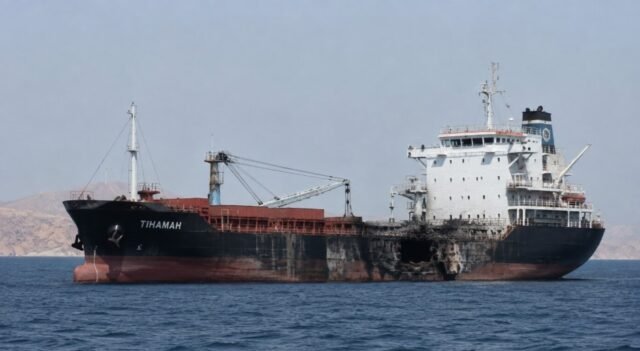
ADEN — A cargo ship was hit by a projectile in the Bab el-Mandeb strait on Tuesday, killing members of its crew and closing off the last practical alternative for vessels that had already given up on the Strait of Hormuz.
The Bab el-Mandeb attack struck the Tihamah, an Egyptian-owned, Tanzania-flagged coaster sailing from Salalah in Oman via Djibouti. Reuters, citing sources in Yemen, reported three crew killed, two Pakistani nationals and one Indonesian. Yemen’s coastguard put the toll higher, at four crew members plus two members of a force sent to evacuate the ship. The Houthis have not claimed the strike.
Whichever count holds, these are the first deaths from an attack on shipping in the Red Sea corridor since the Iran war began on 28 February. That is the detail that will change behaviour.
What the numbers hide
Yemen’s coastguard said the opening salvo “caused a fire to break out aboard the vessel and inflicted extensive damage,” according to an account carried by France 24, adding that there were deaths and injuries among the crew. The seafarers lost control of the ship afterwards and were approached by the coastguard.
The discrepancy between the Reuters figure and the Yemeni figure is not unusual in this waterway, where casualty reporting depends on whoever reaches the hull first. Diurna is carrying both counts because neither has been independently confirmed, and because the difference between three dead and six changes how governments respond.
Maritime authorities monitoring the corridor confirmed only that a strike had taken place near Al Mokha and that it came from an “unknown projectile,” with an unknown number of casualties, in an account relayed by Reuters. That phrasing is standard when nobody has recovered fragments, and it is why attribution here is likely to stay contested for days.
What is not disputed is the nationality mix. Pakistani and Indonesian seafarers crewing an Egyptian-owned ship under a Tanzanian flag is an ordinary configuration in this trade, and it is the reason attacks on small coasters produce diplomatic consequences in countries with no stake in the Yemeni war.
It is also worth noting what the Tihamah was not. It was not a tanker, not a container ship on a major liner service, and not obviously connected to Israel, Saudi Arabia or the United States. It was a small coaster on a regional run. If that profile is now inside the target set, the target set has effectively no boundary.
The traffic went south, and the war followed
The sequence here matters more than the incident. When Hormuz effectively shut, a share of Gulf-bound and Gulf-origin traffic shifted towards the Red Sea and the Suez route. Diurna set out the early stage of that redistribution in our analysis of Saudi Arabia’s warnings about Houthi and Iraqi militia planning, which described how the Houthis followed the traffic north as Yanbu became Riyadh’s main outlet.
The movement has now completed a circuit. Ships fled one chokepoint, concentrated in another, and the second chokepoint has become a target. On 20 July the Houthis declared a maritime embargo against Saudi Arabia in the Red Sea, in response to what they described as a Saudi siege. Riyadh denies that Yemen is under siege.
Two days before the Tihamah was hit, the Houthis launched one of the largest waves of strikes on government-held territory since the 2022 truce. The port city of Mocha was struck twice inside twenty-four hours.
“Four members of the armed forces and three civilians have been killed, and 30 others injured,” Yemen’s military said in a statement early on Monday, adding that air defences intercepted eleven Houthi drones involved in the assault.
Houthi military spokesman Yahya Saree said on Telegram that the operation had targeted “Saudi troop concentrations and weapons depots” along Yemen’s western coast. A Houthi political council member, Hizam al-Assad, separately claimed that the continuing explosions and columns of smoke from the port came from large quantities of weapons stored there.
The Yemeni government says the port and civilian infrastructure were hit. A photograph carried by AFP on 10 August showed the navigation bridge of a sunken vessel protruding above the surface of Mocha harbour, which is the clearest available answer to the question of what was in the port.
Why this is worse than the 2023 campaign
The Houthi campaign that began in late 2023 was declared, claimed and framed around Gaza. Shipowners could model it. They knew which flags and which ownership structures drew fire, they knew the geography, and insurers priced accordingly. Attacks eventually tapered, and by late 2025 carriers had begun cautiously returning to the Suez route.
This is a different problem. The Tihamah strike is unclaimed. The stated Houthi target set is Saudi military, not commercial. And the declared embargo is against a state rather than a coalition, which gives no guidance at all to a Tanzanian-flagged coaster carrying Pakistani crew.
An unclaimed attack on a ship with no obvious connection to the stated dispute removes the one thing that made the earlier campaign navigable, which was predictability. War-risk underwriters cannot price a rule they cannot identify. What they do instead is price the worst case, which is how a single incident becomes a permanent cost on every voyage through the corridor.
The mechanics of that are quick. War-risk premiums in the southern Red Sea are quoted as a percentage of hull value per transit, and they moved from fractions of a per cent to multiples of that within days during the earlier campaign. Crew wages rise too, because seafarer unions negotiate hazard bonuses for designated warlike operations areas, and the International Bargaining Forum has applied that designation to this corridor before.
Two chokepoints, no third option
Between Hormuz and Bab el-Mandeb, the Gulf has two exits, and both are now carrying risk premiums. The overland alternatives are limited. Saudi Arabia’s East-West pipeline to Yanbu and the UAE’s Fujairah line together cover a fraction of the volume that Hormuz used to carry, and Yanbu itself sits on the Red Sea, which is the waterway now under attack.
That is the structural point. The bypass infrastructure the Gulf built to reduce dependence on Hormuz terminates in the Red Sea. A campaign that makes the Red Sea dangerous does not just add a second problem to the first. It cancels the solution to the first.
The Suez Canal Authority has spent two years trying to recover transit volumes lost to the earlier Houthi campaign. Egypt lost billions of dollars in canal revenue when carriers rerouted around the Cape of Good Hope, and the state has an acute fiscal interest in keeping the corridor viable. An Egyptian-owned ship being hit at the southern entrance is, from Cairo’s perspective, close to the worst possible headline.
What it means for India
India’s exposure here is different from its exposure at Hormuz, and in some ways larger. Hormuz is about crude. Bab el-Mandeb and Suez are about containers, and about the westbound leg of India’s trade with Europe, which is its single largest export market bloc.
When the earlier Houthi campaign forced rerouting around Africa, Indian exporters absorbed longer transit times, higher freight rates and a squeeze on container availability. Textile, engineering goods and pharmaceutical shipments to Europe were hit hardest, because those trades run on thin margins and fixed delivery windows. Basmati and other agricultural exports to Egypt and the Levant face the same problem in reverse.
The India-Middle East-Europe Economic Corridor, announced with some ceremony in 2023, was designed partly to reduce exactly this dependence. It has not been built, and its intended route runs through the same region that is now producing the risk.
There is also a consular dimension. Indian nationals make up one of the largest groups of seafarers in the world merchant fleet, and the Directorate General of Shipping has issued advisories for the corridor before. The Indian Navy has kept warships on anti-piracy and escort duty in the Gulf of Aden almost continuously since 2008, and expanded those deployments during the 2024 attacks. The presence of Pakistani and Indonesian crew on the Tihamah is a reminder that South Asian seafarers absorb this war at close range, whatever their governments say about it.
For now the practical question for Indian shippers is whether war-risk premiums on the Red Sea leg rise far enough to make the Cape route cheaper again. If they do, the extra fortnight of sailing time returns, and it returns in the run-up to the festive and year-end shipping season.