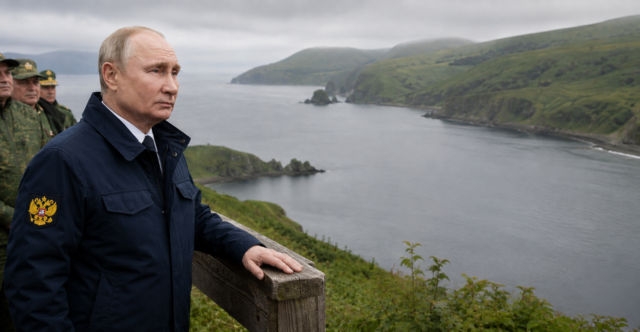
Standing on the deck of a missile cruiser during Pacific Fleet exercises on 12 August, President Vladimir Putin threatened to seize European commercial ships in retaliation for the way European navies are treating the shadow fleet, the ageing armada of tankers that keeps his oil moving despite Western sanctions. The threat opened a new front in a fight that has moved, over the past year, from the sanctions list to the open sea. Understanding why means understanding what the shadow fleet is, how it works, and what has just changed.
What the shadow fleet is
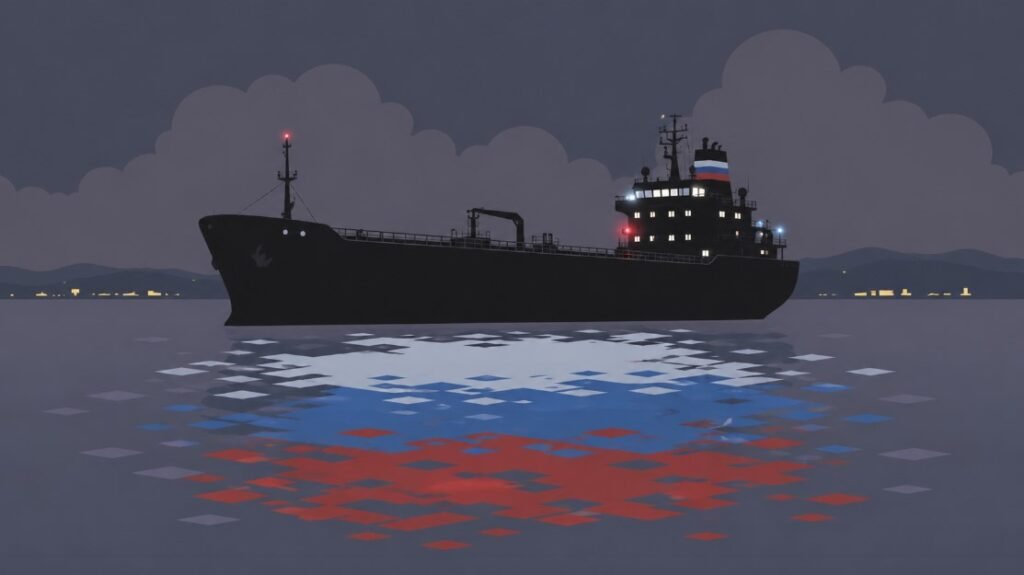
The shadow fleet, sometimes called the dark or ghost fleet, is the collection of tankers Russia assembled to carry its crude and refined products beyond the reach of the Western sanctions machine. These are typically old vessels, often more than fifteen years in service, owned through opaque shell companies, flagged to states such as Cameroon, Panama or Gabon, and insured outside the London market that once underwrote most of the world’s oil trade. They exist to sever the link between a barrel of Russian oil and the Western banks, insurers and shipowners that the G7 price cap was built to control.
Estimates of its size vary widely because the definition does. The Geopolitics and Security Studies Center puts the core at roughly 600 to 800 tankers, around a tenth of the global tanker fleet. Ukrainian intelligence has catalogued more than 1,300 ships. Counting every vessel that has made even a single sanctioned voyage, the KSE Institute, Kpler and Lloyd’s List together point to more than 1,400. The US Center for Strategic and International Studies estimates the fleet moves around 3.7 million barrels a day, roughly 65 percent of Russia’s seaborne oil, generating somewhere between 87 and 100 billion dollars a year. By one European estimate, Russian fossil-fuel exports still bring in on the order of 460 million euros a day.
How the trade actually works
The mechanics are a study in evasion. Tankers switch off their transponders to go dark, transfer cargo ship-to-ship in unregulated anchorages to disguise its origin, and change flags and names between voyages. Some carry insurance certificates from shell companies that do not really exist. In 2026 a growing share simply re-registered under the Russian flag itself. The KSE Institute found the Russian flag’s share of shadow-fleet volumes jumped from 3 percent to 23 percent in under a year, a sign that Moscow has stopped hiding and started daring the West to act.
The oil goes east and south. China and India are the two dominant destinations for shadow-fleet crude, with India the largest single buyer of the Baltic cargoes. Much of the trade runs through chokepoints Europe can watch: out of the Baltic through the Danish straits, and out of the Black Sea past NATO’s southern flank. The fleet is also dangerously old. On the Baltic run, vessels older than fifteen years account for well over 90 percent of shadow crude tankers, which is why every passage carries the risk of a spill nobody has insured.
Why Europe started boarding
For most of the war, the fleet operated largely unchallenged. That ended in late 2025. The tankers are elderly, uninsured in any meaningful sense, and increasingly linked to damaged undersea cables in the Baltic, and European states decided the risk of doing nothing had grown too large. French, Swedish and Belgian commandos began descending onto tanker decks from helicopters, arresting crews and escorting vessels to European ports. In one case Belgian forces boarded a Guinea-flagged tanker in the North Sea that turned out to have sailed on an expired registry for nearly a year. The pressure has pushed Moscow to escort some cargoes with its own navy, which is how, as Diurna reported, Russian warships came to shadow tankers through British waters. The environmental fear is not abstract. “The risk for an oil spill accident has existed for many years in the Baltic Sea, but the Russian shadow fleet has increased the risk significantly,” said Mikko Hirvi of the Finnish Border Guard.
The decisive turn came in July, when the European Union’s latest sanctions package gave member states the legal power to sell the oil, and even the grain, seized from detained shadow-fleet ships. Confiscation crossed from a threat into a mechanism. Sweden announced it would transfer a seized Russian vessel and its cargo of grain taken from occupied Ukraine to Kyiv. As EU foreign-policy chief Kaja Kallas has framed the wider pressure, “the longer Russia wages war, the tougher our response.”
The confiscation power was the peak of a long escalation. The EU began naming shadow-fleet vessels in 2024; its 17th sanctions package in May 2025 blacklisted 189 more ships, pushing the listed total toward 350, while Britain added a tranche of its own. Each round made it harder for a named tanker to find a port, an insurer or a buyer. The 21st package in July 2026 went further than any before it, turning detention into forfeiture. The memory of the Kerch Strait disaster of December 2024, when two ageing tankers broke up in a storm and fouled Russian and Crimean beaches with fuel oil, hangs over the whole debate, a reminder of what a single uninsured wreck can cost.
Putin’s threat, and the escalation it invites
That mechanism is what Putin was answering. He called the European seizures illegal, warning that Moscow saw states “in violation of international maritime law, attempting to restrict the movement of vessels operated by our businesses,” and that they had gone so far as to consider selling property plundered from Russia. “This is, of course, nothing other than piracy and robbery,” he said. If the practice continued, he added, “we will be forced to respond in kind,” and not only in the waters where Russian ships are taken, but wherever Moscow deems it necessary, including the Pacific.
His commanders echoed the message. The Pacific Fleet’s Viktor Liina said Russia had everything it needed to inspect and detain the ships of unfriendly states, adding, “we know the routes, what they’re carrying, and whose ships these are.” The danger is plain. If Russia begins seizing European-flagged commercial ships in reprisal, a sanctions dispute becomes a shooting risk in some of the world’s busiest sea lanes, from the Gulf of Finland to the Black Sea approaches.
What it means for India
India is not a bystander here. Its refiners have been the biggest single buyers of discounted Russian crude carried by exactly these tankers, and India does not recognise the G7 price cap. The Urals discount to Brent has run anywhere from 10 to 35 dollars a barrel since 2022, a saving worth billions to Indian importers. Every European boarding, every new sanctions tier, and now every Russian counter-threat raises the cost and the risk attached to that trade, from insurance premiums to the danger of a cargo being impounded mid-voyage. India has kept its Russian oil flowing by staying just outside the Western enforcement net. Putin’s decision to militarise the fight over the shadow fleet narrows the space in which that quiet arrangement can continue.