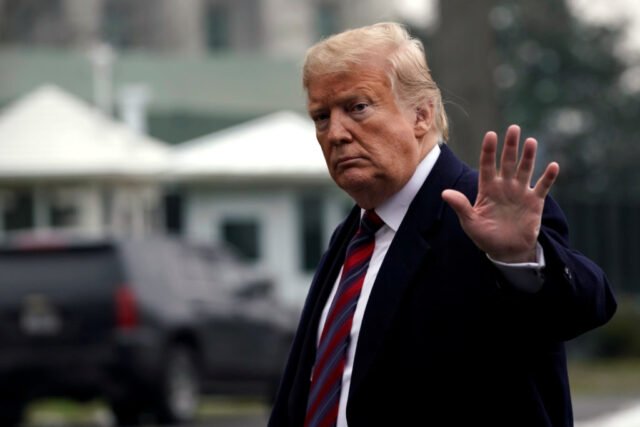
WASHINGTON — The Trump approval rating fell to 33 per cent in the Economist/YouGov poll published on August 11, the lowest reading of either of his presidencies, and it arrived at a moment when Republican pollsters have stopped trying to explain the trend away.
Sixty-two per cent said they disapproved, also a record. That leaves a net rating of minus 29. At the equivalent point in his first term the figure was minus 10. Joe Biden, whose unpopularity Republicans described for four years as historic, stood at minus 17 at the same stage.
The poll was taken between August 7 and 10. A week earlier the same tracker had him at 36 per cent. Three points in seven days is not noise when the direction has been the same since spring.
Where the coalition cracked
The decline is not spread evenly, and that is what makes it dangerous for Republicans in November.
Among independents, 18 per cent approve and 71 per cent disapprove. In January those numbers were 32 and 60. A president losing independents by 53 points is not fighting an ordinary midterm.
The second crack runs through the Republican Party itself. YouGov separates Republicans who identify with MAGA, roughly 60 per cent of the party, from those who do not, roughly 30 per cent. The first group has barely moved: 92 per cent approve now against 94 per cent at the start of the term. The second group began the term at 90 per cent approval and six per cent disapproval. It is now split 51 to 47.
Strong approval, the measure that tracks turnout better than any other, has fallen to 17 per cent of all adults. Fewer than half of Republicans, 48 per cent, say they strongly approve of how he is handling the job. Ninety-one per cent of Democrats strongly disapprove.
Net approval hit new lows among women at minus 36, white Americans at minus 19, and college graduates at minus 42.
Prices did most of the damage
Trump was returned to office by voters angry about the cost of living. That is the promise the numbers are now measuring him against.
Annual inflation ran at 3.5 per cent in the twelve months to June, down from 4.2 per cent in May but still well above the Federal Reserve’s target. Headline prices fell 0.4 per cent in June alone as petrol eased, the first monthly drop in some time, and economists surveyed by Reuters expected only a 0.1 per cent rebound in the July figures released on August 12.
Cooling does not feel like relief when wages have not caught up. “It’s an improvement, but both of those numbers are still extremely high and unpleasant for consumers,” said Tani Fukui, an economist at MetLife Investment Management, in remarks reported by Reuters.
The scale of the reversal on economics is the single most striking number in American polling this year. CNN’s Harry Enten averaged the surveys and found that during the 2018 midterms Trump’s approval on the economy sat at plus nine. It now averages minus 33. That is a 42-point swing against a president whose entire political identity was built on the claim that he was better with money than the other side. On inflation specifically, CNN’s most recent poll put him 50 points underwater.
The war nobody expected to still be running
The second weight is the war with Iran, now well past the point where the White House said it would be settled.
Approval of the administration’s handling of the conflict has slid six points since June, including a fall from 71 to 61 per cent among Republicans. With the Strait of Hormuz still shut and Brent trading near $90, the war reaches American households through the pump rather than the television.
That fusion of war and prices is what breaks the usual rally-round-the-flag effect. A foreign conflict that raises the weekly grocery bill is not a distraction from the economy. It is the economy.
Why Republican strategists are not arguing
What has changed in recent weeks is the tone from inside the party. Republican pollsters and strategists told The Wall Street Journal they fear the GOP has surrendered its traditional advantage on the economy, and that the window to recover it is closing.
Alex Patton, a Republican strategist, put the problem in the plainest possible terms to Newsweek. “Affordability is affordability, and voters get frequent reminders of how affordable things are,” he said, listing petrol, food and the electricity bill.
Micah Roberts, a Republican pollster who worked on a recent CNBC survey, said voters were entering the cycle in a “distinctly sour mood,” with more expecting conditions to worsen than improve. His Democratic counterpart on the same poll, Jay Campbell of Hart Research, said the anger is arithmetic rather than mood: “people are still paying a lot more for stuff,” he said, and short-lived dips at the pump do not close the gap.
The White House rejects the framing. Spokesman Davis Ingle said the president was “working tirelessly” to create jobs, lower inflation and improve housing affordability, and argued that the progress made so far was only the beginning.
The midterm arithmetic
Democrats now lead the generic congressional ballot 46 to 40 among registered voters, their widest margin in the Economist/YouGov series since February. Independents in that sample break for Democratic candidates 43 to 24.
Republicans have spent the past year building a structural answer to this. Eight Republican-led states, including Texas, Missouri, North Carolina, Ohio, Florida, Tennessee, Louisiana and Alabama, redrew congressional maps ahead of the vote as part of a mid-decade redistricting push the president himself initiated. Those gains widen the House map in the party’s favour.
Whether they are enough is the question strategists keep returning to. D. Stephen Voss, a political scientist at the University of Kentucky, noted that modern presidents survive disapproval better than their predecessors did because so many voters dislike both parties. He was blunt about what that buys. “President Trump’s job approval ratings are rock bottom,” Voss told Newsweek, adding that a president’s party usually suffers in the midterms and that Trump would need luck to avoid two years as a lame duck.
Grant Reeher, who teaches political science at Syracuse University, called the reading “definitely of concern, as we head into the mid-terms.”
The longer-running damage may be to the party’s brand rather than the president’s. Brookings noted earlier this year that for the first time since 2010, Democrats are more trusted than Republicans to handle the economy. That trust took fifteen years to shift and will not shift back in three months.
What it means for India
A weakened president is not a quieter one, and New Delhi has already seen what that looks like. The US Senate passed a Russia sanctions bill in early August that authorises tariffs on buyers of Russian crude, with India the obvious target, as Diurna reported at the time. The bill authorises rather than mandates, which leaves the decision on the president’s desk.
A leader polling at 33 per cent and facing a hostile House after November has fewer reasons to spend political capital defending a trade partner and more reasons to look tough on Russian oil. India’s exposure runs through the same barrel that is driving American prices, having bought Russian crude precisely because Hormuz closed. The tariff decision, the trade deal talks and the sanctions waivers all now sit inside an American electoral calendar rather than a diplomatic one.